

 Login
Login


 April 29, 2026
|
Voiced by Amazon Polly |
As the Power BI usage increases within organizations, report development is now just one part of a larger data ecosystem. Managing changes and reducing deployment risks are now important considerations. This is where CI/CD in Power BI can play a vital role.
Continuous Integration and Continuous Deployment (CI/CD) can be seen as a set of processes or workflows aimed at improving the BI team’s management of reports, data sets, and semantic models.
Start Learning In-Demand Tech Skills with Expert-Led Training
- Industry-Authorized Curriculum
- Expert-led Training
Understanding CI/CD in the Power BI Context
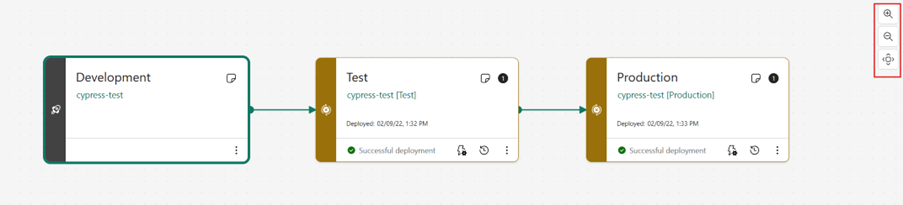
Source: Power BI Deployment Pipeline showing Dev, Test, and Production stages in Microsoft Learn
CI/CD in Power BI adapts traditional software engineering practices to analytics development.
- Continuous Integration (CI):
Integrating report and dataset changes into a shared repository and validating them. - Continuous Deployment (CD):
Promoting content across environments with minimal manual effort.
Together, they bring discipline and predictability to Power BI deployment pipelines.
Key Components of a CI/CD Setup
Integration of Version Control
It is possible to use version control using Git for Power BI content artifacts.
- Monitoring of changes
- Rollback capability
- Enables collaboration
Deployment Pipelines
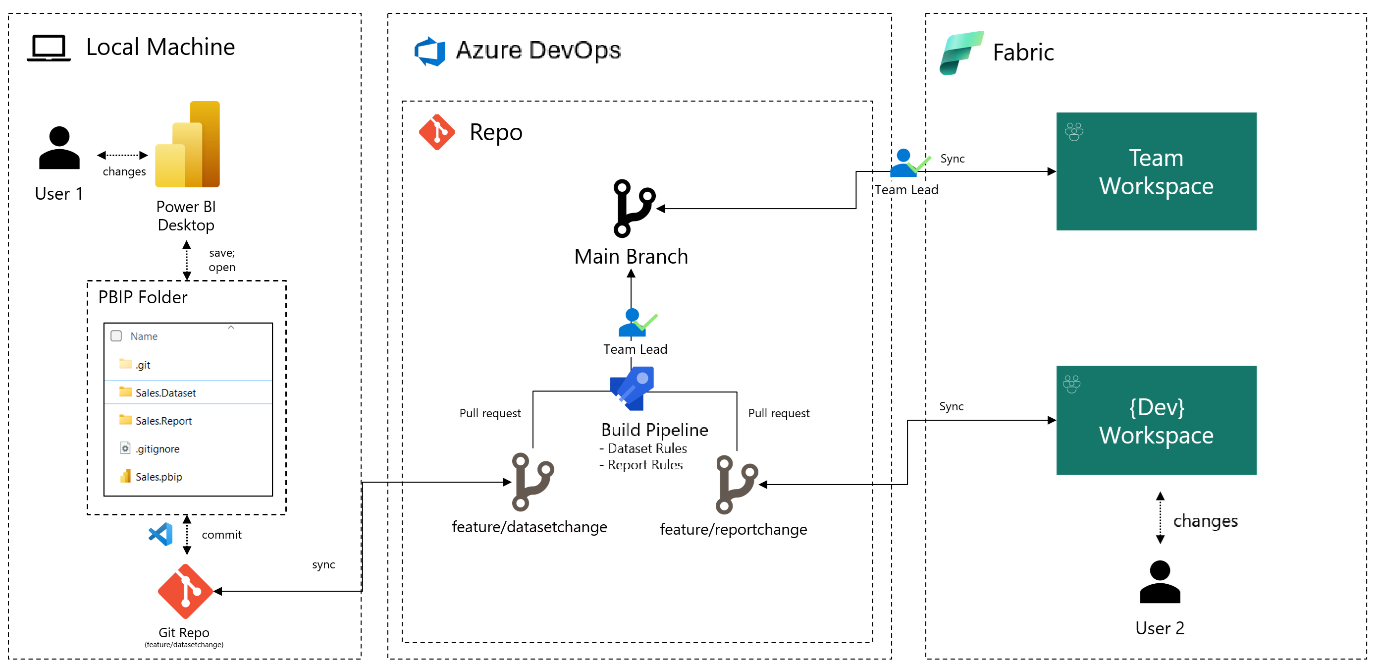
Source: Power BI CI/CD pipeline from Microsoft Learn.
Power BI deployment pipelines enable promotion of content from one stage to another.
- Development to testing and to the production environment
- Controlled releases
- Less risk during deployments
How CI/CD Flow Works in Power BI
The CI/CD pipeline in the analytics context starts with a developer updating reports or a data model due to additional requirements or improvements. Changes get committed to a Git repository, providing an opportunity for version control.
Further, there will be automated validation of commits, checking whether changes are up to standard, don’t break anything, and comply with best-practice principles in data modelling and reporting.
Having successfully passed the validation step, the pipeline moves to Test, where a team can test the functionality, performance, and correctness of changes in a safe environment.
And finally, after all testing procedures are completed and changes are approved by the team, they are deployed to the Production environment, making them available to business users.
Benefits for Business Intelligence Teams
Consistency across different environments
CI/CD provides a high level of consistency between development, testing, and production environments. Automation avoids inconsistencies and manual errors associated with manual publishing. This results in the consistent promotion of the same version of reports and models through the entire pipeline. Ultimately, the consistency generated will increase confidence in the accuracy of the data provided.
Faster development cycle
The use of automation in the development process enables the entire process to be completed much faster. With CI/CD, testing becomes much faster, and issues can be discovered earlier. In addition, CI/CD will enable frequent updates to reports and models, allowing insights to be obtained quickly.
Effective teamwork
Through CI/CD, several developers can work together throughout the development process without hindering one another. This means there will be no interruption to the development process when more developers join. The developer will be able to track all changes made by others using version control.
Relationship with Modern Power BI Features
Git integrations and Power BI semantic models make CI/CD in Power BI feasible.
In addition, TMDL in Power BI makes CI/CD even more feasible by allowing models to be defined as code.
Common Challenges to Consider
- Initial setup complexity
- Learning curve for analysts
- Managing dependencies
- Aligning business users with DevOps workflows
The Shift Toward Analytics Engineering
The application of CI/CD principles in the context of analytics is another example of changes occurring throughout the industry. Modern business intelligence is no longer limited to report creation; it now involves applying engineering principles to data processing.
This leads to the emergence of analytics engineering, in which concepts such as reliability, scalability, and automation play an equally important role alongside insights generation.
Therefore, BI professionals face an increasing number of requirements related to working with practices and tools traditionally used in software engineering.
Among those practices are version control, automated testing, and deployment pipelines.
Scaling Analytics with CI/CD
CI/CD in Power BI brings order, consistency, and scale to analytics development. The integration of version control, automation, and deployment allows companies to decrease risk and increase efficiency.
The adoption of CI/CD is increasingly necessary as Power BI solutions scale up.
Upskill Your Teams with Enterprise-Ready Tech Training Programs
- Team-wide Customizable Programs
- Measurable Business Outcomes
About CloudThat


WRITTEN BY Mohan Krishna Kalimisetty
Mohan Krishna is a Subject Matter Expert at CloudThat. He has 10+ years of experience as a Power BI developer and he has worked on different projects and various technologies like Power BI, SQL Server, Azure Analysis Services, SQL Integration Services, Excel, etc. He has developed Visualization, Dashboard and reports using reporting tools. He loves training people on cutting-edge technologies.


 PREV
PREV












Comments