

 Login
Login


 June 5, 2026
|
Voiced by Amazon Polly |
Introduction
Most people in India who Google “cloud engineer course” are not browsing. They are deciding.
Deciding whether to spend ₹50,000 to ₹1,50,000 on training. Deciding whether to leave a service desk role for the cloud. Deciding whether the AWS sticker on someone’s LinkedIn is worth the six months it takes to put it there.
This blog is the version of the conversation you would have with a senior cloud engineer over coffee. What the role actually looks like in India in 2026. What to learn. What to skip. Which certifications matter to recruiters? What projects get you shortlisted? And how to pick a cloud engineer course that respects your time and money.
Start Learning In-Demand Tech Skills with Expert-Led Training
- Industry-Authorized Curriculum
- Expert-led Training
What a Cloud Engineer Actually Does in 2026?
A cloud engineer in 2026 is not a person who clicks around in the AWS console.
They write Terraform. They build VPCs that don’t blow up in production. They set up CI/CD pipelines that deploy fifty times a day without breaking anything. They debug IAM policies at 11 PM because a developer locked themselves out of a critical resource. They optimize cloud bills that nobody wants to look at.
A cloud engineer is part infrastructure, part DevOps, part SRE, part on-call firefighter. The job description varies. The work pattern is similar across companies.
If a cloud engineer course in India is selling you a curriculum that ends at “configuring an EC2 instance” or “setting up an S3 bucket,” that course was written in 2019. The actual job in 2026 needs Terraform, Kubernetes, observability, GitOps, and a working understanding of how cloud-native applications are built.
Is AI Replacing Cloud Engineers? The Honest Answer
This question shows up in every “People Also Ask” panel. Let’s settle it.
No. AI is not replacing cloud engineers. It is changing what they do.
The boring parts of the job, like writing boilerplate Terraform or generating Lambda functions for routine tasks, are getting easier. The hard parts, like designing a multi-region architecture, debugging IAM at scale, or running a cloud migration for a regulated industry, are not.
If anything, the role is becoming more valuable. Enterprises in India are building more cloud-native systems than ever, and they need engineers who can ship them safely. The engineers who use AI well will outperform the ones who don’t. Same as every previous tooling shift.
The 2025 Stanford AI Index report tracks this clearly. AI is augmenting infrastructure work, not eliminating it.
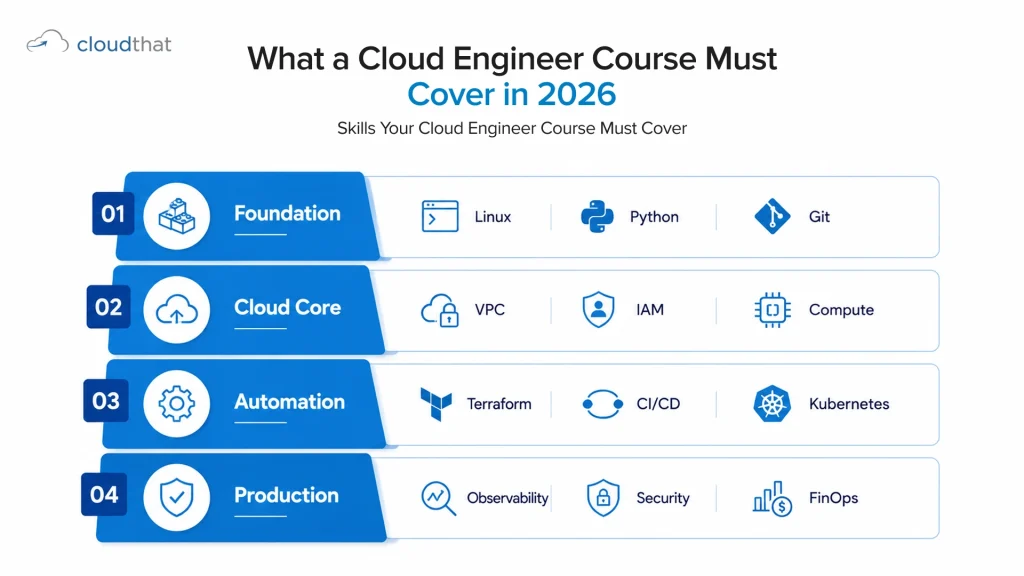
Skills Your Cloud Engineer Course Must Cover
If your course curriculum skips any of these, you are paying for an outdated program.
The foundation layer:
- Linux basics. Shell scripting. Networking fundamentals
- One programming language at a working level. Python is the default
- Git, branching strategies, and pull request workflows
The cloud core:
- Compute, storage, networking, identity, and security on at least one major provider (AWS is the default ask in Indian JDs)
- VPC design, subnetting, routing, NAT, and load balancing
- IAM policies, roles, service control policies, and least-privilege design
- Cloud cost management. Most engineers don’t learn this and pay for it later
The infrastructure-as-code and automation layer:
- Terraform end-to-end. Modules, state management, drift detection
- CloudFormation or Bicep, depending on the stack
- CI/CD pipelines with GitHub Actions, GitLab CI, or Jenkins
- Containerization with Docker and orchestration with Kubernetes
The production layer that separates a beginner from a hireable cloud engineer:
- Observability. CloudWatch, Prometheus, Grafana, distributed tracing
- Incident response. How to read a runbook and write a clean post-mortem
- Cloud security basics. Network policies, secrets management, compliance
- Cost optimisation patterns
For a reliable baseline of what AWS itself expects of production cloud engineers, the AWS Well-Architected Framework documentation is the most useful free reference online.
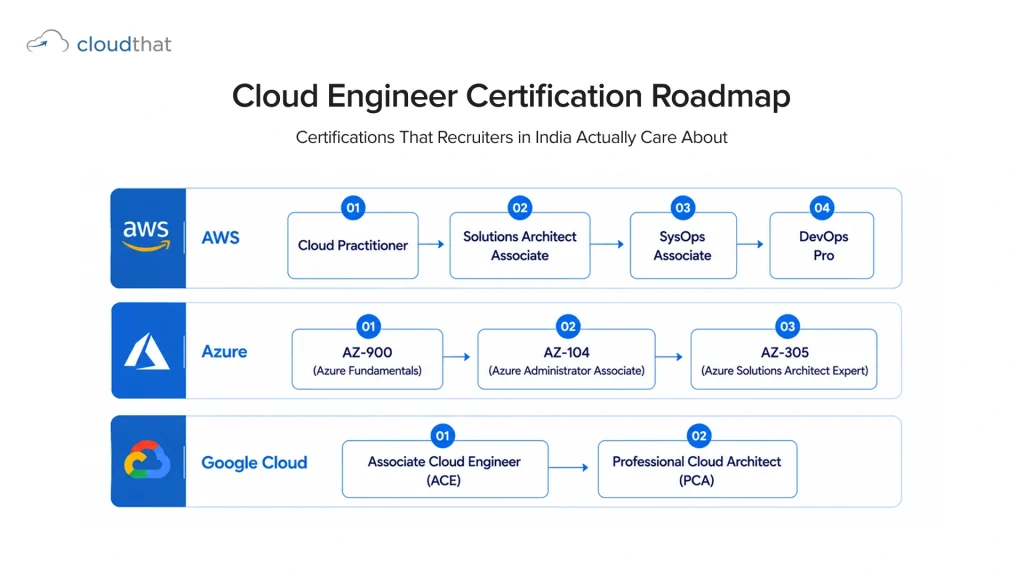
Certifications That Recruiters in India Actually Care About
Not every certification carries the same weight on an Indian CV.
AWS certifications that move the needle:
- AWS Certified Cloud Practitioner (entry signal)
- AWS Certified Solutions Architect Associate (the most asked-for cert on Indian JDs)
- AWS Certified SysOps Administrator Associate
- AWS Certified DevOps Engineer Professional (senior signal)
Microsoft Azure certifications:
- Azure Fundamentals (AZ-900)
- Azure Administrator Associate (AZ-104)
- Azure Solutions Architect Expert (AZ-305)
- Azure DevOps Engineer Expert (AZ-400) for engineers building CI/CD-heavy cloud workflows
Google Cloud certifications:
- Associate Cloud Engineer
- Professional Cloud Architect
If you are starting fresh, pick one cloud platform and stick to it for the first year. The training calendar lists upcoming live cohorts for AWS, Azure, and GCP certifications so you can plan your sequence before committing.
Projects That Get You Shortlisted vs Projects That Don’t
Three real GitHub projects beat any certificate sticker.
Projects that get you noticed:
- A multi-tier web application deployed on AWS with Terraform, CI/CD, and CloudWatch monitoring
- A Kubernetes cluster set up from scratch with one real application, Helm charts, and ingress configured
- A cloud migration simulation. Move a sample on-prem workload to AWS with proper architecture documentation
- A cost optimization case study on a sandbox AWS account
Projects that get scrolled past:
- “Launched an EC2 instance and hosted a static website.” Done by every beginner.
- A copy-pasted notebook from a YouTube tutorial with your name on it
- A LinkedIn screenshot of a passed exam with no project to back it
The CloudThat Job Ready Cloud Operations Engineer Program is structured around this exact gap. The capstone projects map to what enterprise clients ship in real engagements.
How Long It Realistically Take to Become Job-Ready?
If you already have an engineering or IT background, plan for four to six months of focused learning at 10 to 12 hours a week.
If you are switching careers from a non-tech background, plan for nine to twelve months.
The “land a cloud engineer job in 30 days” claims are marketing. Ignore them. Real cloud engineering work cannot be compressed into a sprint. The fundamentals take time. The lab muscle memory takes time. The interview preparation takes time.
The professionals who succeed are the ones who treat this like a structured training program, not a checklist of YouTube videos.
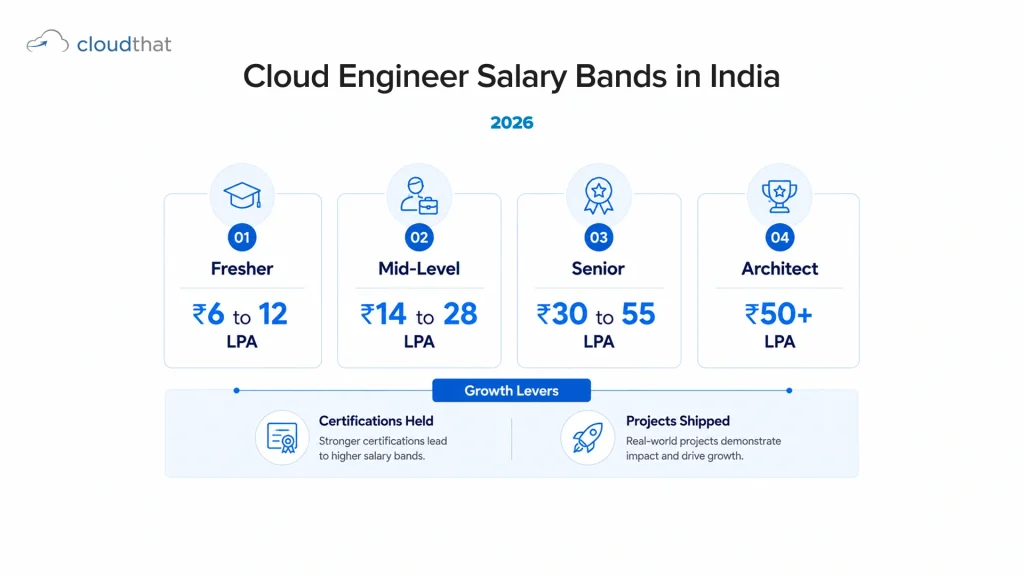
Cloud Engineer Salary Bands in India
Let’s be honest about the numbers.
Fresher with certifications and projects: ₹6 LPA to ₹12 LPA, depending on the company and the strength of your project portfolio.
Mid-level (2 to 5 years): ₹14 LPA to ₹28 LPA.
Senior cloud engineer (5 to 8 years): ₹30 LPA to ₹55 LPA.
Cloud architect or principal engineer (8+ years): ₹50 LPA and upward, sometimes much higher in product companies.
These are real ranges from current Indian job listings. The variance is huge because two things move the number more than anything else. Your cloud platform depth and the company you work for. Product companies pay more than service firms. Specialists pay more than generalists.
Red Flags to Watch For Before You Enroll
Six things that should make you walk away from any cloud engineer course in India.
The curriculum is still built around “introduction to cloud computing” modules in 2026. Best cloud training in 2026 starts at the production layer, not at the definition layer.
The trainers are anonymous freelancers without LinkedIn profiles you can verify.
No hands-on lab environments. Only slide-based learning.
Vague placement promises with no defined process or track record.
The course doesn’t mention Terraform, Kubernetes, or observability anywhere. A cloud computing course that skips infrastructure-as-code is not a 2026 program.
No partner credentials. AWS Premier Tier, Microsoft Partner, and Google Cloud Partner status are audited, not bought.
If a course fails on more than two of these, pick a different course.
Why CloudThat Is the Best Cloud Engineer Course Provider in India?
If you are evaluating a cloud engineering course in India and want one that leads to a job, not just a certificate sticker, the Job Ready Cloud Operations Engineer Program is designed for that. Live cohorts, hands-on labs across AWS, IAM, VPC, EC2, EKS, CloudWatch, Terraform, and CI/CD, capstone projects mapped to real enterprise patterns, and job assistance built into the program.
For engineers who want to go deeper into DevOps alongside cloud, the Cloud and DevOps Expert Program covers the full stack, from cloud fundamentals through DevOps certification, Kubernetes, and pipeline automation, in a single structured track.
If you would rather buy a year of self-paced cloud training across the full AWS catalog, the AWS Mastery Pass is ₹1,14,900 for 35+ AWS courses, including Solutions Architect Associate, SysOps Administrator, and DevOps Engineer Professional. EMI starts at ₹4,999 a month. Azure, GCP, NVIDIA, DevOps, and full-stack tracks are also available across the full cloud computing courses library.
Specifically for exam preparation, testprep.cloudthat.com offers practice tests and mock exams for AWS, Azure, and Google Cloud certifications. Used by candidates who want to validate readiness before booking the exam slot.
Need cloud expertise for a live production project, not just training? The CloudThat consulting team handles cloud migration, DevSecOps, managed services, and app modernization, and the same team feeds real-world patterns back into every classroom cohort. The GenAI Innovation Center runs live Bedrock and RAG engagements that directly inform the GenAI modules across training tracks.
If your company is upskilling a cohort of 50 or 500 engineers, the Capability Development Framework takes them from baseline developer skills to billable cloud roles in 1 to 60 days. Pre-training assessment first. Custom learning paths per role next. Hands-on labs, need-based sessions, and a project-readiness check at the end. No batch size minimum. It is the same framework used for corporate training at Accenture, Deloitte, HCL, and Protiviti in India, and it scales equally to teams across Bangalore, Kolkata, and remote locations.
If you are an enterprise hiring cloud engineers and you would rather skip the training cycle entirely, Hire From Us connects you to engineers who have already finished the same training stack and shipped real projects.
Everything sits atop AWS Premier Tier Services Partner status, plus partnerships with Microsoft, Google Cloud, and NVIDIA. These aren’t badges you buy. They are audited.
Conclusion
A cloud engineer course in India in 2026 is not a generic purchase. The right one depends on whether you want a structured job-ready outcome or self-paced subscription learning. Audit the curriculum, check the trainers, look at the projects you walk away with, and ignore any program that promises results in 30 days.
To see the live cohorts, capstone projects, and placement structure, explore the Job Ready Cloud Operations Engineer Program on the CloudThat training page. Check the training calendar for upcoming batches, or if your organization needs a structured upskilling path, start with the Capability Development Framework.
Key Takeaways:
- A cloud engineer course in India in 2026 must cover Terraform, Kubernetes, CI/CD, observability, and cost optimization. Not just service walkthroughs.
- AWS Solutions Architect Associate is the most sought-after certification in Indian JDs, followed by Azure AZ-104 and Google Cloud Associate Cloud Engineer.
- Three real GitHub projects with proper documentation beat any certificate sticker in interviews.
- Four to six months for engineers with IT backgrounds. 9 to 12 months for career switchers from non-tech backgrounds.
- Fresher salary bands range from ₹6 LPA to ₹12 LPA in 2026. Mid-level and senior engineers go significantly higher.
- AI is not replacing cloud engineers. The role is shifting toward higher-leverage design and architecture work.
Upskill Your Teams with Enterprise-Ready Tech Training Programs
- Team-wide Customizable Programs
- Measurable Business Outcomes
About CloudThat
FAQs
1. Which cloud engineer course is best in India in 2026?
ANS: – The one that includes Terraform, Kubernetes, CI/CD, observability, and hands-on labs on a real cloud platform. The Job Ready Cloud Operations Engineer Program is built for outcome-based learning with job assistance included.
2. What qualifications do I need to become a cloud engineer in India?
ANS: – A bachelor’s degree in engineering or IT helps but is not mandatory. What recruiters actually screen for is one cloud certification, working knowledge of Linux and Python, and three real GitHub projects.
3. Is a cloud engineer high-paying in India?
ANS: – Yes. Freshers with certifications and strong projects start between ₹6 LPA and ₹12 LPA. Mid-level engineers earn ₹14 LPA to ₹28 LPA. Senior cloud engineers cross ₹30 LPA, often higher in product companies.
4. Can I learn cloud engineering in 3 months?
ANS: – You can learn the foundations in 3 months. Becoming job-ready takes four to six months minimum if you already have an IT background, and nine to twelve months if you are switching from non-tech. Anyone selling a 30-day job guarantee is overselling.
5. Is AI replacing cloud engineers?
ANS: – No. AI is changing what cloud engineers do, not eliminating the role. Engineers who use AI well will outperform those who don’t. The hard parts of the job, like architecture, security, and migration, still need human judgement.
6. Do cloud engineer courses in India offer placement?
ANS: – Some do, some don’t. Outcome-based programmes like the Job Ready Cloud Operations Engineer Program build placement assistance into the curriculum. Avoid vague “job assistance” claims without a defined process.
7. Should I learn AWS, Azure, or Google Cloud first?
ANS: – AWS first if you are in India. It dominates Indian enterprise cloud adoption and is the most asked-for skill on Indian JDs. Add Azure or Google Cloud after one to two years.

WRITTEN BY Himisha Raval
Himisha Raval is a Digital Marketing Manager at CloudThat with a strong command of search engine optimization, web analytics, link building, and content strategy. She brings a data-driven approach to digital marketing, helping IT companies strengthen their online presence, improve search rankings, and generate consistent leads across channels. Beyond execution, she plays an active role in ideation, campaign strategy, and website performance optimization. Outside of work, she balances her analytical side with a love for travel, nature painting, and dancing.


 PREV
PREV











Comments