

 Login
Login

 July 29, 2025
|
Voiced by Amazon Polly |
Overview
In many applications, user registration marks a critical first step, but it often becomes a missed opportunity without proper follow-up. Organizations frequently face the challenge of executing essential post-signup tasks such as storing user data, assigning roles, or sending welcome communications, which are crucial for a seamless onboarding experience. Relying on manual processes or delayed backend workflows can lead to inconsistent user engagement and operational inefficiencies. This blog addresses that challenge by introducing the Amazon Cognito Post Confirmation Lambda trigger, a powerful mechanism that enables you to automate custom logic immediately after user confirmation. From use case examples to step-by-step implementation guidance, this article provides a practical roadmap to help developers and architects streamline post-registration workflows and enhance the user onboarding experience using AWS-native tools.
Pioneers in Cloud Consulting & Migration Services
- Reduced infrastructural costs
- Accelerated application deployment
Introduction
Amazon Cognito is a fully managed authentication, authorization, and user management service provided by AWS. It enables developers to easily add secure user sign-up, sign-in, and access control to web and mobile applications. Amazon Cognito supports authentication through username/password, social identity providers like Google, Facebook, and Apple, and enterprise identity providers via SAML and OIDC. It also integrates with other AWS services, making it a powerful tool for managing user identity, protecting resources, and building scalable, secure applications without needing custom authentication infrastructure.
Use Cases for Post Confirmation Trigger
- Send a welcome email after signup.
- Assign user groups or roles based on signup data.
- Store new user information in Amazon DynamoDB.
- Initialize user analytics or tracking.
- Trigger downstream workflows like onboarding or tutorials.
Steps to Set Up a Post Confirmation AWS Lambda Trigger
Step 1: Create AWS Lambda Function
- Go to the AWS Lambda Console.
- Click “Create function”.
- Choose Author from scratch.
- Give it a name like PostConfirmationHandler.
- Choose an appropriate runtime (e.g., Python 3.12, Node.js 18).
- Click Create function.
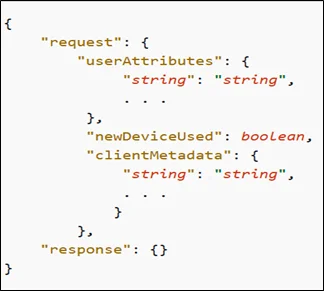
Python Example
|
1 2 3 4 |
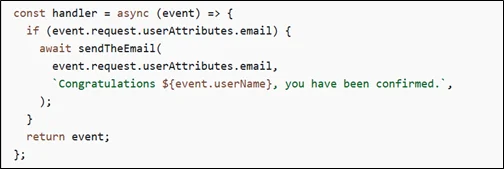
def lambda_handler(event, context): print(“User confirmed:”, event[‘userName’]) # Add your custom logic here Return event |
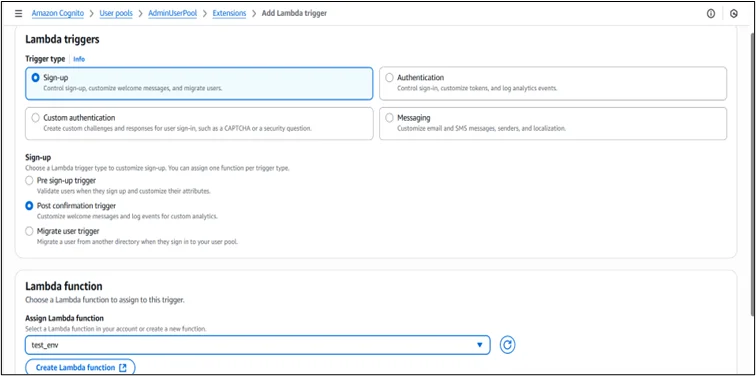
Step 2: Add AWS Lambda Trigger to Amazon Cognito User Pool
- Go to Amazon Cognito Console.
- Select your User Pool.
- Click on the “Triggers” tab in the left sidebar.
- Under Post confirmation, select the Lambda function you just created.
- Click Save changes.
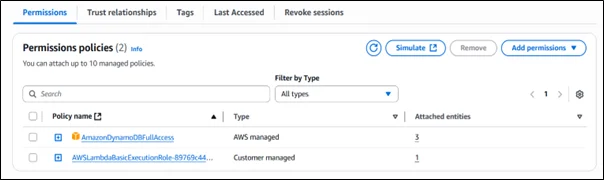
Step 3: Add Necessary Permissions
If your Lambda function interacts with other AWS services (like DynamoDB, SNS), you must:
- Go to AWS IAM Console.
- Find the AWS Lambda execution role.
- Attach necessary permissions policies, such as:
- AmazonDynamoDBFullAccess
- AmazonSNSFullAccess
Make sure to restrict permissions to only what is needed.
Step 4: Test the Trigger
To test:
- Sign up a new user in your Amazon Cognito User Pool.
- Confirm the email (or trigger auto-confirm if enabled).
- Check your Lambda CloudWatch Logs for output.
- Verify the expected behavior (DB insert, email sent, etc.).
Conclusion
The Post Confirmation trigger in Amazon Cognito is a powerful feature that automates onboarding logic immediately after user signup.
Drop a query if you have any questions regarding Amazon Cognito and we will get back to you quickly.
Making IT Networks Enterprise-ready – Cloud Management Services
- Accelerated cloud migration
- End-to-end view of the cloud environment
About CloudThat
FAQs
1. When is the Post Confirmation trigger executed?
ANS: – It is executed:
- Right after the user successfully confirms their signup (via email/phone verification).
- Instantly, if auto-confirmation is enabled in the user pool settings.
2. Can the Post Confirmation trigger modify user attributes?
ANS: – No. It is called after the user is confirmed. If you need to modify user attributes, use the Pre Signup or Pre Token Generation triggers.


WRITTEN BY Anusha R
Anusha R is Senior Technical Content Writer at CloudThat. She is interested in learning advanced technologies and gaining insights into new and upcoming cloud services, and she is continuously seeking to expand her expertise in the field. Anusha is passionate about writing tech blogs leveraging her knowledge to share valuable insights with the community. In her free time, she enjoys learning new languages, further broadening her skill set, and finds relaxation in exploring her love for music and new genres.


 PREV
PREV












Comments