

 Login
Login

 May 19, 2026
|
Voiced by Amazon Polly |
Overview
Tools like LangChain and LangGraph can be used to build AI workflows. Lang Graph supports more flexible routes, while Lang Chain operates sequentially. Both help produce further intelligent apps by integrating AI models with data and technologies.
Pioneers in Cloud Consulting & Migration Services
- Reduced infrastructural costs
- Accelerated application deployment
Lang Chain
To connect large language models to structured procedures that enable colonization and multi-step logic, the LangChain framework was developed. It facilitates the development of AI systems that must chain together numerous operations, similar to recycling stoner input, reacquiring data, and generating responses.
Structure: This approach uses” chains,” which are sequences of operations where the affair of one step becomes the input for the next, to break down complex sense into manageable gobbets.
Operations: It includes building chatbots, handling and consolidating documents, automating multi-step logic processes, and integrating LLMs with third-party apps or APIs.
Strengths: Compatible with other tools and APIs for enhanced capabilities, modular for simple step switching or exercise, and simple to integrate for direct processes.
Limitations: It can be grueling to set up multi-step workflows, requires careful error handling, and may lead to delays with large models.
Lang Graph
Large language models are organized into graph-grounded procedures via a frame called Lang Graph, enabling flexible, concurrent, multi-step logic. By enabling jobs to branch, circle, or run in similar ways, it helps construct AI systems that give more complex logic than succession chains.
Structure: By representing operations and data flow with bumps and edges, the labor of a single knot can feed several downstream bumps that offer dynamic decision pathways.
Operations: Ideal for multi-agent collaboration, tentative sense- grounded task colonization, complex decision- making channels, and coincidently coordinating multiple LLMs or tools.
Strengths: Facilitates dynamic workflows, is modular for reusing bumps, is adaptable for branching and similar conditioning, and interfaces with external APIs and LLMs with ease.
Limitations: Large or multiple concurrent processes may cause delays, complex graphs can be grueling to debug, and literacy can be challenging at first.
While Lang Graph is suitable for more complex, networked systems, Lang Chain is an excellent tool for novices and API commerce.
Key Differences
While LangGraph is suited for complex, networked systems, LangChain is ideal for simpler, sequential workflows and beginners.
Lang Chain
- Fluently integrates with popular LLMs like OpenAI GPT and Hugging Face models.
- Its modular chain architecture allows it to support databases, tools, and other APIs.
- It works right out of the box, which makes it great for direct workflows.
Lang Graph
- Designed to be readily integrated with numerous LLMs contemporaneously.
- Effectively manages complicated tool operation and multi-agent unity.
- Makes it easier for bumps, APIs, and workflows to connect in real time, which makes AI channels more complex.
When to Choose LangChain
- Suitable for simple chatbots, document retrieval, and summarization
- Ideal for single-agent logic
- Easier to set up and maintain for small to medium applications
When to Choose Lang Graph
- Perfect for complex branching processes with multiple agents or ongoing conditioning.
- Salutary when multi-agent cooperation, dynamic tool use, or multi-step logic is demanded.
- Provides further inflexibility and scalability than process sense for large- scale operations.
Use Cases
Use Cases for Lang Chain
Operations with a succession and methodical workflow, where each step logically depends on the state of the ongoing one, are especially well-suited for LangChain.
- Chatbots
Conversational systems that accept stoner input, retain contextual memory, and provide direct responses are made possible by LangChain. It is thus perfect for virtual adjunct and client service operations.
- Summarization of Documents
Dividing them into manageable portions and producing summaries facilitates the effective processing of lengthy papers. This is particularly helpful when recycling repetitions, exploration papers, and reports.
- Channels for Text to SQL
Natural language queries are continually translated into SQL statements using LangChain. It facilitates schema appreciation, query development, prosecution, and affect formatting in a systematized channel.
For example, a straightforward SQL query such as “recoup product prices” can be executed on a MariaDB database.
- The reclamation-stoked generation, or RAG
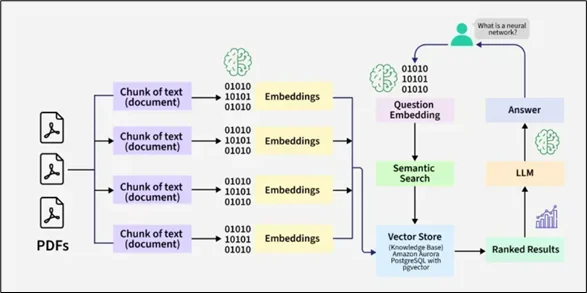
LangChain’s seamless integration with vector databases enables retrieval-grounded question-and-answer responses. It obtains material documents and adds environment to the language model’s response.
- Basic robotization workflows
It is effective in automating repetitive tasks such as data birth, report compilation, and dispatch processing.
Use Cases for Lang Graph
Lang Graph is designed for complex, dynamic processes that require inflexibility, tentative prosecution, and multi-agent cooperation.
- Multiple Agent Systems
Multiple agents, each responsible for a specific activity such as data recovery, processing, or decision-making, can work together through Lang Graph. These agents work together to create a final result.
- Difficult Ways to Share Your Views
It enables workflows such as tentative sense and dynamic routing. For instance, depending on the type of stoner question, a system may choose to employ a reclamation-grounded technique or a database query.
- Independent AI agents
Building autonomous systems that can use tools, reason iteratively, and tone-correct until the desired outcome is achieved is made simpler by LangGraph.
- Condition- Grounded Workflow Orchestration
It allows for the application of tentative sense, which is comparable to IF-ELSE structures and enables processes to adapt to intermediate problems swiftly.
- Use of comparable tools
Lang Graph enhances efficiency and speed by enabling the concurrent execution of numerous tasks, such as database queries and document reclamation.
Conclusion
In conclusion, even though their functions differ according to the process’s complexity, both LangChain and Lang Graph make substantial contributions to advancing modern AI-powered processes.
Lang Chain provides a simple, methodical, and efficient way to build processes with direct prosecution, making it an excellent choice for use cases such as chatbots, document summarization, and text-to-SQL channels. Because of its strong ecosystem support and user-friendliness, it is particularly well suited for small to medium-sized systems for rapid-fire development.
However, Lang Graph provides a more complex and flexible structure that enables programmers to create dynamic processes with comparable branching, looping, and prosecution. It works better in complex systems that exhibit large-scale unity, tentative sense, and multi-agent cooperation.
Drop a query if you have any questions regarding LLM Workflows and we will get back to you quickly.
Empowering organizations to become ‘data driven’ enterprises with our Cloud experts.
- Reduced infrastructure costs
- Timely data-driven decisions
About CloudThat
FAQs
1. Does LangGraph support multi-agent systems?
ANS: – Yes. LangGraph is designed for multi-agent collaboration, where agents handle tasks such as retrieval, reasoning, and decision-making.
2. What is an LLM workflow?
ANS: – An LLM workflow is a structured pipeline where:
- User input is processed
- Data may be retrieved (RAG)
- The LLM generates a response
- Results are formatted and returned
3. Does LangGraph support multi-agent systems?
ANS: – Yes. LangGraph is designed for multi-agent collaboration, where agents handle tasks such as retrieval, reasoning, and decision-making.


WRITTEN BY Sweata Kumari Rauniyar
Sweata works primarily in the field of cloud computing, with additional expertise in data visualization. She has a strong foundation in cloud technologies and specializes in designing scalable, efficient cloud-based solutions. Skilled in SQL and Python, Sweata leverages these tools to support data-driven applications and create impactful visualizations. Passionate about using cloud technologies to solve real-world problems, she stays updated on emerging tools and trends to continually enhance her expertise and deliver innovative solutions.


 PREV
PREV










Comments