

 Login
Login


 May 19, 2026
|
Voiced by Amazon Polly |
Overview
The importance of extracting meaningful information from databases is greater today than before, as data plays a critical role in decision-making. Nevertheless, searching through a database still necessitates an understanding of SQL. Not everyone is skilled in SQL, which poses a significant barrier to extracting information from databases. Text-to-SQL addresses this issue by enabling non-technical users to query databases without writing any code, as a result of developments in machine learning and natural language processing (NLP).
Pioneers in Cloud Consulting & Migration Services
- Reduced infrastructural costs
- Accelerated application deployment
Text-to-SQL
Text-to-SQL is a useful tool that aims to reduce the gap between SQL and natural language. Doing away with complex SQL coding allows people to query databases using natural language alone.
How Text-to-SQL Works?
- User Question: An inquiry in natural language provided by the user triggers the process.
- Understanding the Question: The system analyzes the question, pointing out crucial elements and the overall request.
- Meaning Acquisition: The system represents the query in the form of a logical structure conveying its essence.
- Generating SQL Query: The system constructs an SQL query according to the meanings obtained from the question.
- Executing the SQL Query: The database undergoes execution according to the constructed SQL query.
- Showing the Results: The results are presented to the user in an intelligible way by the system.
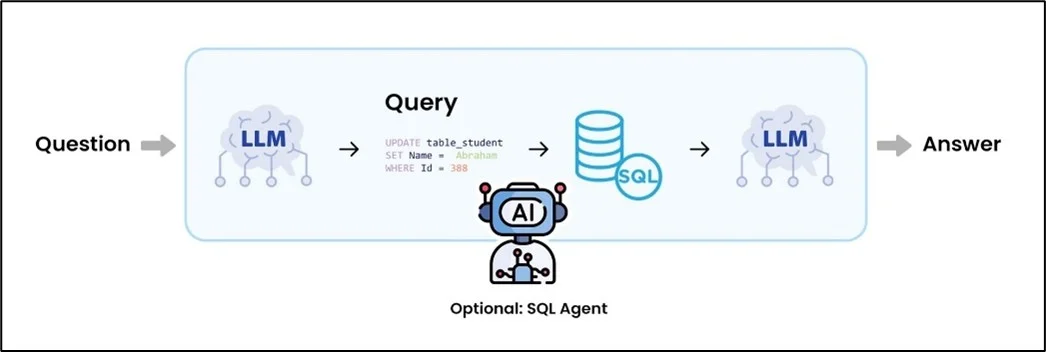
Source: Rysun
Challenges in Text-to-SQL Development
Some problems related to text-to-SQL that need to be addressed are:
- Incomplete or Ambiguous Questions: Individuals tend to phrase their queries in many different ways, some of which may not be clear enough. For a correct SQL statement to be generated, the system must understand such differences.
- Complexity of Real-World Databases: In real-world applications, there are multiple tables and columns involved in complex relations within a database. The system must be able to understand these complexities and use the correct part of the database when answering users’ queries.
- Query Validation: Incorrect SQL statements can cause problems, damage data, or provide wrong data. There should be methods used to validate the query before its execution.
- Big Data Management: It is important to handle large amounts of data efficiently.
Advanced Methods to enhance the creation of queries
- Some Short-Term Prompting
By integrating sample queries into the prompts, few-shot prompting improves the creation of accurate SQL queries. It minimizes errors and improves efficiency by helping the model learn query structures from relevant usage scenarios.
- Query Validation
The queries can be validated by searching for errors, inefficiencies, or potential security risks before executing the generated SQL query. It can include analyzing the execution plan, validating the access privileges, and processing the query.
- Based on Metadata Querying
Including additional metadata about the database structure in the models helps create more accurate SQL queries. For example, it can include column descriptions, foreign key relationships, and indices.
- Schema-Aware Decoding
It enables the generated SQL to be compatible with the actual database schema by structuring the decoding process according to the schema requirements. Thus, incorrect table or column references and syntactic mistakes are reduced.
- Adaptive Query Optimization
With the help of text-to-SQL systems, adaptive querying optimizes generated SQL queries in real time by evaluating their performance. In large databases, this approach ensures proper querying.
- Decomposition of Multi-Step Queries
This accuracy may be improved by breaking down multi-step queries that require multiple joins or subqueries into smaller steps. Once the intermediate queries have been created and partial answers tested, the generated SQL query is based on those results.
How Agentic AI Uses LangGraph to Improve Text-to-SQL?
- Multi-Step Dynamic Reasoning
If the question is ambiguous or complex, text-to-SQL translation may generate erroneous SQL queries. With an agentic AI trained on LangGraph, it becomes feasible to break a complex query into multiple stages, check schema information, and iteratively enhance SQL generation.
- Creation of Schema-Based Queries
The language model may make errors in defining tables’ connections or create nonexistent columns. The generation of exact SQL is guaranteed by an agent’s capability of obtaining schema information dynamically.
- Self-Assessment and Correction of Questions
Unsuitable join conditions or incorrect syntax may appear in the output. The agent can assess errors, test SQL queries, and enhance queries.
- Processing Memory and Contextual Data
The context may become irrelevant in multi-round conversations. In such cases, an agentic AI can save the interaction history using memory modules within LangGraph.
Rather than composing a new query, the agent can correct the existing one by understanding the next request.
- Optimizing Adaptive Queries
The generated SQL query might not have optimization features. The agent can estimate the efficiency of the query and apply appropriate improvements.
Workflow for Text-to-SQL Agent in LangGraph
The following definition of a LangGraph agentic system with several nodes executing different functions can be offered:
- User Input Node – Responsible for parsing natural language queries.
- Schema Retrieval Node – Responsible for retrieving the database schema dynamically.
- SQL Generation Node – Responsible for generating SQL queries using large language models (LLMs), such as GPT-4 and Llama.
- Query Validation Node – Responsible for testing SQL queries.
- Correction Node – Correcting errors when necessary.
- Execution Node – Responsible for collecting results post-execution of SQL.
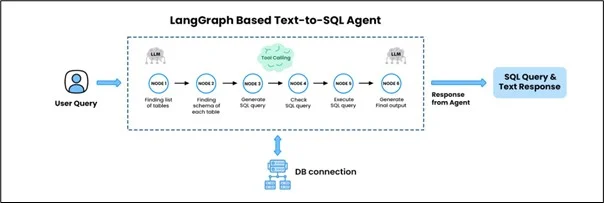
Source: Rysun
Conclusion
By enabling users to query complex data in plain language and eliminating the need for SQL knowledge, text-to-SQL technology is transforming database interactions. It overcomes obstacles such as unclear queries and complex database structures by leveraging advances in Natural Language Processing (NLP) and machine learning to make data exploration more accessible.
Drop a query if you have any questions regarding NLP and we will get back to you quickly.
Empowering organizations to become ‘data driven’ enterprises with our Cloud experts.
- Reduced infrastructure costs
- Timely data-driven decisions
About CloudThat
FAQs
1. How does Text-to-SQL work?
ANS: – It processes a user’s natural language input, analyzes its meaning, generates an SQL query, executes it on the database, and returns results in a readable format.
2. Which LLMs are used in Text-to-SQL workflows?
ANS: – Models such as GPT-4 and Llama are commonly used for SQL generation in LangGraph-based agentic pipelines.
3. Can Text-to-SQL handle ambiguous queries?
ANS: – Yes. Advanced methods like few-shot prompting and schema-aware decoding help interpret unclear questions.


WRITTEN BY Sweata Kumari Rauniyar
Sweata works primarily in the field of cloud computing, with additional expertise in data visualization. She has a strong foundation in cloud technologies and specializes in designing scalable, efficient cloud-based solutions. Skilled in SQL and Python, Sweata leverages these tools to support data-driven applications and create impactful visualizations. Passionate about using cloud technologies to solve real-world problems, she stays updated on emerging tools and trends to continually enhance her expertise and deliver innovative solutions.


 PREV
PREV











Comments