

 Login
Login


 April 30, 2026
|
Voiced by Amazon Polly |
Overview
As organizations increasingly adopt AI agents to automate workflows and enhance decision-making, managing these agents at scale has become a major challenge. The introduction of AWS Agent Registry (in preview) marks a significant step toward solving this problem. Built within Amazon Bedrock AgentCore, it provides a centralized system for discovering, governing, and reusing AI agents, tools, and skills across an enterprise.
Pioneers in Cloud Consulting & Migration Services
- Reduced infrastructural costs
- Accelerated application deployment
Introduction
The rise of Generative AI has led to a surge in AI agents and autonomous systems capable of performing tasks, making decisions, and interacting with users or other systems. While this evolution unlocks immense productivity, it also introduces complexity.
Imagine an organization running hundreds of agents across different teams, cloud platforms, and environments. Without a centralized system, teams struggle to answer basic questions:
- What agents already exist?
- Who owns them?
- Are they approved for use?
- Can we reuse them instead of rebuilding?
This is where AWS Agent Registry comes in. It acts as a single source of truth for all AI agents within an organization, enabling scalable, secure, and efficient agent management.
The Problem: Agent Sprawl at Scale
As enterprises grow their AI capabilities, they often encounter three major challenges:
- Visibility: Lack of awareness about existing agents across teams
- Control: No governance over who can publish or use agents
- Reuse: Teams rebuild similar solutions instead of leveraging existing ones
This leads to duplicated effort, increased costs, and compliance risks. Additionally, organizations rarely operate in a single ecosystem agents may exist across AWS, other cloud providers, or even on-premises systems. Without a unified registry, these agents remain fragmented and underutilized.
The Solution: Centralized Agent Registry
The AWS Agent Registry provides a centralized catalog for registering and managing agents, tools, and skills.
It allows organizations to:
- Store structured metadata about each agent
- Track ownership, capabilities, and compliance status
- Enable discovery through search
- Enforce governance policies
Unlike traditional systems, it is designed to be platform-agnostic, meaning it can index agents regardless of where they are hosted.
Key Features and Capabilities
a. Unified Metadata Management
Each agent is stored as a structured record containing:
- Publisher details
- Supported protocols (like MCP, A2A)
- Capabilities and usage instructions
- Invocation methods
This structured approach ensures consistency and clarity across teams.
b. Flexible Registration Methods
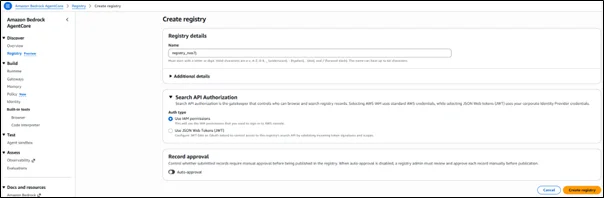
Agents can be registered in two ways:
- Manual registration via console, SDK, or API
- Automatic discovery by pointing to endpoints (e.g., MCP servers)
This ensures that both new and existing agents can be quickly onboarded into the registry.
c. Advanced Search and Discovery
The registry uses hybrid search, combining:
- Keyword-based search
- Semantic (natural language) search
For example, searching for “payment processing” can surface agents related to billing or invoicing, even if they are named differently. This dramatically improves discoverability and reduces redundant development.
d. Governance and Approval Workflows
Governance is critical when scaling AI systems. The registry enforces:
- Role-based access using AWS IAM or OAuth (JWT)
- Approval workflows (draft → pending → approved)
- Version tracking and lifecycle management
This ensures that only validated and compliant agents are available organization-wide.
e. Lifecycle and Compliance Tracking
From creation to retirement, every agent is tracked. Organizations can:
- Deprecate outdated agents
- Maintain audit trails using AWS monitoring tools
- Integrate custom compliance metadata
This brings enterprise-grade control to AI ecosystems.
f. Open and Extensible Architecture
Built within Amazon Bedrock AgentCore, the registry supports:
- Any AI model
- Any framework
- Any deployment environment
This flexibility ensures that organizations are not locked into a single technology stack.
Real-World Impact
Companies adopting centralized agent registries can:
- Reduce development time by reusing existing agents
- Improve collaboration across teams
- Enhance governance and compliance
- Gain complete visibility into their AI ecosystem
For example, enterprises managing dozens or hundreds of agents can now maintain a unified catalog, ensuring every asset is discoverable and accountable.
Future Roadmap
AWS is building toward a more integrated and intelligent ecosystem. Future enhancements may include:
- Automatic indexing of agents upon deployment
- Integration with developer tools and IDEs
- Cross-registry federation (search across multiple registries)
- Operational insights like usage, latency, and performance
This vision transforms the registry from a static catalog into a dynamic intelligence layer for AI operations.
Conclusion
The emergence of AI agents marks a new era in enterprise automation, but scaling them effectively requires more than just building models. It demands robust systems for discovery, governance, and reuse.
As AI ecosystems continue to grow, tools like this will become essential, not optional, for enterprises aiming to stay competitive in a rapidly evolving digital landscape.
Drop a query if you have any questions regarding AI agents and we will get back to you quickly.
Empowering organizations to become ‘data driven’ enterprises with our Cloud experts.
- Reduced infrastructure costs
- Timely data-driven decisions
About CloudThat
FAQs
1. Can it work with non-AWS agents?
ANS: – Yes, it is designed to be platform-agnostic and can index agents from other cloud providers and on-premises systems.
2. How are agents discovered in the registry?
ANS: – Through hybrid search combining keyword matching and semantic understanding, enabling natural language queries.
3. Does it support governance and compliance?
ANS: – Yes, it includes approval workflows, role-based access control, versioning, and lifecycle management.


WRITTEN BY Yerraballi Suresh Kumar Reddy
Suresh is a highly skilled and results-driven Generative AI Engineer with over three years of experience and a proven track record in architecting, developing, and deploying end-to-end LLM-powered applications. His expertise covers the full project lifecycle, from foundational research and model fine-tuning to building scalable, production-grade RAG pipelines and enterprise-level GenAI platforms. Adept at leveraging state-of-the-art models, frameworks, and cloud technologies, Suresh specializes in creating innovative solutions to address complex business challenges.


 PREV
PREV










Comments