

 Login
Login


 May 19, 2026
|
Voiced by Amazon Polly |
Overview
The leap from building a functional AI agent to building a high-performing one is often the steepest part of the development curve. While creating an agent in Amazon Bedrock AgentCore is straightforward, ensuring that it remains accurate, helpful, and efficient requires constant iteration.
With the introduction of Amazon Bedrock AgentCore Optimizations (Preview), AWS has provided a scientific framework for improving agentic applications. This suite of tools, centered on automated recommendations and A/B testing, allows developers to move away from gut-feeling adjustments and toward data-driven excellence.
Pioneers in Cloud Consulting & Migration Services
- Reduced infrastructural costs
- Accelerated application deployment
Introduction
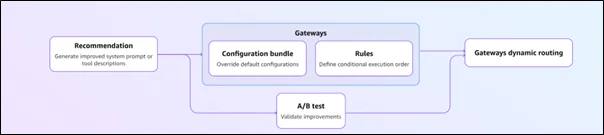
Amazon Bedrock AgentCore Optimizations is a feature set designed to refine the performance of autonomous agents by systematically improving their core configurations. It focuses on two primary workflows:
- Recommendations: Using historical trace data and sophisticated evaluators to suggest better system prompts and tool descriptions.
- A/B Testing: Validating those improvements by splitting live traffic between a “Control” (your current version) and a “Variant” (the optimized version) to see which performs better in the real world.
By integrating these features, Bedrock ensures that your agents don’t just work, they evolve.
In the world of Generative AI, small changes can have massive impacts. A single word added to a system prompt or a slight tweak to a tool’s description can be the difference between an agent completing a task or getting stuck in an infinite loop.
Previously, developers had to manually test these changes, often relying on anecdotal evidence or small, manual sample sizes. This was time-consuming and prone to human error. Amazon AgentCore Optimizations automates this lifecycle. It analyzes how your agent is currently behaving, identifies where it is failing (using metrics like “Tool Selection Accuracy” or “Faithfulness”), and suggests concrete improvements. It then provides the infrastructure to safely test those suggestions against your production traffic before a full rollout.
Source: AWS
- The Recommendation Engine: Data-Driven Refinement
The optimization process usually begins with a Recommendation. This feature takes your existing system prompts or tool descriptions and uses them as “code snippets” or “configuration bundles” to generate improved versions.
How Recommendations are Generated?
To create a high-quality recommendation, Amazon AgentCore looks at your Data Source. This typically involves scanning Amazon CloudWatch log groups for traces of previous agent sessions. By looking at where the agent succeeded or failed in the past, the system can understand the “gap” between the current performance and the desired outcome.
Recommendation Types
- System Prompt Optimization: The engine recommends an improved set of instructions for your agent’s runtime. This might involve adding clearer constraints or better defining the agent’s persona.
- Tool Description Optimization: One of the most common reasons agents fail is that they don’t understand when to use a specific tool. This feature recommends clearer, more descriptive language for your Gateway, helping the model make better tool-selection decisions.
- The Power of Reward Signals: Evaluators
You can’t optimize what you can’t measure. Amazon AgentCore Optimizations uses a wide array of built-in or custom reward signals and evaluators to assess the quality of an agent’s response. These are categorized into several critical buckets:
- Response Quality Metrics: These evaluate the output itself.
- Correctness & Faithfulness: Is the info accurate and supported by the sources?
- Helpfulness & Relevance: Does it actually solve the user’s problem?
- Conciseness & Coherence: Is it easy to read and logically structured?
- Task Completion Metrics:
- Goal Success Rate: Did the conversation actually meet the user’s end goal?
- Component Level Metrics:
- Tool Selection Accuracy: Did the agent pick the right tool for the job?
- Tool Parameter Accuracy: Did it extract the right data from the user’s query to fill into the tool’s inputs?
- Safety Metrics:
- Harmfulness & Stereotyping: Ensures the agent remains unbiased and safe for public interaction.
- Trajectory Metrics: These advanced metrics examine the order of operations, ensuring the agent follows a specific logical path (Exact Order, In-Order, or Any-Order matches).
- Validating Improvements with A/B Testing
Once you have a recommendation (a “Variant”), you need to prove it is actually better than your current setup (the “Control”). The A/B Test feature automates this comparison.
Setting Up the Test
- Define Control and Variant: You specify two configuration bundles. The “Control” is your baseline, and the “Variant” is your candidate for improvement.
- Traffic Weighting: You can decide exactly how much traffic to send to each version. For instance, you might send 90% of traffic to the stable Control and 10% to the new Variant to minimize risk.
- Gateway Routing: The Amazon AgentCore Gateway serves as the traffic controller, dynamically routing requests based on the rules you define.
Analyzing Results
During the test, Amazon AgentCore collects evaluator scores for both versions. You can view side-by-side comparisons of “Goal Success Rate” or “Response Quality.” If the Variant consistently outperforms the Control across your chosen metrics, you can deploy the winning configuration bundle to 100% of your traffic with a single click.
- Integration with Configuration Bundles
Optimizations are deeply tied to Configuration Bundles. This allows for version control similar to how software developers use Git. You can create different branches for your agent’s configuration, run A/B tests on those branches, and merge the high-performing “winning” configurations back into your main production line.
Conclusion
Instead of guessing why an agent failed to select a tool or why its responses were too wordy, developers now have a suite of metrics and an automated engine to guide them toward the most efficient configuration. As agents become more integrated into our daily workflows, these optimization tools will be the foundation for trust and performance.
Drop a query if you have any questions regarding Amazon Bedrock AgentCore Optimizations and we will get back to you quickly.
Empowering organizations to become ‘data driven’ enterprises with our Cloud experts.
- Reduced infrastructure costs
- Timely data-driven decisions
About CloudThat
FAQs
1. What is a "Trajectory Metric" and why does it matter?
ANS: – A trajectory metric doesn’t just look at the final answer; it looks at the steps the agent took to get there. For example, if an agent is supposed to “Search Database” then “Calculate Total,” a trajectory metric ensures the agent didn’t skip the search step or do them in the wrong order. This is vital for complex, multi-step business processes.
2. Can I use my own custom metrics for A/B testing?
ANS: – Yes. While Amazon Bedrock provides a robust list of built-in evaluators (like Correctness and Helpfulness), you can also define Custom Evaluators. This is useful if your agent has specific industry requirements or unique success criteria that generic metrics might miss.
3. Does running an A/B test require me to change my application code?
ANS: – No. Because the optimization happens at the Gateway and Configuration Bundle level, the routing is handled internally by Amazon Bedrock. Your application simply continues to call the same endpoint, and the Gateway manages traffic distribution between the Control and Variant versions.


WRITTEN BY Yerraballi Suresh Kumar Reddy
Suresh is a highly skilled and results-driven Generative AI Engineer with over three years of experience and a proven track record in architecting, developing, and deploying end-to-end LLM-powered applications. His expertise covers the full project lifecycle, from foundational research and model fine-tuning to building scalable, production-grade RAG pipelines and enterprise-level GenAI platforms. Adept at leveraging state-of-the-art models, frameworks, and cloud technologies, Suresh specializes in creating innovative solutions to address complex business challenges.


 PREV
PREV










Comments