

 Login
Login


 April 30, 2026
|
Voiced by Amazon Polly |
Introduction
Not too long ago, building an application meant wiring up a few APIs and querying a database. Today, that’s barely the starting line. Modern apps are expected to surface live data, respond to events as they happen, and increasingly think for themselves by pulling in AI-generated insights. That’s a lot to ask of any backend architecture, and it’s exactly where teams start adding layers: one for data, another for real-time messaging, and another for the AI.
AWS AppSync paired with Amazon Bedrock offers a way out of that complexity. A single managed API layer where operational data, live events, and generative AI responses can finally coexist.
Pioneers in Cloud Consulting & Migration Services
- Reduced infrastructural costs
- Accelerated application deployment
AWS AppSync
Most Amazon API Gateways do one thing well, which is to route requests. AWS AppSync was built with a bigger job in mind, where it brings data access, real-time communication, and application logic together through a managed GraphQL and Pub/Sub layer so that applications can fetch exactly what they need, listen for live updates, and talk to multiple backends without teams having to write mountains of orchestration code from scratch.
- Unified API Layer – With AWS AppSync’s GraphQL APIs, developers get a single endpoint to access and combine data from multiple sources securely. If your application needs to blend structured business data with AI-generated outputs, that’s exactly the kind of problem AWS AppSync was designed to handle cleanly.
- Direct AI Integration with Amazon Bedrock – AWS AppSync supports JavaScript resolvers and functions that can call Amazon Bedrock models directly. That means capabilities like summarization, content generation, or AI-assisted decision support don’t need a separate backend layer. They live in the same API that already serves the rest of your application data.
- Real-Time Application Experiences – AWS AppSync handles WebSocket connections automatically, so clients can receive live updates without anyone on the team worrying about connection infrastructure. AWS AppSync Events takes this further with serverless WebSocket APIs that support broadcast, multicast, unicast, and channel-based pub/sub patterns, depending on the use case.
- Built-In Security and Operations – AWS AppSync supports multiple authorization modes, including AWS IAM, OIDC, Amazon Cognito, AWS Lambda authorizers, and API keys. It also integrates with AWS WAF, Amazon CloudWatch, and AWS X-Ray, and provides enhanced monitoring capabilities for teams that need deeper visibility into what’s happening at the API layer.
How AWS AppSync Works?
AWS AppSync gives you two ways to build your API layer, either through GraphQL or an Event API, and each one serves a different purpose depending on what your application needs.
- GraphQL API – A client sends a query, mutation, or subscription request, and AWS AppSync resolvers fetch exactly what’s needed, whether from a database, AWS Lambda function, or external API. When Bedrock is involved, those same resolvers can call a foundation model and return AI-generated content through the same API surface.
- Real-Time with Subscriptions – Whenever a mutation happens, AWS AppSync automatically pushes updates to all connected clients. This is especially useful when AI outputs need to appear live inside dashboards or copilot interfaces, where waiting for a refresh isn’t acceptable.
- Event-Driven with AWS AppSync Events – Clients can publish via HTTP or WebSocket and subscribe to channels in real time through a serverless pub/sub model. A natural fit for notification systems, collaborative apps, or AI-assisted workflows where one event needs to reach many subscribers at once.
- Amazon Bedrock as the AI Layer – AWS AppSync acts as the controlled interface between your AI models and enterprise data. Amazon Bedrock models and agents connect to knowledge bases, APIs, and databases through a single self-documenting GraphQL endpoint.
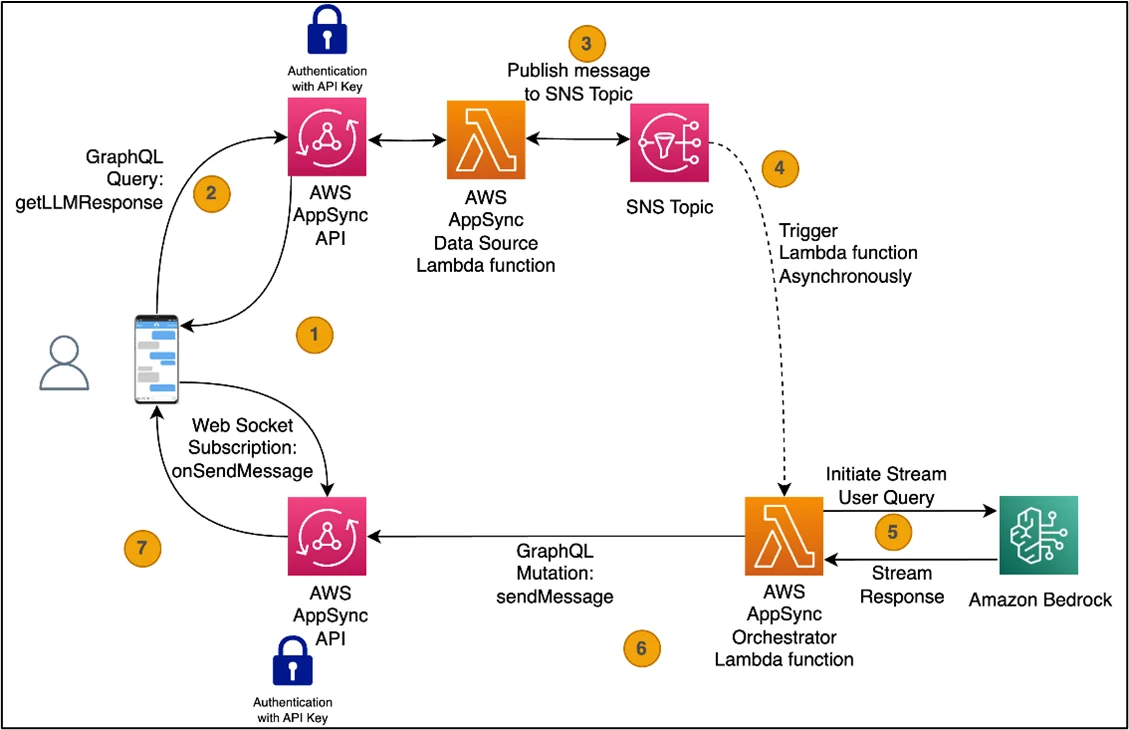
Applications Where AWS AppSync Fits
- Customer Experience Platforms: Build intelligent portals where users can fetch account data, receive AI-generated explanations, and subscribe to live status changes through a single managed API layer.
- Enterprise Copilots: Use AWS AppSync as the connective layer between Amazon Bedrock models and internal data sources, enabling AI assistants to retrieve context, call business APIs, and return governed answers.
- Operational Dashboards: Deliver real-time updates for inventory, incidents, order flows, or workflow states while also exposing AI-generated summaries or recommended actions.
- Collaboration and Messaging Apps: Combine real-time pub/sub with AI-generated responses, moderation, summarization, or contextual assistance for chat, activity feeds, and support interactions.
- API Modernization: Replace fragmented backend access patterns with a unified GraphQL layer that securely orchestrates microservices, data stores, and AI services.
Key Business Advantages of AWS AppSync
Building modern applications usually means managing more moving parts than anyone planned for. AWS AppSync helps reduce that overhead in ways that matter to both engineering teams and the business.
- One API, Less Complexity: Instead of maintaining separate layers for data access, real-time messaging, and AI integration, teams get a single managed API surface that handles all three. That’s less infrastructure to build, fewer failure points to monitor, and a faster time-to-ship features.
- Faster, More Responsive Experiences: Managed subscriptions and serverless WebSocket capabilities mean applications can deliver live updates without teams building and scaling their own connection infrastructure. For AI-powered features, especially, the difference between a response that streams in real time and one that makes users wait is often the difference between adoption and abandonment.
- Enterprise-Grade Governance: AWS AppSync comes with multiple authorization modes, AWS WAF support, Amazon CloudWatch and AWS X-Ray integration, and enhanced monitoring out of the box. For organizations introducing AI into their products, having a controlled and auditable integration point for Amazon Bedrock access isn’t just convenient, it’s often a requirement.
- Costs That Scale With You: AWS AppSync’s pay-per-use model means teams aren’t paying for idle capacity. For workloads that fluctuate, like real-time AI features that spike during business hours or event-driven workflows tied to external triggers, that pricing model tends to work in the business’s favor.
Conclusion
AWS AppSync and Amazon Bedrock together make a compelling case for teams that are tired of stitching together separate layers to deliver a modern application experience. With a single managed API that handles data access, real-time updates, and AI integration, teams can stop worrying about backend complexity and focus on building smarter applications.
Drop a query if you have any questions regarding AWS AppSync and we will get back to you quickly.
Empowering organizations to become ‘data driven’ enterprises with our Cloud experts.
- Reduced infrastructure costs
- Timely data-driven decisions
About CloudThat
FAQs
1. When should I use AWS AppSync instead of Amazon API Gateway?
ANS: – Choose AWS AppSync when your application needs to pull data from multiple sources, support real-time updates, or offer a flexible GraphQL interface. Amazon API Gateway is great for REST routing, but AWS AppSync is the better fit for data aggregation and event-driven experiences.
2. Can AWS AppSync integrate with Amazon Bedrock?
ANS: – Yes, AWS AppSync resolvers can call Amazon Bedrock models alongside traditional data sources, enabling applications to blend operational data with AI-generated responses through a single API layer without a separate backend.
3. What types of applications benefit most from AWS AppSync?
ANS: – Any application that needs real-time updates, multi-source data, or AI-powered experiences. Think enterprise dashboards, customer portals, collaboration tools, and copilots that depend on live data and contextual insights.


WRITTEN BY Sujay Adityan
Sujay works as a Research Associate in the Data & AIoT team at CloudThat, with a background in Data Science. He is skilled in data analytics, machine learning, cloud computing, Python programming, and working with large-scale databases and networks. Sujay has contributed to multiple AI/ML and Generative AI projects for both internal teams and clients. Passionate about continuous learning, he aspires to become a proficient software developer, creating meaningful, technology-driven solutions that make a real impact.


 PREV
PREV










Comments