

 Login
Login


 March 23, 2026
|
Voiced by Amazon Polly |
As organizations adopt AI-assisted development at scale, tools like GitHub Copilot are no longer viewed as productivity enhancers alone. In enterprise DevOps environments, they must align with governance models, security policies, and operational standards.
The question for most technology leaders is no longer whether to adopt Copilot, but how to implement it responsibly across distributed teams.
This article explores how GitHub Copilot in Enterprise DevOps environments can be governed securely, aligned with compliance frameworks, and deployed at scale without disrupting established engineering workflows.
Start Learning In-Demand Tech Skills with Expert-Led Training
- Industry-Authorized Curriculum
- Expert-led Training
Understanding GitHub Copilot in Enterprise Context
GitHub Copilot is an AI-powered coding assistant that provides contextual code suggestions inside supported IDEs. It is trained on publicly available code and supports multiple programming languages and frameworks.
According to GitHub documentation, enterprise administrators can centrally manage Copilot access, enforce policies, and configure feature settings across organizations within their enterprise account.
This administrative layer is what differentiates individual usage from enterprise-scale adoption.
The following architecture illustrates how GitHub Copilot operates within enterprise governance, repository controls, and CI/CD enforcement layers.
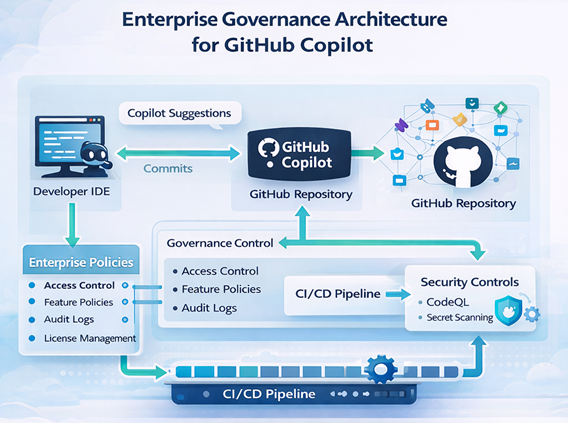
Fig 1: Enterprise governance architecture illustrating how GitHub Copilot operates within repository controls, security scanning, and CI/CD enforcement layers.
Governance Controls in Enterprise Environments
In enterprise DevOps ecosystems, governance must extend beyond repository permissions. It must also address:
- Who can access Copilot
- Which features are enabled
- What models are permitted
- How policies are enforced across organizations
GitHub provides enterprise-level policy management that allows administrators to define and enforce Copilot settings centrally.
These controls include:
- Feature restrictions at organization or enterprise level
- Model access configuration
- Policy inheritance across teams
- License management and user assignment
This structured governance ensures Copilot adoption aligns with internal compliance requirements and audit expectations.
Security Considerations in DevOps Pipelines
One of the most important concerns in adopting AI-assisted development is code security.
It is important to clarify that GitHub Copilot does not replace secure development practices. Instead, it complements them. Enterprise teams must continue to rely on established DevOps controls, such as:
- Pull request reviews
- Branch protection rules
- GitHub Advanced Security scanning
- CodeQL analysis
- Secret scanning
GitHub emphasizes that Copilot-generated code should be reviewed and validated just like human-written code.
In enterprise DevOps environments, Copilot operates within the existing repository permission model. It does not override repository access controls or bypass CI/CD checks.
The workflow below demonstrates how AI assistance enhances development while security enforcement remains embedded within the DevOps lifecycle.
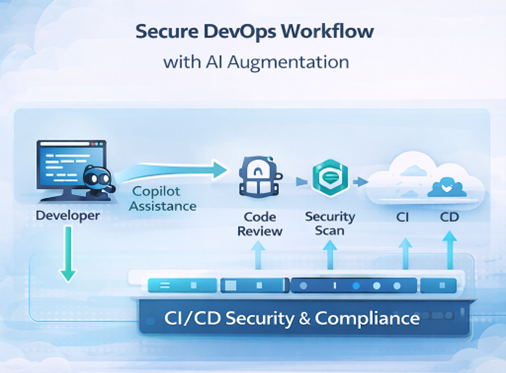
Fig 2: Secure DevOps workflow augmented by Copilot, with security scanning and CI/CD compliance controls enforced before deployment.
This design ensures that AI assistance does not compromise pipeline integrity.
Integrating Copilot with Enterprise DevOps Workflows
Modern DevOps workflows extend beyond repositories to planning and tracking systems.
Microsoft Learn documentation describes integration scenarios in which GitHub Copilot can assist with Azure DevOps Boards workflows, helping automate pull request descriptions and align tasks with context.
In practical enterprise DevOps pipelines, Copilot can assist in:
- Writing test cases
- Generating documentation
- Refactoring legacy code
- Suggesting improvements during pull request creation
However, deployment automation, compliance checks, and environment approvals remain governed by CI/CD systems such as GitHub Actions or Azure DevOps pipelines.
Copilot enhances developer efficiency; it does not replace DevOps governance structures.
Scalable Adoption Strategies for Enterprises
Rolling out Copilot across large engineering teams requires structured planning.
- Start with Controlled Pilot Programs
Enable Copilot for selected teams and gather productivity and code quality metrics.
- Define Governance Policies Early
Use enterprise-level policy enforcement features to ensure consistent configuration across business units.
- Align with Security & Compliance Teams
Document how Copilot suggestions are reviewed, validated, and scanned within pipelines.
- Provide Internal Enablement Sessions
Train engineers on responsible usage patterns and limitations of AI-generated code.
GitHub’s enterprise governance capabilities, including centralized license management and policy enforcement, are designed specifically for this controlled expansion model (Source: GitHub Enterprise Governance Preview Updates).
For organizations looking to deepen their understanding of enterprise DevOps governance and AI-assisted development workflows, the structured DevOps Training track provides practical exposure to CI/CD, security controls, and scalable adoption strategies.
Balancing Productivity with Responsibility
Enterprise DevOps is built on traceability, auditability, and secure workflows. AI tools must respect these principles.
When deployed with:
- Policy enforcement
- Secure code scanning
- Controlled access management
- Audit logging
Copilot can significantly improve development velocity without compromising operational standards.
For organizations seeking structured enablement in GitHub enterprise environments, programs focused on DevOps governance and secure implementation, such as those delivered through GitHub and DevOps training tracks, help teams operationalize AI responsibly at scale.
AI-Driven DevOps Governance
Adopting GitHub Copilot in Enterprise DevOps environments requires more than enabling licenses. It demands alignment with governance, policy enforcement, and integration into secure CI/CD pipelines.
When deployed responsibly, Copilot becomes a powerful augmentation layer within enterprise development ecosystems, enhancing productivity while respecting compliance, security, and operational discipline.
The future of DevOps is not fully autonomous automation. It is intelligent augmentation supported by structured governance.
Upskill Your Teams with Enterprise-Ready Tech Training Programs
- Team-wide Customizable Programs
- Measurable Business Outcomes
About CloudThat


WRITTEN BY Rohit Tiwari
Rohit Tiwari is a Senior Subject Matter Expert (SME) at CloudThat, specializing in Multi-Cloud Infrastructure, Solutions Architecture, DevOps and Generative AI. A Microsoft Certified Trainer (MCT) and Google Cloud Authorized Trainer (GCI), Rohit is recognized among the Top 100 MCT Quality Award winners (January 2025) for excellence in All Courses and Microsoft Data & AI Courses. With 19+ years of global experience in training, software development, and quality assurance, he has trained over 20,000 professionals globally across Azure, AWS, GCP, and modern cloud-native architectures. He holds 65+ industry certifications, in Azure, AWS, GCP, Oracle Cloud (OCP), and in Databricks, demonstrating his unmatched expertise in cloud infrastructure design, security, and cost optimization. Known for simplifying complex multi-cloud and AI concepts with hands-on, real-world insights, Rohit brings deep technical expertise and practical application into every learning experience. His passion for mentoring and building transformative cloud learning journeys reflects in his dedication to enabling professionals and enterprises to innovate with confidence.


 PREV
PREV











Comments