

 Login
Login


 March 23, 2026
|
Voiced by Amazon Polly |
In modern cloud environments, organizations operate multiple VPCs, connect on-premises data centres, and manage hybrid or multi-account architectures. As infrastructure grows, network design becomes increasingly complex, especially when relying on traditional VPC peering or point-to-point connections.
AWS Transit Gateway (TGW) is a fully managed service that simplifies connectivity between multiple Amazon VPCs, on-premises networks, and remote sites. It acts as a centralized network hub that enables scalable, secure, and manageable architectures.
This blog explains how AWS Transit Gateway simplifies network design, the role of route tables and attachments, connectivity models, and why TGW is foundational for enterprise-grade cloud networking.
Start Learning In-Demand Tech Skills with Expert-Led Training
- Industry-Authorized Curriculum
- Expert-led Training
Key Benefits of AWS Transit Gateway
Organizations adopting AWS Transit Gateway gain several advantages:
- Simplified Architecture – Replaces complex mesh VPC peering with a centralized hub-and-spoke model.
- Scalability – Supports thousands of VPCs and high bandwidth connections without manual peering management.
- Centralized Routing Control – Route tables within TGW allow fine-grained traffic segmentation.
- Hybrid Connectivity – Seamlessly integrates with VPN and Direct Connect for on-premises connectivity.
- Cross-Account Connectivity – Works with AWS Resource Access Manager (RAM) for multi-account environments.
- Operational Efficiency – Reduces routing complexity and improves manageability at scale.
Understanding Core Concepts
- What Is AWS Transit Gateway?
AWS Transit Gateway is a regional network transit hub that connects multiple VPCs and on-premises networks through a single gateway.
Instead of creating multiple VPC peering connections (full mesh), TGW provides a hub-and-spoke architecture, where:
- VPCs attach to the Transit Gateway.
- Traffic flows through the central hub.
- Routing decisions are managed centrally.
TGW eliminates the scaling limitations and operational overhead of traditional VPC peering.
- What Are Attachments? Who Manages Them?
An attachment is a connection between Transit Gateway and another network resource.
Types of attachments include:
- VPC Attachment
- VPN Attachment
- Direct Connect Gateway Attachment
- Peering Attachment (TGW to TGW)
Management responsibility:
- AWS manages the underlying infrastructure.
- Network administrators configure attachments and routing.
- Each attachment is associated with a TGW route table.
Attachments act as spokes connecting to the central transit hub.
How AWS Transit Gateway Simplifies Network Design (Step-by-Step)
Transit Gateway follows a centralized connectivity approach:
Step 1: Create a Transit Gateway
You deploy a TGW in a specific AWS Region. This becomes the central routing hub.
Step 2: Attach VPCs
Each VPC creates a VPC attachment to the Transit Gateway.
Subnets are selected for attachment (one per Availability Zone for high availability).
Step 3: Configure TGW Route Tables
Transit Gateway uses its own route tables.
You can:
- Associate attachments to specific route tables.
- Propagate routes dynamically.
- Create isolated network segments.
Step 4: Enable Hybrid Connectivity
You can connect on-premises networks via:
This allows seamless communication between the cloud and the data centre.
Step 5: Control Traffic Flow
By controlling route propagation and associations, you can:
- Isolate production from development.
- Restrict traffic between business units.
- Enable shared services VPC access.
Step 6: Monitor and Audit
You can use:
- VPC Flow Logs
- CloudWatch
- CloudTrail
to monitor traffic and API activity.
This centralized approach ensures scalable and controlled connectivity.
Real-World Use Cases
- Multi-VPC Enterprise Architecture
Large organizations operate separate VPCs for:
- Production
- Development
- Testing
- Shared services
Transit Gateway connects them centrally while maintaining segmentation through route tables.
- Hybrid Cloud Connectivity
Organizations connecting on-premises data centers to AWS use:
- VPN attachments
- Direct Connect attachments.
Transit Gateway becomes the single integration point for hybrid networking.
- Multi-Account Architecture
Using AWS Organizations and RAM sharing, multiple accounts can attach their VPCs to a centralized Transit Gateway, reducing network sprawl.
Architecture Overview
The Transit Gateway architecture includes:
- A central Transit Gateway (hub)
- Multiple VPC attachments (spokes)
- VPN or Direct Connect attachments for hybrid connectivity.
- TGW route tables for traffic segmentation
- Dynamic route propagation
- Monitoring and logging integration
Unlike VPC peering (which requires N×(N-1)/2 connections), Transit Gateway requires only one attachment per VPC, drastically reducing architectural complexity.
The Transit Gateway design ensures scalable, highly available, and centrally managed connectivity across enterprise environments.
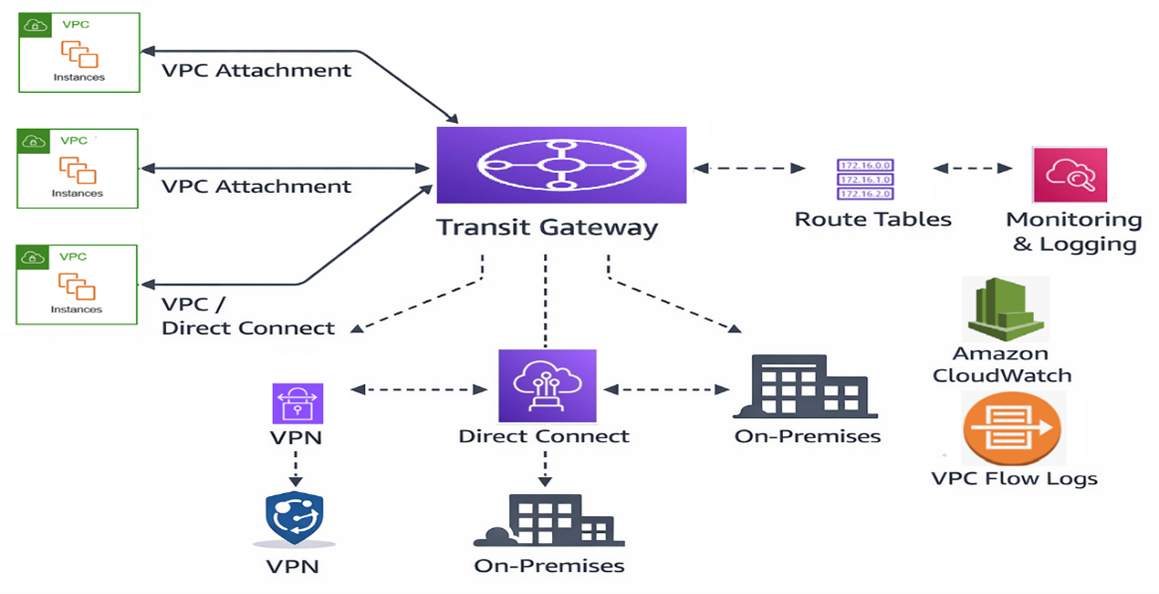
Fig 1: Scalable hub‑and‑spoke connectivity using AWS Transit Gateway.
Why Enterprises Choose AWS Transit Gateway
Compared to traditional networking models, Transit Gateway provides:
- Centralized routing governance
- High scalability for large environments
- Integrated hybrid connectivity
- Support for multicast and inter-region peering.
- Reduced operational complexity.
- Improved security through segmentation
Enterprises prefer TGW because it simplifies network operations while maintaining performance and security at scale.
Transit Gateway Advantage
AWS Transit Gateway is a foundational service for simplifying modern cloud network architectures. By replacing complex VPC peering meshes with a centralized hub-and-spoke model, organizations achieve better scalability, cleaner routing control, and streamlined hybrid connectivity.
With centralized attachments, flexible route tables, and enterprise-grade scalability, Transit Gateway enables secure, efficient, and manageable networking across multi-account, multi-VPC, and hybrid environments.
It is not just a connectivity service; it is the backbone of scalable AWS network design.
Upskill Your Teams with Enterprise-Ready Tech Training Programs
- Team-wide Customizable Programs
- Measurable Business Outcomes
About CloudThat


WRITTEN BY Avinash Singh Bundela
Avinash Singh Bundela is a Subject Matter Expert at CloudThat, specializing in AWS Architecting / AWS DevOps and AWS Security. With 14 years of experience in Training and Consultancy, he has trained over 10000+ professionals/students to upskill in Multiple Technologies. Known for simplifying complex concepts and delivering interactive hands-on sessions, he brings deep technical knowledge and practical application into every learning experience. Avinash’s passion for continuous learning reflects in his unique approach to learning and development.


 PREV
PREV










Comments