

 Login
Login


 March 24, 2026
|
Voiced by Amazon Polly |
Introduction
As organizations rapidly adopt cloud-native technologies, managing cloud costs has become a critical challenge. While the cloud provides unmatched scalability and flexibility, it also introduces unpredictable spending patterns due to dynamic resource provisioning.
Traditional cost management approaches are no longer sufficient in environments driven by Kubernetes, microservices, and auto-scaling systems. This is where FinOps (Financial Operations) comes into play, bringing financial accountability to the cloud.
FinOps is not just about reducing costs; it is about maximizing business value by balancing cost, performance, and reliability. It enables teams to make data-driven decisions, optimize resource utilization, and ensure efficient cloud spending.
In this blog, we explore FinOps principles, architecture, challenges, and best practices to build cost-efficient cloud systems.
Pioneers in Cloud Consulting & Migration Services
- Reduced infrastructural costs
- Accelerated application deployment
Architecture Overview
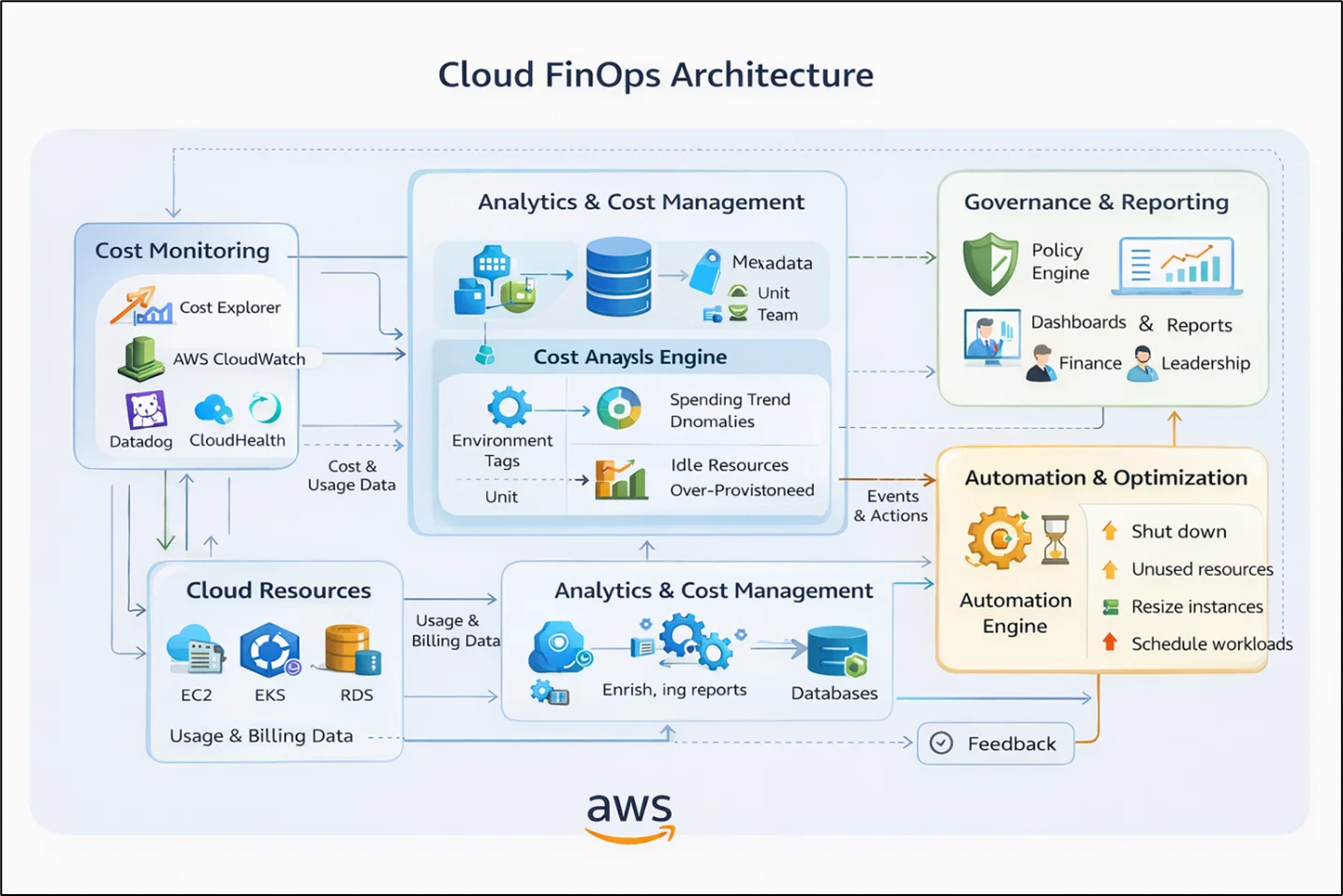
Architecture Explanation:
The architecture represents a cloud FinOps framework designed to provide real-time visibility, cost optimization, and governance.
Cloud resources such as compute (EC2/EKS), storage (S3/EBS), and databases continuously generate usage and billing data.
This data is collected through cost monitoring tools such as AWS Cost Explorer, CloudWatch, and third-party platforms like Datadog or CloudHealth.
The collected data is processed and stored in a centralized analytics layer, where it is enriched with metadata such as environment tags, application ownership, and business units.
A cost analysis engine evaluates spending patterns, identifies anomalies, and highlights optimization opportunities such as idle resources, over-provisioned instances, or inefficient workloads.
Event-driven automation systems trigger actions based on defined rules, for example, shutting down unused resources, resizing instances, or scheduling workloads.
A governance layer enforces policies such as mandatory tagging, budget limits, and resource quotas to maintain financial discipline.
Dashboards and reporting tools provide visibility to stakeholders, enabling engineering, finance, and leadership teams to collaborate effectively.
The Shift: From Cloud Spending to Cloud Efficiency
Traditional cloud usage focuses on:
- Rapid provisioning of resources
- Scaling without strict cost control
- Limited visibility into spending
FinOps shifts the focus toward:
- Cost-aware architecture design
- Continuous cost monitoring
- Shared accountability across teams
Instead of reacting to billing surprises, organizations proactively optimize cloud usage.
Core Pillars of Cloud FinOps
1. Cost Visibility
Understanding where money is being spent is the foundation of FinOps.
Real-time dashboards provide insights into:
- Service-wise cost breakdown
- Environment-level spending (dev/staging/prod)
- Team or application-level usage
2. Cost Optimization
Identifying inefficiencies and optimizing resource usage.
Examples include:
- Rightsizing Amazon EC2 instances
- Removing idle or unused resources
- Using Spot Instances or Savings Plans
3. Automation
Manual cost optimization does not scale.
Automation enables:
- Scheduled shutdown of non-production environments
- Auto-scaling based on demand
- Lifecycle policies for storage cleanup
4. Governance and Accountability
Policies ensure financial discipline across teams.
Examples:
- Mandatory tagging policies
- Budget alerts and thresholds
- Resource usage limits
5. Continuous Improvement
FinOps is an ongoing process.
Teams continuously analyze usage patterns and refine strategies to improve efficiency.
Best Practices for FinOps Implementation
- Implement Tagging Strategy
Tag resources based on:
- Application
- Environment
- Owner
This enables accurate cost allocation.
- Use Reserved and Spot Instances
Optimize compute costs by leveraging:
- Reserved Instances for predictable workloads
- Spot Instances for flexible workloads
- Enable Auto-Scaling
Avoid overprovisioning by dynamically scaling resources based on demand.
- Automate Cost Controls
Use automation for:
- Scheduling shutdowns
- Cleaning unused storage
- Enforcing budget limits
- Build Cost-Aware Culture
Encourage teams to take ownership of cloud costs.
Make cost metrics visible alongside performance metrics.
Outcome of Implementing FinOps
- 30–50% reduction in cloud costs through optimization
- Improved resource utilization across workloads
- Increased transparency in cloud spending
- Faster decision-making with real-time insights
- Better alignment between engineering and finance teams
- Sustainable and scalable cloud operations
Conclusion
As cloud adoption grows, cost management becomes as important as performance and scalability.
In modern cloud environments, FinOps is not optional, it is essential for sustainable growth and operational excellence.
Drop a query if you have any questions regarding FinOps and we will get back to you quickly.
Making IT Networks Enterprise-ready – Cloud Management Services
- Accelerated cloud migration
- End-to-end view of the cloud environment
About CloudThat
FAQs
1. What is FinOps in cloud computing?
ANS: – FinOps is a practice that brings financial accountability to cloud usage, enabling teams to optimize costs while maintaining performance.
2. How is FinOps different from traditional cost management?
ANS: – Traditional cost management is reactive, while FinOps is proactive and continuous, involving engineering, finance, and business teams.
3. What tools are used in FinOps?
ANS: – AWS Cost Explorer, Amazon CloudWatch, Azure Cost Management, GCP Billing, Datadog, and CloudHealth are commonly used.


WRITTEN BY Anusha R
Anusha R is Senior Technical Content Writer at CloudThat. She is interested in learning advanced technologies and gaining insights into new and upcoming cloud services, and she is continuously seeking to expand her expertise in the field. Anusha is passionate about writing tech blogs leveraging her knowledge to share valuable insights with the community. In her free time, she enjoys learning new languages, further broadening her skill set, and finds relaxation in exploring her love for music and new genres.


 PREV
PREV











Comments