

 Login
Login


 June 11, 2026
|
Voiced by Amazon Polly |
Introduction
If you are new to cloud in India and want the fastest path to a job offer, start with AWS Certified Solutions Architect Associate. If you are targeting enterprises running Microsoft infrastructure, go with Azure Administrator Associate (AZ-104). If you are aiming at data engineering or ML roles, Google Associate Cloud Engineer is the strongest entry point. The right certification is not about vendor preference. It is about where the jobs are in your target market.
No Job After Graduation? Cloud Engineering is Your Answer
- Beginner Friendly
- 92% Placement Rate
- Live Instructor-Led
Why Cloud Engineer Certifications Still Matter in 2026
86% of companies report struggling to fill IT roles requiring cloud expertise a figure CloudThat sees reflected directly in enterprise hiring requests. A cloud certification does two concrete things: it proves baseline competency on a specific platform, and it gets your resume past the first recruiter filter.
What it does not do is guarantee a job on its own. Employers have grown sharper about the difference between someone who passed a multiple-choice exam and someone who has built VPCs, configured IAM policies, and debugged a broken CI/CD pipeline at 11 PM. The certification opens the door. Hands-on experience is what gets you hired.
AWS certifications dominate Indian job postings in volume. Azure certifications lead in enterprise and consulting firms. GCP certifications are climbing fast in data and ML-focused roles. Pick based on where you want to work, not which logo you prefer.
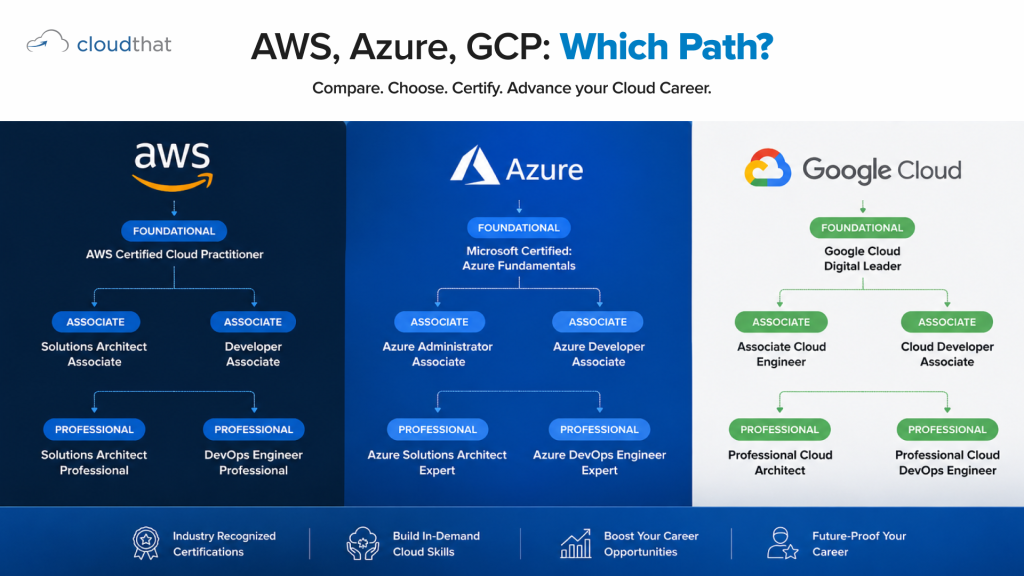
AWS Certification Path: When to Start Here
AWS holds the largest share of the global cloud infrastructure market. If you are targeting startups, SaaS companies, or tech-heavy enterprises, AWS is statistically the most likely platform you will encounter in interviews.
AWS Certified Solutions Architect Associate is the most requested entry-level certification for cloud engineers in India. It covers EC2, S3, RDS, VPC, IAM, Lambda, and CloudFormation, the services that appear in practically every cloud engineering job description. It is the right starting point if you are moving from sysadmin, IT support, or development into cloud.
AWS Certified SysOps Administrator Associate is the operations-focused path. It goes deeper into monitoring, logging, deployment automation, and incident response. If your background is in IT operations or DevOps, this path fits better than the Solutions Architect track.
Once you clear an Associate certification, AWS Certified DevOps Engineer Professional or AWS Certified Solutions Architect Professional becomes the natural next step for senior roles.
CloudThat’s AWS Mastery Pass covers 35+ AWS courses, including Solutions Architect, SysOps, Developer Associate, and specialty tracks including Security and Machine Learning, with one-year access, live sessions, and hands-on labs in real AWS environments. EMI starts at ₹4,999 a month.
Azure Certification Path: Who This Works Best For
Azure certifications make the most sense when you are targeting enterprises, consulting firms, or organizations running Microsoft infrastructure. Think companies operating Active Directory, Office 365, Dynamics 365, or hybrid environments that connect on-premises Windows Server to Azure.
Azure Administrator Associate (AZ-104) is the real starting line for cloud engineers in this ecosystem. It covers virtual machines, storage accounts, Azure Active Directory, virtual networks, Azure Monitor, and disaster recovery. Most Azure-focused roles in India’s IT services sector specify AZ-104 as the baseline requirement.
Skip Azure Fundamentals (AZ-900) unless your organization requires it. It is non-technical and does not signal engineering readiness to hiring managers.
Azure Solutions Architect Expert (AZ-305) is the next step for engineers designing large-scale Azure environments. It builds on AZ-104 and adds governance, security architecture, data platform design, and business continuity planning.
Azure certifications consistently appear in job descriptions at Accenture, Deloitte, HCL, and other Fortune 500 captives operating out of India. If you are targeting IT services or enterprise consulting roles, Azure is often a stronger first investment than GCP.
CloudThat’s Azure Mastery Pass covers 17 Azure certifications at ₹49,900, with instructor-led training from CloudThat’s Microsoft Partner-certified trainers: engineers who deploy Azure in production, not just prep students for exams.
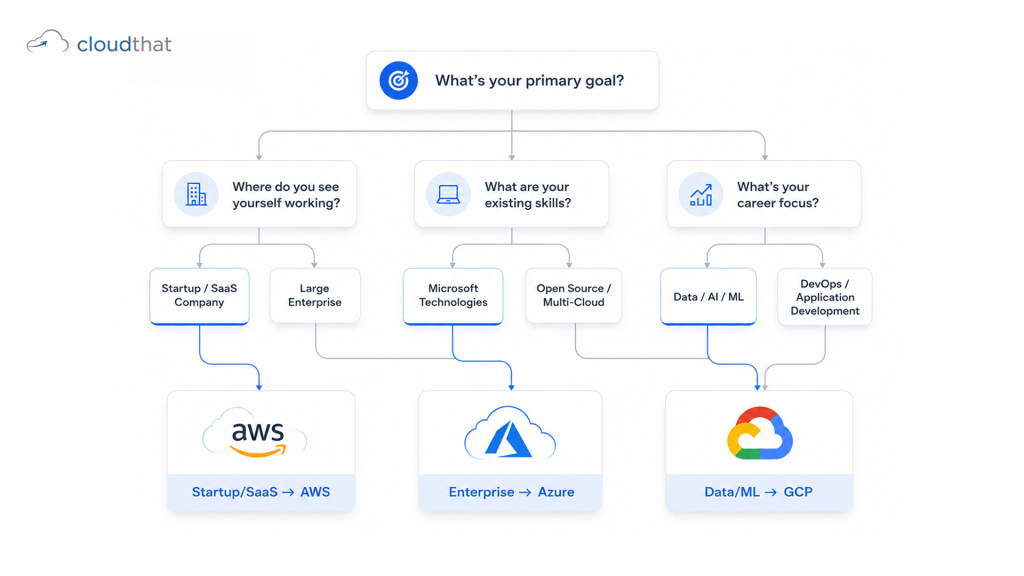
GCP Certification Path: The Underrated Option
GCP certifications are less saturated than AWS or Azure, which works in your favor if you are targeting the right roles. Google Cloud is heavily used in data engineering, ML, and by companies building Kubernetes-native architectures.
Google Associate Cloud Engineer is the entry point. It covers Compute Engine, Cloud Storage, Cloud SQL, VPC networking, IAM, and Kubernetes Engine. This certification makes sense if you are targeting data-heavy companies, ML engineering teams, or organizations that use BigQuery, Vertex AI, or other Google-native services.
Google Professional Cloud Architect is an advanced certification and one of the higher-paying cloud certifications globally. It focuses on distributed systems design, hybrid architectures, and GCP cost optimization.
GCP certifications appear less frequently in general cloud engineer postings, but competition is lower when they do. If your target companies are Google Cloud partners or SaaS startups building on GCP, this path is worth prioritizing over AWS or Azure.
CloudThat offers GCP training across 76 courses, including Associate Cloud Engineer, Professional Cloud Architect, Data Engineer, and Security Engineer tracks.
What a Cloud Engineer Certification Actually Costs
Exam fees range from ₹7,500 to ₹25,000 per attempt, depending on the vendor and level. Training costs vary significantly based on the format you choose.
Here is the actual cost picture across the main options:
Exam fees (approximate, 2026):
- AWS Associate exams: ~₹14,000 per attempt
- AWS Professional and Specialty exams: ~₹25,000 per attempt
- Azure exams (AZ-104, AZ-305): ~₹7,500–₹11,000 per attempt
- Google Cloud Associate and Professional exams: ~₹14,000 per attempt
Training costs:
- Self-paced platforms (Udemy, A Cloud Guru): ₹5,000–₹20,000 per course
- CloudThat AWS Mastery Pass: ₹1,14,900 for 35+ AWS courses, one year of access, live instruction, and hands-on labs. EMI available from ₹4,999 a month.
- CloudThat Azure Mastery Pass: ₹49,900 for 17 Azure certifications
- CloudThat DevOps Mastery Pass: ₹74,900 for the full DevOps track
Hidden costs most people miss: Retake fees (most exams allow retakes at full price), AWS Sandbox costs if you are not using a managed lab environment, and the opportunity cost of 3–6 months spent on a certification that does not align with your target job market.
Outcome-based programs like the Job Ready Cloud Operations Engineer Program include lab environments, retake preparation, and placement support in a single cost, which often works out cheaper than stitching together free content, a Udemy course, and a certification prep book, and still not having a job at the end.
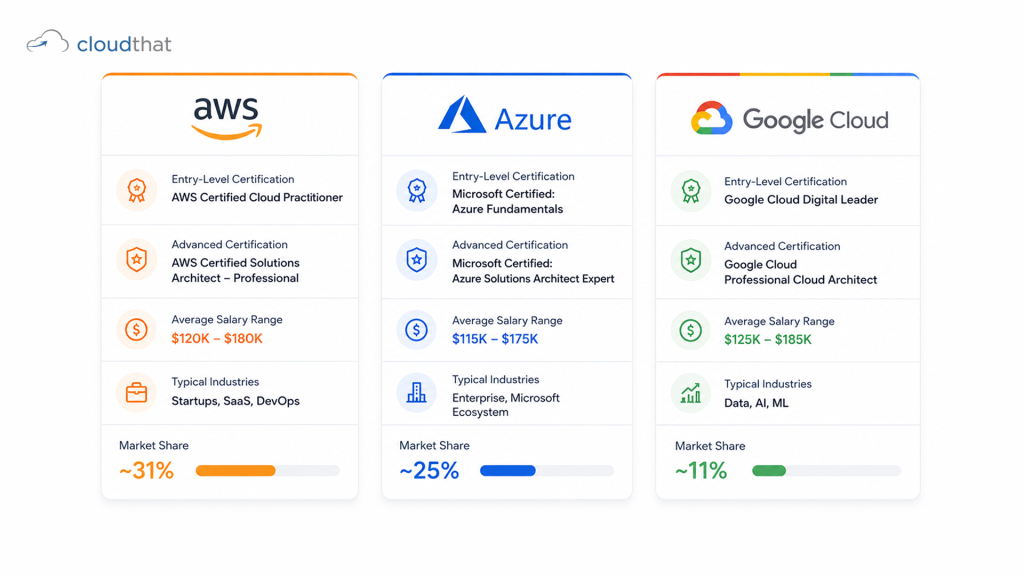
How to Pick the Right Cloud Certification for Your Career Stage
New to cloud: Start with AWS Certified Solutions Architect Associate or Azure Administrator Associate (AZ-104). Both are entry-level but respected enough to open doors. Choose AWS for startups and tech companies. Choose Azure for enterprises and IT services firms.
Already in IT operations or support: Go straight to AWS SysOps Administrator or Azure Administrator. Skip the fundamentals-level certifications. You already understand networking, storage, and compute you just need to map those concepts to cloud services.
Developer moving into cloud engineering: AWS Certified Developer Associate or Azure Developer Associate (AZ-204) are better starting points. They focus on deploying applications, working with APIs, and using serverless functions, which aligns with an existing development background.
Aiming for high-paying roles: AWS Certified Solutions Architect Professional and Google Professional Cloud Architect consistently rank among the highest-paying certifications according to the Global Knowledge IT Skills and Salary Report. Both require Associate-level experience first. Jumping to Professional without understanding core services produces exam failure and wasted spend.
Wanting job-readiness, not just a certificate: The certification is the floor, not the ceiling. Programs like CloudThat’s Job Ready Cloud Operations Engineer Program combine certification training with hands-on projects, real-world troubleshooting scenarios, and placement assistance. A certificate proves you passed an exam. A job-ready program proves you can configure production environments.
Stick to one cloud provider for the first year. Multi-cloud experience makes sense after two or more years of single-cloud depth, not before.
What Employers Actually Look for Beyond the Certificate
A cloud certification is a filter, not a hiring decision.
Employers expect hands-on experience with the services you are certified in. That means building and troubleshooting VPCs, configuring IAM policies with least-privilege principles, deploying containerized workloads, setting up CI/CD pipelines, and responding to real incidents. The gap between passing an exam and being job-ready is where most certified candidates get stuck.
This is why CloudThat builds 50–60% hands-on lab time into every course. Engineers work through scenarios like configuring multi-tier VPCs, deploying containerized applications on EKS, setting up disaster recovery for RDS databases, and implementing monitoring with CloudWatch and Prometheus. These are the same patterns that appear in production environments. The AWS Well-Architected Framework documentation outlines exactly what production teams are expected to know, and CloudThat’s curriculum maps directly to it.
Certifications combined with documented projects on GitHub make a far stronger case than a certificate alone.
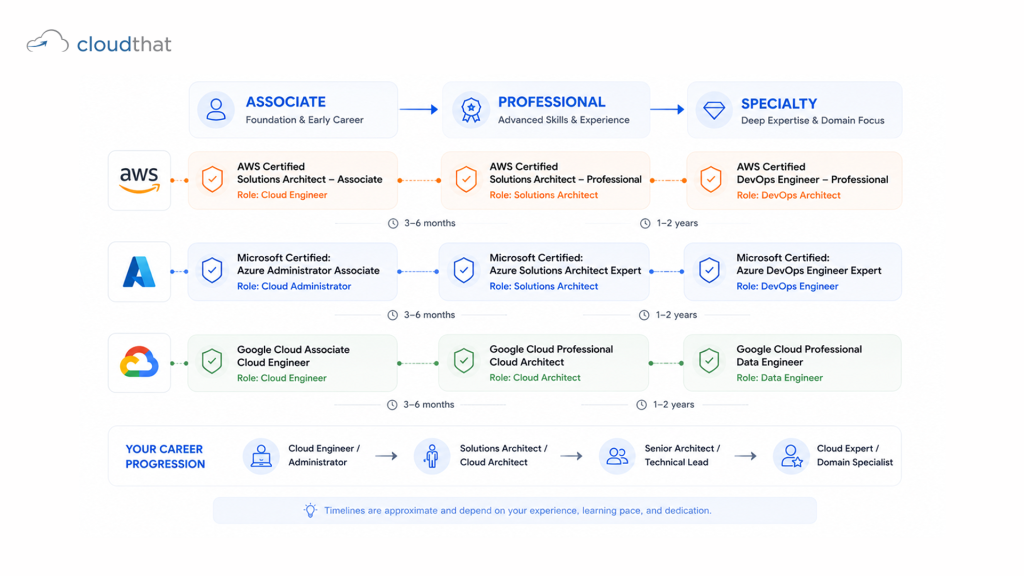
Why CloudThat Is the Best Choice for Cloud Certification Training
CloudThat is an AWS Premier Tier Services Partner, the highest tier in the AWS Partner Network, which means the engineers teaching AWS certifications are the same people running real cloud migrations and production deployments for enterprises. Not freelancers recording generic videos. Trainers hold 1,000+ cloud certifications internally, across AWS, Azure, GCP, and NVIDIA.
The AWS Mastery Pass covers 35+ courses, including Solutions Architect, SysOps, DevOps Engineer, and specialty tracks. One-year access. Live sessions. Hands-on labs using actual AWS services, not simulations. EMI from ₹4,999 a month.
The Azure Mastery Pass includes 17 certifications from AZ-104 through AZ-305. CloudThat is a Microsoft Partner, so the training reflects how Azure actually gets implemented in enterprise environments, not how it appears in exam prep slides.
For engineers who want job-readiness beyond exam prep, the Job Ready Cloud Operations Engineer Program combines certification training with real-world troubleshooting scenarios, capstone projects, and placement support. For exam-specific preparation, testprep.cloudthat.com covers practice tests across AWS, Azure, and Google Cloud.
Conclusion
Picking the right cloud engineer certification comes down to one question: where are the jobs you want, and what platforms do those companies run?
AWS certifications open the most doors across startups and tech companies. Azure certifications dominate enterprise and consulting roles. GCP certifications are climbing fast in data engineering and ML positions. Whatever you choose, the certification is the starting line. Hands-on experience and shipped projects are what close the gap between passing an exam and landing the role.
Ready to start? Explore the AWS Mastery Pass, Azure Mastery Pass, or the Job Ready Cloud Operations Engineer Program to build job-ready skills with live instruction and hands-on labs from certified practitioners.
Key Takeaways
- AWS certifications lead in Indian job posting volume; Azure certifications dominate enterprise roles; GCP certifications are strongest in data and ML positions.
- The right certification depends on target companies, not vendor preference. Map your choice to where the jobs actually are.
- Exam fees range from ₹7,500 to ₹25,000 per attempt; hidden costs like retakes and sandbox environments add up faster than most people plan for.
- Associate-level certifications are the correct starting point for cloud career switchers. Skip Fundamentals-level exams unless your organization requires them.
- Hands-on lab work and shipped GitHub projects matter more to employers than the certificate itself.
- Multi-cloud certification only makes sense after 2+ years of single-cloud depth, not at the fresher or early-career stage.
- Job-ready programs that combine certification prep with live labs and placement support close the gap between passing an exam and landing a role.
- AWS Certified Solutions Architect Professional and Google Professional Cloud Architect consistently rank among the highest-paying certifications, but both require solid Associate-level experience first.
- CloudThat’s trainers are practicing consultants, not freelancers. They are the same engineers who deploy production environments on AWS, Azure, and GCP.
- A certification opens the door; real troubleshooting experience and documented projects are what get you hired.
Already in IT? Switch to Cloud & Earn 55% More
- Weekend Batches
- Dedicated Career Support
- Official AWS Labs
About CloudThat
FAQs
1. What certificates do I need to be a cloud engineer?
ANS: – Start with one Associate-level certification from AWS, Azure, or GCP based on your target job market. In India, AWS Certified Solutions Architect Associate is the most requested. Add a second certification after 12–18 months of hands-on experience.
2. Which cloud certification is best for getting a job in India?
ANS: – AWS Certified Solutions Architect Associate leads in volume of job postings. Azure Administrator Associate (AZ-104) is the dominant ask at enterprise IT services firms. Pick based on where you want to work, not which exam is cheaper.
3. What does a cloud certification actually pay in India?
ANS: – Based on Naukri.com and AmbitionBox salary data (2025–2026): freshers with an AWS or Azure Associate certification and real projects start between ₹6–12 LPA. Mid-level engineers with 3–5 years and a Professional certification earn ₹14–28 LPA. Senior cloud architects cross ₹30 LPA at product companies.
4. Can I become a cloud engineer in 3 months?
ANS: – If you already have IT experience, you can clear an Associate certification in 3 months. Becoming genuinely job-ready with hands-on project work and troubleshooting experience typically takes 6–9 months. For career switchers from outside tech, 9–12 months is realistic.
5. Can I learn AWS in 3 months?
ANS: – You can prepare for the Associate exam in that window with structured training. Real-world proficiency, meaning the ability to architect, deploy, and debug production workloads, comes through hands-on lab work and takes longer. The exam and the job are two different things.
6. Is multi-cloud certification worth it for freshers?
ANS: – No. Multi-cloud experience makes sense after 2+ years of deep single-cloud work. Freshers who try to learn AWS, Azure, and GCP simultaneously rarely build the depth employers are looking for in any of them.
7. What is the difference between AWS Premier Tier and Advanced Tier partners?
ANS: – Premier Tier is AWS’s highest partner designation, requiring the most verified customer deployments, certified staff, and competency validations. It signals that CloudThat is running real enterprise migrations at scale, not just teaching the theory of how they work.
8. Do online cloud certifications count for enterprise jobs?
ANS: – Vendor certifications (AWS, Azure, GCP) are what enterprise employers check, not platform completion certificates from Udemy or Coursera. The former requires passing a proctored exam. The latter requires finishing a video course. They carry very different weight on a resume.

WRITTEN BY Himisha Raval
Himisha Raval is a Digital Marketing Manager at CloudThat with a strong command of search engine optimization, web analytics, link building, and content strategy. She brings a data-driven approach to digital marketing, helping IT companies strengthen their online presence, improve search rankings, and generate consistent leads across channels. Beyond execution, she plays an active role in ideation, campaign strategy, and website performance optimization. Outside of work, she balances her analytical side with a love for travel, nature painting, and dancing.


 PREV
PREV










Comments