

 Login
Login


 June 11, 2026
|
Voiced by Amazon Polly |
Introduction
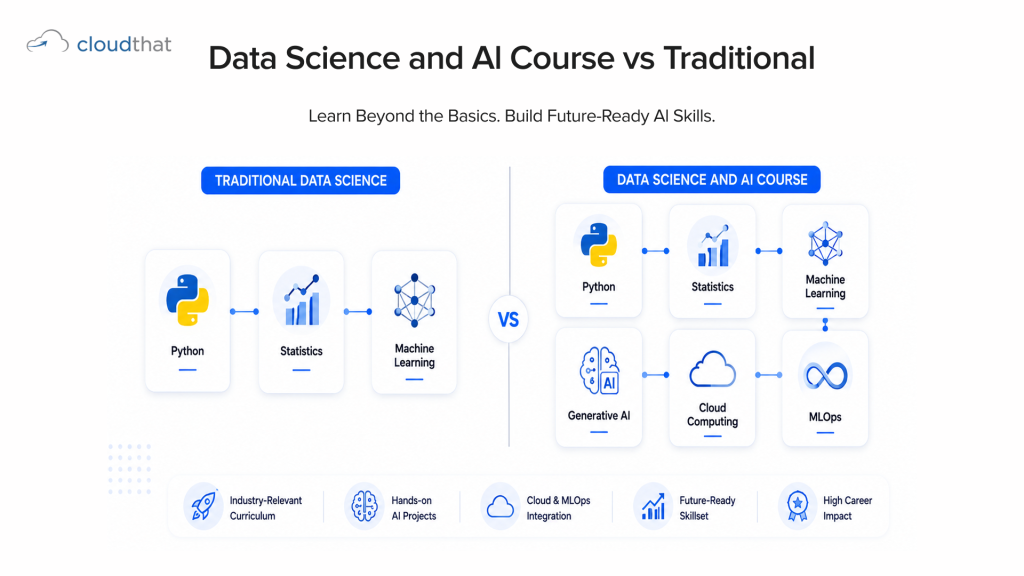
A traditional data science course covers Python, statistics, and machine learning. A data science and AI course adds generative AI, cloud ML platforms (AWS SageMaker, Azure Machine Learning), MLOps, and agentic AI workflows on top of that foundation. In 2026, most mid-level and senior data science job descriptions now require at least one of those additions. If you are a working professional or switching into data roles, the AI course is the more future-proof path.
Here is what nobody tells you when you start comparing these two.
A traditional data science course and a data science and AI course often look nearly identical on a syllabus. Both have Python. Both have statistics. Both mention machine learning somewhere in the middle. Then you finish the program, apply for jobs, and realize that what separated the two was not the syllabus. It was what was actually taught, how deep it went, and whether GenAI was treated as a module or a mindset.
If you are deciding between the two in 2026, this breaks it down clearly.
Launch Your AI Career with AWS GenAI Training
- Interview Guarantee
- Up to 75% Money Back
- Real-World Learning
What a Traditional Data Science Course Actually Covers
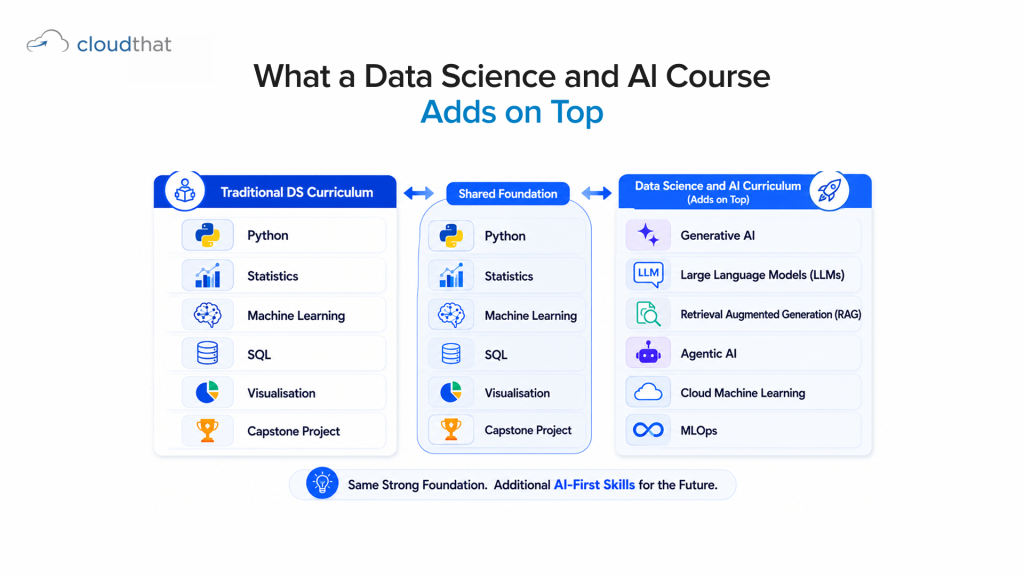
Traditional data science programs were built around a specific workflow: collect data, clean it, analyze it, model it, and present findings. The core curriculum looks like this:
- Python and R for data manipulation
- Statistics and probability
- Exploratory data analysis and visualization
- Supervised and unsupervised machine learning
- SQL and basic data engineering
- A capstone project using a public dataset
This is solid. For roles like data analyst, business intelligence analyst, or junior data scientist at a company not doing cutting-edge ML work, this foundation still holds up.
The problem is that job descriptions for data scientists have shifted. Companies are no longer asking for someone who can build a regression model on their own. They want people who can work with LLMs, deploy models on cloud platforms, and build or integrate AI-powered features into real products. A traditional data science course built three or four years ago has not caught up with this.
What a Data Science and AI Course Adds on Top
A data science and AI course starts with the same foundations but goes further into the territory that traditional programs either skim or skip.
Generative AI and LLMs: working with large language models, prompt engineering, retrieval-augmented generation (RAG), and multi-agent systems. According to McKinsey’s State of AI report, GenAI adoption has more than doubled year on year, and it is showing up in job requirements across data roles, not just dedicated AI engineer roles.
Agentic AI Workflows: building systems where AI models take sequential actions, call tools, and handle multi-step tasks without constant human input. This is the direction enterprise AI is moving.
Cloud-Specific AI Tools: AWS SageMaker, Azure Machine Learning, and Google Vertex AI are where models get deployed in the real world. A course that includes hands-on lab time inside these platforms produces a very different graduate from one that teaches algorithms in isolation.
MLOps and Model Deployment: taking a model from a notebook to a production endpoint, monitoring it, and retraining it when performance drifts. This is the gap between someone who can build a model and someone who can operate one.
The Skills Gap That Is Showing Up in Hiring Right Now
Hiring managers at mid- to large enterprises are filtering for a specific combination: statistical thinking plus the ability to work with modern AI tooling. A candidate who can explain gradient descent but has never touched a cloud ML platform or worked with an LLM API is getting deprioritized.
A few signals from job descriptions right now:
- “Experience with LLM APIs (OpenAI, Bedrock, or similar)” is appearing in data scientist listings, not just AI engineer roles
- “Deployed models in a cloud environment” has become a near-standard requirement for mid-level data science roles
- “Familiarity with MLOps practices” shows up in junior and mid-level postings at a frequency that was not there two years ago
People coming out of traditional data science courses are not unqualified. They are missing the second layer. A well-designed data science and AI program puts that second layer in place before the job search starts.
Which One Should You Choose Based on Where You Are
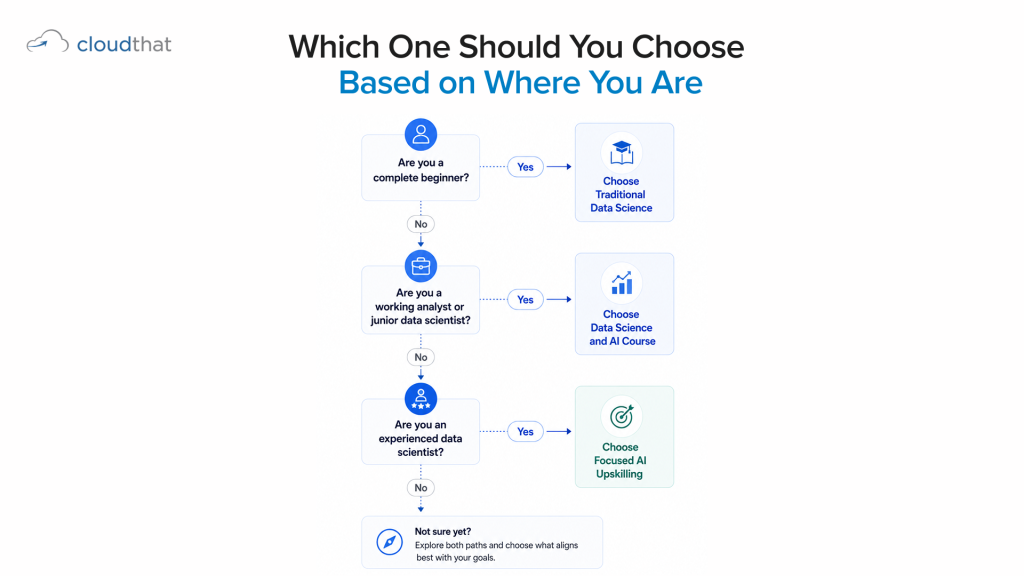
Complete beginner with no coding background. Start with a traditional data science program. Build Python fluency, understand statistics, and get comfortable with the data workflow before adding GenAI complexity. Jumping into LLMs without ML foundations creates gaps that show up in interviews.
Working analyst or junior data scientist. A data science and AI course is exactly what you need. You already have the base. Adding cloud ML, GenAI tools, and MLOps is what moves you from analyst-level to mid-level data scientist compensation.
Experienced data scientist who trained two to three years ago. Your traditional skills are not obsolete. A focused upskilling track covering GenAI and cloud deployment would meaningfully extend what you can offer. You do not need another full program. The AI layer is what moves the needle.
Corporate cohort decision. Analysts need the data science foundation. Engineers working on AI product features need the full data science and AI curriculum. A program that runs a pre-training skill assessment and customizes pathways per role is significantly more efficient than sending everyone through the same content.
What Does a Data Science and AI Course Cost, and Is It Worth It
Traditional data science courses: Self-paced platforms start from under Rs. 5,000. Instructor-led programs run Rs. 30,000 to Rs. 70,000 and typically take 3 to 6 months.
Data science and AI courses: Structured programs with live instruction, cloud lab access, and job support typically run Rs. 80,000 to Rs. 1,50,000 and take 6 to 9 months. University-backed programs go higher.
The question is not which one is cheaper. A Rs. 40,000 traditional data science course will not get you to ML engineer-level compensation if the market is asking for GenAI and cloud deployment experience. A well-structured data science and AI course may cost more upfront, but return the difference in the first salary increment.
- Entry-level data analyst / junior data scientist: Rs. 5 LPA to Rs. 9 LPA
- Mid-level data scientist with ML and cloud exposure: Rs. 12 LPA to Rs. 22 LPA
- AI specialists and GenAI engineers with deployment experience: Rs. 20 LPA to Rs. 35 LPA and above in product companies
The premium is real, and it goes to professionals who can bridge statistical data science with applied AI. Before committing to a full paid program, use Google Cloud Skills Boost free labs to test your comfort level with cloud AI environments.
Why CloudThat Bridges the Gap Between Traditional Data Science and Applied AI
Most programs teach you one or the other. CloudThat’s training is built around what the market is asking for in 2026: data science foundations plus hands-on AI implementation on real cloud infrastructure. The instructors are the same engineers running production GenAI deployments for enterprise clients on AWS and Azure, not career educators working from slides.
The Integrated Program in AI and Data Science covers the complete path: Python, ML fundamentals, deep learning, Azure Machine Learning, and GenAI tools including RAG pipelines and agentic AI workflows, with every lab running inside actual Azure cloud environments.
For corporate cohorts, the Capability Development Framework handles role-based pathway design and post-training project readiness validation. Cohorts do not sit through the same content regardless of their starting point. The framework runs a pre-training skill assessment and customizes delivery from there. The same model took Protiviti’s fresh hires from onboarding to billable in 45 days.
CloudThat’s GenAI Innovation Center runs active Bedrock and Azure OpenAI implementations for enterprise clients, and that production context feeds directly into the curriculum. AWS Premier Tier Services Partner status, competencies in Machine Learning and MLOps, and over 1.1 million professionals trained across 30 countries back the credibility. These are audited credentials, not badges.
Conclusion
The decision comes down to one question: what does the job you want actually require right now? If the answer includes cloud deployment, GenAI tooling, or MLOps alongside statistical modeling, a traditional data science course alone does not get you there.
To see how a job-ready data science and AI path is structured, explore CloudThat’s AI and Data Science programs or talk to the team about corporate upskilling options for your organization.
Key Takeaways
- A data science and AI course covers everything a traditional course does, plus GenAI, cloud ML platforms, and MLOps.
- The skills gap in hiring right now is not about ML knowledge. It is about cloud deployment and familiarity with GenAI.
- Beginners should build Python and ML fundamentals before jumping into the complexity of GenAI.
- Working analysts and junior data scientists benefit most from adding the AI layer to their existing skills, rather than starting from scratch.
- Experienced data scientists do not need a full new program. A focused GenAI and cloud upskilling track moves the needle.
- Corporate cohorts need role-based pathways to avoid sending analysts and engineers through the same content.
- Entry-level salaries start at Rs. 5-9 LPA; mid-level with cloud and AI exposure reach Rs. 12-22 LPA; AI specialists with deployment experience can cross Rs. 30 LPA (AmbitionBox, Glassdoor 2025 data).
- Program costs range from Rs. 30,000 for self-paced to Rs. 1,50,000 for live instructor-led with cloud labs. Match the investment to the outcome you are chasing.
- Self-paced platforms have low completion rates. Live instructor-led training with project work produces better job outcomes.
- The salary premium in 2026 goes to data professionals who can work across both statistical data science and applied AI implementation.
Become an AI Engineer with AWS GenAI Training
- Mock Interviews
- AWS Expert Trainers
- Career Support
About CloudThat
FAQs
1. Which course is best for data science and AI in 2026?
ANS: – For working professionals, an instructor-led program covering Python, machine learning, deep learning, GenAI tools, and cloud deployment on AWS or Azure is the strongest option. Certifications like Azure AI-102 and AWS Machine Learning Specialty add employer-recognized validation on top.
2. Can I do data science with AI?
ANS: – Yes, and in 2026, you largely need to. Modern data scientist roles expect familiarity with LLM APIs, cloud ML platforms, and model deployment workflows. Pure statistical data science without exposure to AI is becoming a narrower skill set.
3. Can I learn AI and data science in 3 months?
ANS: – You can build a working foundation in 3 months. Reaching job-readiness, with a portfolio of real projects, cloud certification, and ML deployment experience, realistically takes 6 to 9 months of structured learning.
4. What should I study first in data science and AI?
ANS: – Python and statistics are non-negotiable starting points. Then move to machine learning fundamentals, then cloud ML platforms and GenAI tooling. Jumping to LLMs without ML foundations creates gaps that show up in technical interviews.
5. Which has a higher salary, AI or traditional data science?
ANS: – Roles at the intersection, where data scientists can also work with GenAI tools and deploy models in cloud environments, earn more than either pure category. The salary premium in 2026 goes to professionals who can bridge both.
6. What AI tools matter most for data science roles right now?
ANS: – AWS SageMaker, Azure Machine Learning, and Google Vertex AI for deployment. Scikit-learn and PyTorch or TensorFlow for model building. Bedrock or Azure OpenAI for GenAI integration. Python and SQL remain foundational across all of these.
7. Is AI replacing data scientists?
ANS: – No. AI is automating routine data preparation and reporting tasks. The roles that remain, including architecture, model evaluation, production deployment, and GenAI integration, still need human judgment and are paying more than before.

WRITTEN BY Himisha Raval
Himisha Raval is a Digital Marketing Manager at CloudThat with a strong command of search engine optimization, web analytics, link building, and content strategy. She brings a data-driven approach to digital marketing, helping IT companies strengthen their online presence, improve search rankings, and generate consistent leads across channels. Beyond execution, she plays an active role in ideation, campaign strategy, and website performance optimization. Outside of work, she balances her analytical side with a love for travel, nature painting, and dancing.


 PREV
PREV










Comments