

 Login
Login


 March 24, 2026
|
Voiced by Amazon Polly |
Introduction
Modern DevOps has successfully automated deployments, scaling, and infrastructure provisioning. Yet, most systems today still depend heavily on human intervention for incident response, optimization, and recovery.
As systems grow more distributed and complex, spanning Kubernetes clusters, microservices, and multi-cloud environments, manual operations become a bottleneck. The next evolution in DevOps is not just automation, but autonomy.
Autonomous DevOps introduces systems that can detect issues, make decisions, and take corrective actions without human intervention. By combining observability, AI-driven insights, and event-driven automation, organizations can move toward self-healing and self-optimizing platforms.
In this blog, we explore how to design autonomous DevOps systems, their architecture, key components, challenges, and best practices.
Pioneers in Cloud Consulting & Migration Services
- Reduced infrastructural costs
- Accelerated application deployment
Architecture Overview
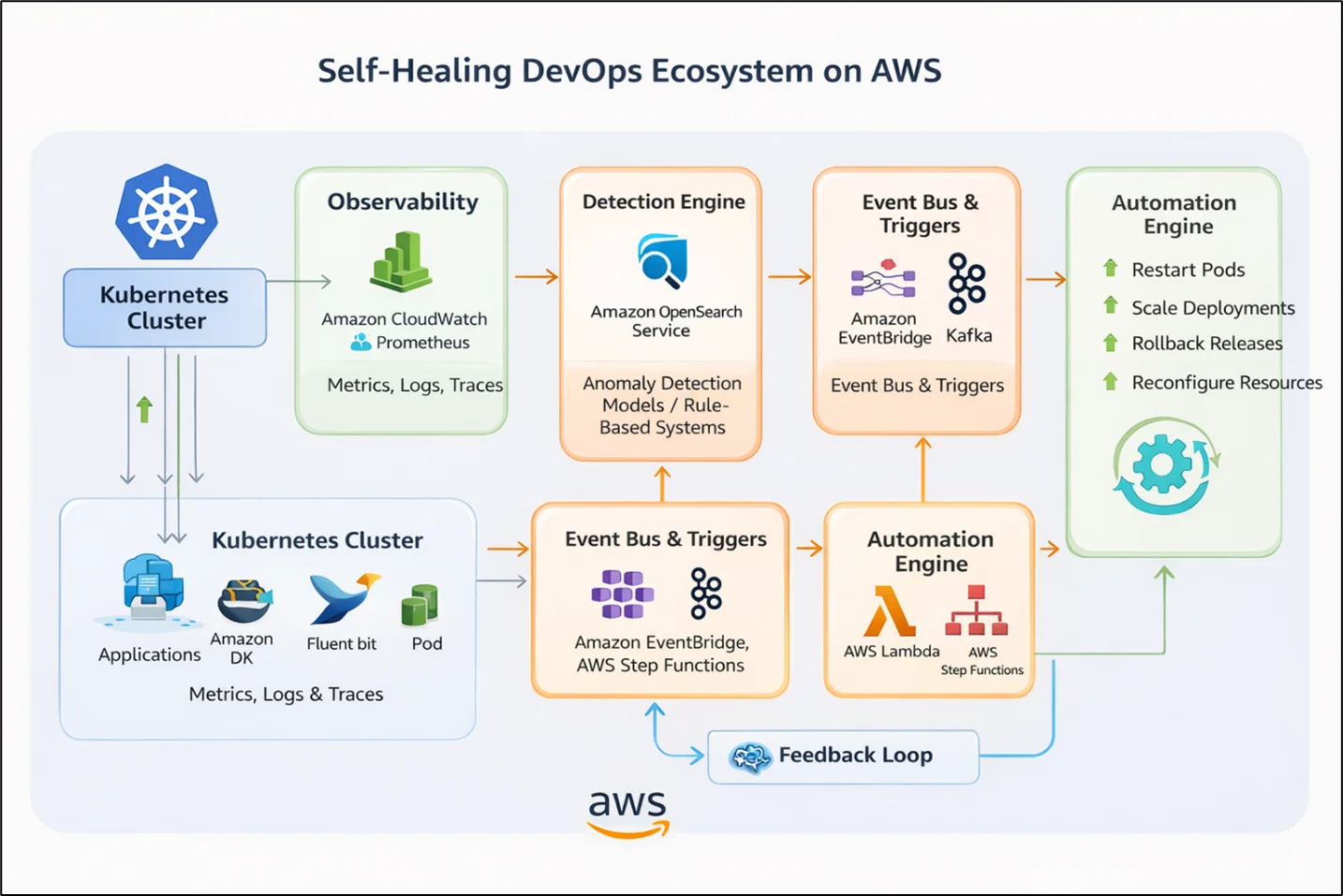
Architecture Explanation:
The architecture demonstrates a self-healing DevOps ecosystem built on Kubernetes and cloud-native tooling.
Applications and infrastructure emit telemetry data, logs, metrics, and traces, which are collected through observability tools such as Prometheus, OpenTelemetry, and Fluent Bit.
This telemetry is fed into an analytics engine that could power anomaly detection models or rule-based systems. These engines identify abnormal patterns, such as latency spikes, increased error rates, or resource saturation.
Event-driven systems like Kafka, AWS EventBridge, or Argo Events act as the backbone for triggering automated workflows when anomalies are detected.
Automation engines, such as Kubernetes operators, AWS Lambda, or Argo Workflows, execute remediation actions. These may include restarting pods, scaling deployments, rolling back releases, or reallocating resources.
A policy layer ensures that all automated actions comply with governance and safety constraints, preventing unintended consequences.
Over time, the system learns from historical incidents, improving its response accuracy and reducing false positives.
The Shift: From Reactive DevOps to Autonomous Systems
Traditional DevOps focuses on:
- Monitoring alerts
- Manual debugging
- Human-driven incident resolution
Autonomous DevOps shifts this model toward:
- Proactive anomaly detection
- Automated root cause analysis
- Self-healing actions
Instead of waiting for alerts, systems continuously analyze behavior and respond in real time.
Core Pillars of Autonomous DevOps
1. Deep Observability
Autonomy begins with visibility.High-quality telemetry (metrics, logs, traces) provides the context required for intelligent decision-making.Without observability, automation becomes blind and risky.
2. Intelligent Detection
Anomaly detection systems identify deviations from normal behavior.This can include:· Sudden traffic spikes
· Increased latency
· Memory leaks
· Unusual error patternsMachine learning models or statistical baselines help distinguish real issues from noise.
3. Event-Driven Automation
Events act as triggers for action.Instead of static scripts, systems respond dynamically to real-time conditions using event-driven architectures.
4. Self-Healing Mechanisms
Automated remediation actions include:· Restarting failed services
· Scaling workloads
· Rolling back faulty deployments
· Reconfiguring infrastructureThese actions reduce downtime and eliminate the need for manual intervention.
5. Continuous Learning
Systems improve over time by learning from past incidents.Feedback loops help refine detection models and automation workflows.
Best Practices for Building Autonomous DevOps
- Start with Rule-Based Automation
Before introducing AI, implement deterministic automation for common scenarios.
Example: Auto-restart pods on failure or scale based on CPU thresholds.
- Implement Guardrails
Define policies to limit automation scope.
Ensure that critical actions require validation or fallback mechanisms.
- Use Progressive Automation
Gradually move from manual → semi-automated → fully autonomous systems.
- Integrate with CI/CD Pipelines
Enable automated rollback if deployments degrade performance.
Combine observability signals with deployment strategies.
- Build Feedback Loops
Capture incident data and continuously refine automation logic.
Outcome of Implementing Observability
- 60% reduction in incident response time
- Significant decrease in manual intervention during outages
- Improved system reliability and uptime
- Faster recovery through automated remediation
- Reduced on-call fatigue for DevOps teams
- Increased operational efficiency at scale
Conclusion
DevOps has evolved from manual operations to automation, and now to autonomy.
Autonomous DevOps represents the next frontier, where systems not only run themselves but also heal and optimize continuously.
As cloud-native complexity continues to grow, autonomy will no longer be optional, it will be essential.
Drop a query if you have any questions regarding DevOps and we will get back to you quickly.
Empowering organizations to become ‘data driven’ enterprises with our Cloud experts.
- Reduced infrastructure costs
- Timely data-driven decisions
About CloudThat
FAQs
1. Is Autonomous DevOps the same as AIOps?
ANS: – Not exactly. AIOps focuses on using AI for insights, while Autonomous DevOps extends it to automated decision-making and action.
2. Can this be implemented without machine learning?
ANS: – Yes. Many self-healing systems start with rule-based automation before incorporating AI.
3. What tools support autonomous DevOps?
ANS: – Prometheus, OpenTelemetry, Argo Events, Kubernetes Operators, AWS Lambda, and Datadog are commonly used.


WRITTEN BY Sourabh Murgod
Sourabh Murgod works as a Research Associate at CloudThat, focusing on AWS, Kubernetes, and DevOps engineering. He is passionate about designing scalable cloud architectures, automating infrastructure, and optimizing production workloads.


 PREV
PREV











Comments