

 Login
Login


 May 21, 2026
|
Voiced by Amazon Polly |
Introduction
Data drives today’s world, and enterprises generate huge volumes of structured and semi-structured data daily. But analyzing this data quickly often eludes business teams, as traditional dashboards and SQL-based reporting require technical expertise. The challenge has created a growing need for intelligent conversational analytics systems that allow users to ask questions in natural language and get insights in real time.
With the power of Python Pandas, Large Language Models (LLMs), and Amazon Bedrock, enterprises can now build enterprise-grade AI data chatbots that understand business questions, analyze datasets, and generate meaningful insights in real time.
Start Learning In-Demand Tech Skills with Expert-Led Training
- Industry-Authorized Curriculum
- Expert-led Training
Overview
Pandas Agent
Pandas Agent is an AI-enabled system that lets users interact with Pandas DataFrames using natural language rather than writing Python code manually.
For example, users may ask questions like:
- “What product generated the most revenue?”
- “Find customers that have had failed transactions”
- “How much is it growing month over month?”
The AI model takes natural language questions and generates executable Pandas operations, returning results immediately.
This approach is much more accessible to non-technical users, such as:
- Analysts business
- Finance departments
- Operations management
- Marketing teams
- Executives
Amazon Bedrock
Amazon Bedrock is a fully managed AWS service that provides access to a variety of foundation models from multiple AI providers, including:
- Anthropic Claude
- Amazon Titan
- Meta Llama
- AI21 Labs
It enables businesses to build secure generative AI applications without managing infrastructure or training models from scratch.
Why use Pandas Agent with Amazon Bedrock?
The combination yields:
Enterprise data interaction in natural language
- Scalable AI capabilities in the cloud
- Enterprise-grade security deployment
- Better reporting and analytics
- Less reliance on technical teams
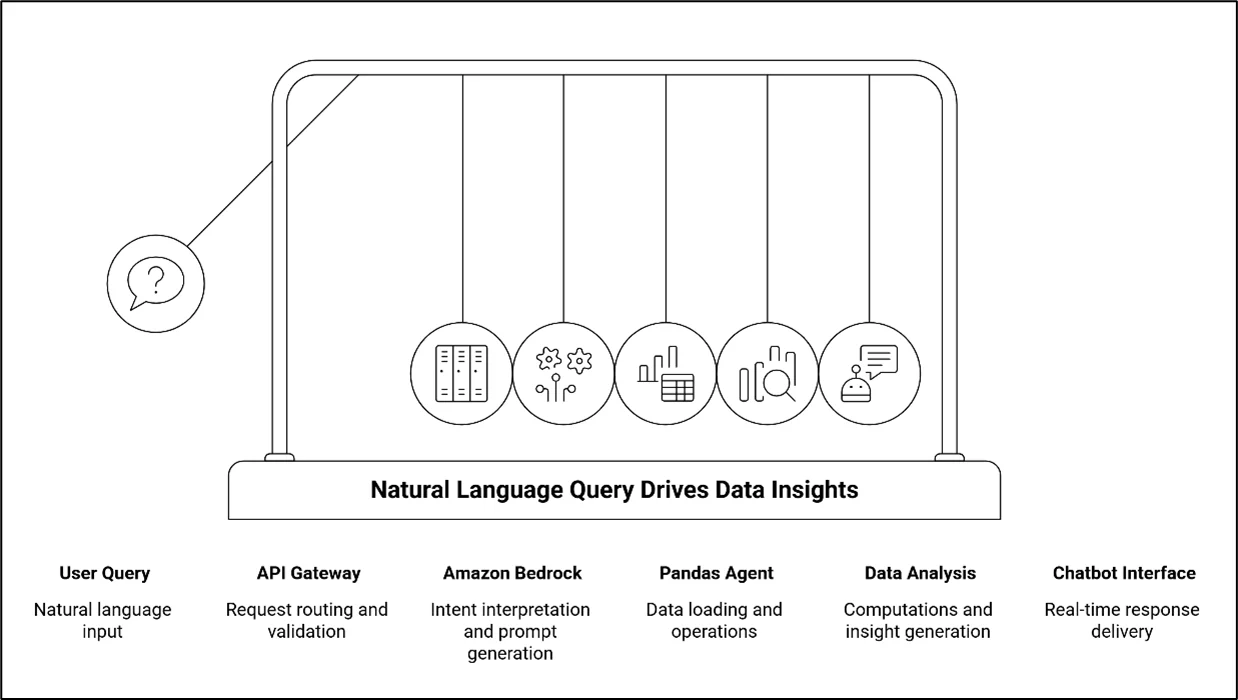
Solution Architecture Flow
- User Query Layer
This is the entry point where enterprise users interact with the chatbot using natural language.
- API Gateway Layer
Acts as the secure communication bridge between users and backend AI services.
- Amazon Bedrock Processing Layer
Amazon Bedrock interprets user intent and orchestrates the AI reasoning process.
- Prompt Orchestration & Agent Layer
Transforms interpreted prompts into executable analytical tasks.
- Enterprise Data Access Layer
Connects the chatbot with enterprise datasets and business systems.
- Pandas Agent Data Processing Layer
Executes analytical computations on enterprise datasets.
- Data Analysis & Insight Generation Layer
Transforms raw computations into meaningful business insights.
- Visualization & Response Formatting Layer
Formats outputs into user-friendly visual and conversational responses.
- Chatbot Response Delivery Layer
Returns insights back to the user in real time.
- Security, Monitoring & Governance Layer
Ensures enterprise-grade security, compliance, and observability.
Technology Stack
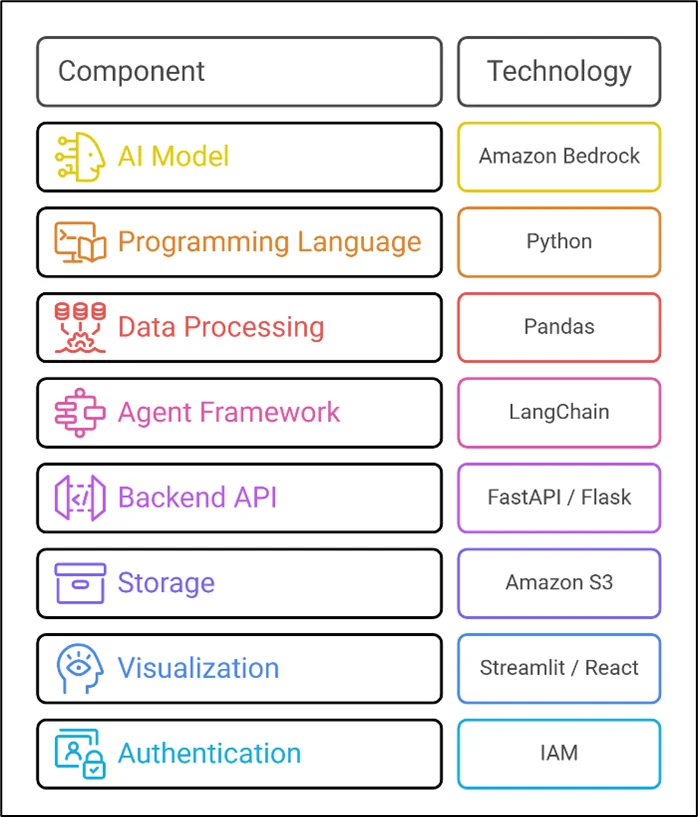
The following technologies are commonly used:
Role of Foundation Models in Enterprise Chatbots
Foundation models play a critical role in enabling enterprise chatbots to understand user queries, process business context, and generate intelligent responses.
- Language Understanding
- Foundation models analyze natural language queries and identify the user’s intent, keywords, and business requirements.
- They help convert conversational questions into structured analytical instructions for backend systems like Pandas Agent.
- Contextual Response Generation
- The model generates human-like responses based on enterprise data and conversational context.
- It maintains continuity across multi-step conversations and provides business-friendly explanations rather than raw technical outputs.
- Intelligent Summarization
- Foundation models summarize large analytical outputs into concise business insights.
- They help users quickly understand trends, KPIs, and performance metrics without reading lengthy reports.
Integrating Enterprise Data Sources
Enterprise chatbots require access to multiple organizational data systems to deliver accurate and real-time insights.
- SQL Databases
- The chatbot connects with relational databases such as MySQL or PostgreSQL to retrieve structured business data.
- Data Warehouses
- Enterprise data warehouses store large volumes of historical and analytical data for reporting and business intelligence.
- The chatbot accesses warehouse data for trend analysis, forecasting, and enterprise-level insights.
- Cloud Storage Systems
- Cloud storage services are used to store datasets, including CSV files, reports, logs, and documents.
- The Pandas Agent loads these files into DataFrames for AI-driven analysis.
- ERP and CRM Integration
- ERP and CRM systems provide the chatbot with enterprise operational and customer-related information.
- Integration enables real-time business analytics across finance, supply chain, sales, and customer management.
Security and Governance
Security is critical in enterprise AI systems.
Important Best Practices
- AWS IAM Role-Based Access
Use AWS IAM policies to restrict access to models and datasets.
- Data Encryption
Encrypt:
- S3 buckets
- API traffic
- Sensitive datasets
- Audit Logging
Enable:
- CloudWatch Logs
- API monitoring
- User tracking
- Row-Level Security
Restrict sensitive data visibility based on user roles.
Integrating with Real Enterprise Data
Most organizations do not store data solely in CSV files.
The chatbot can connect to:
- SQL databases
- MongoDB
- Snowflake
- Redshift
- Athena
- Data Lakes
Using Pandas, data can be loaded dynamically from these systems.
Adding Visualization Support
Data visualization improves user understanding.
You can integrate:
- Matplotlib
- Plotly
- Streamlit charts
- QuickSight dashboards
Challenges and Limitations
While powerful, enterprise AI chatbots also have challenges.
- Hallucinations
LLMs may generate incorrect responses.
Solution:
- Add validation layers
- Restrict tool access
- Use verified datasets
- Large Dataset Performance
Pandas may struggle with massive datasets.
Solution:
- Use chunk processing
- Use Spark
- Query databases directly
- Security Risks
Improper access control may expose sensitive information.
Solution:
- Implement IAM policies
- Enable authentication
- Apply governance rules
Future Enhancements
Enterprise AI analytics will continue evolving rapidly.
Future improvements may include:
- Multi-agent AI systems
- Autonomous business reporting
- Real-time streaming analytics
- Voice-enabled analytics
- AI-powered dashboard generation
Organizations that adopt conversational analytics early will gain a significant competitive advantage.
Benefits of Enterprise Data Chatbots
Faster Decision-Making
Business teams receive instant insights.
Reduced Technical Dependency
Non-technical users can analyze data independently.
Improved Productivity
Automates repetitive reporting tasks.
Better Accessibility
Anyone can interact with enterprise data using natural language.
Scalable Analytics
Supports organization-wide reporting systems.
Conclusion
Enterprise AI chatbots are transforming the way organizations interact with data. By combining Pandas Agents with Amazon Bedrock, businesses can build intelligent conversational analytics systems that simplify reporting, automate insights, and improve operational efficiency.
With the flexibility of Python, the analytical power of Pandas, and the scalability of Amazon Bedrock, enterprises can build secure, production-ready AI assistants for data analysis.
Drop a query if you have any questions regarding Pandas Agents or Amazon Bedrock, and we will get back to you quickly.
Upskill Your Teams with Enterprise-Ready Tech Training Programs
- Team-wide Customizable Programs
- Measurable Business Outcomes
About CloudThat


WRITTEN BY Balaji M
Balaji works as a Research Associate in Data and AIoT at CloudThat, specializing in cloud computing and artificial intelligence–driven solutions. He is committed to utilizing advanced technologies to address complex challenges and drive innovation in the field.


 PREV
PREV










Comments