

 Login
Login


 March 24, 2026
|
Voiced by Amazon Polly |
Introduction
As cloud-native systems grow more complex with microservices, Kubernetes, and distributed architectures, traditional monitoring and security approaches struggle to keep up. Agents introduce overhead, logs lack context, and tracing often misses deep system-level insights.
This is where eBPF (Extended Berkeley Packet Filter) is transforming the landscape.
For cloud and DevOps engineers, eBPF is becoming a game-changer, powering next-generation tools for monitoring, security, and performance optimization.
In this blog, we explore how eBPF works, its architecture, use cases, and best practices in modern cloud environments.
Pioneers in Cloud Consulting & Migration Services
- Reduced infrastructural costs
- Accelerated application deployment
Architecture Overview
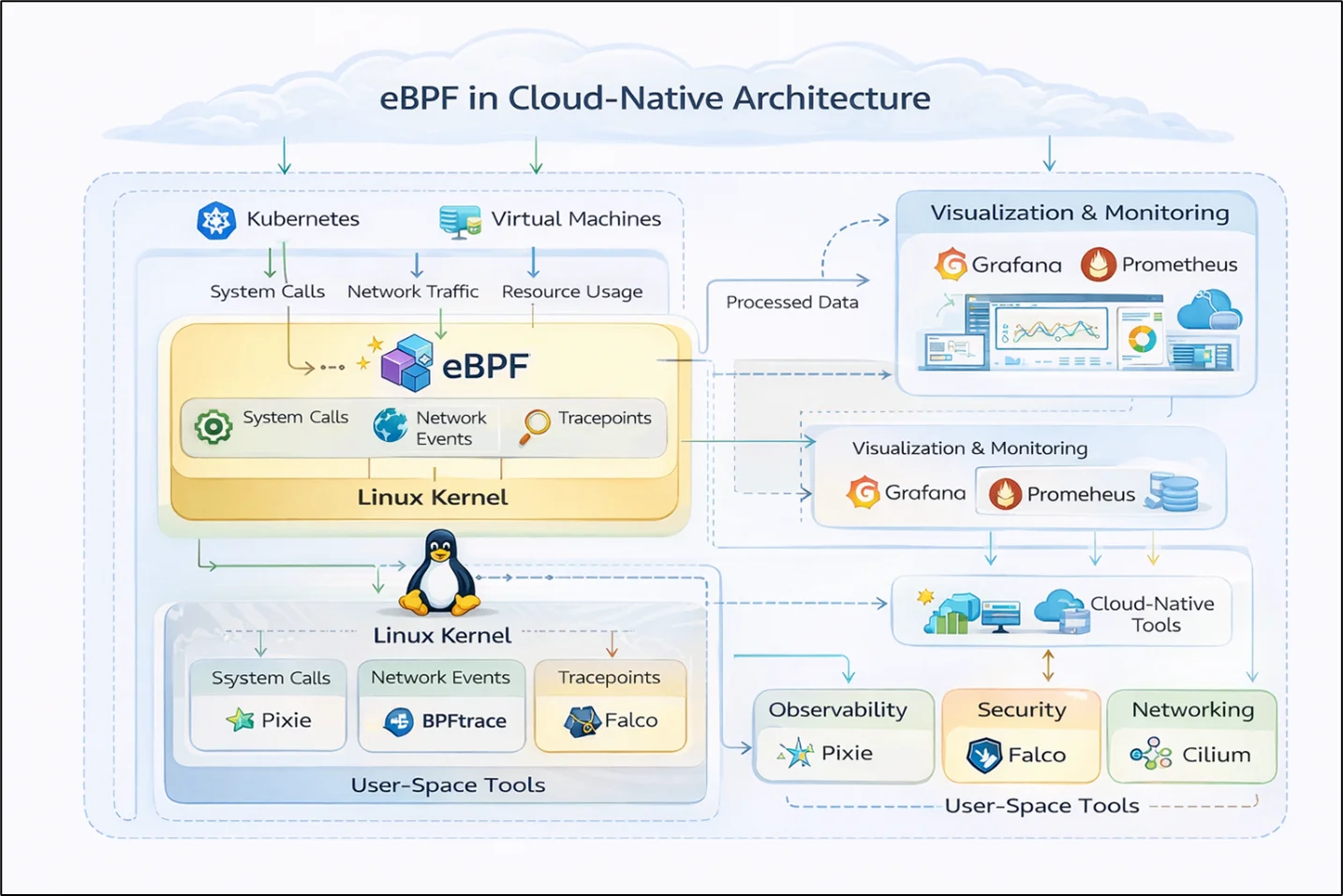
Architecture Explanation:
The architecture demonstrates how eBPF operates within a cloud-native system.
Applications run on Kubernetes or virtual machines, generating system calls, network traffic, and resource usage events.
eBPF programs are attached to kernel hooks such as system calls, network events, and tracepoints. These programs capture real-time data directly from the Linux kernel without requiring intrusive agents.
The eBPF layer processes this data and sends it to user-space components through efficient communication channels.
User-space tools such as Cilium, Pixie, or Falco consume this data for different purposes:
- Observability (latency, request tracing, system metrics)
- Security (threat detection, runtime protection)
- Networking (load balancing, traffic filtering)
The processed data is then integrated with visualization and monitoring platforms such as Grafana and Prometheus, as well as cloud-native tools.
This architecture enables deep visibility and control with minimal performance overhead.
The Shift: From Agent-Based Monitoring to Kernel-Level Insight
Traditional approaches rely on:
- Sidecar containers
- Logging agents
- Network proxies
These introduce latency and resource overhead.
eBPF shifts the model toward:
- Kernel-level data collection
- Zero-instrumentation observability
- High-performance networking
This allows engineers to observe systems without modifying applications.
Core Pillars of eBPF in Cloud
- Kernel-Level Observability
eBPF captures events directly from the kernel.
Examples:
- System calls
- Network packets
- File system operations
This provides deep, real-time insights.
- High-Performance Networking
eBPF enables advanced networking features:
- Load balancing
- Traffic routing
- Network policies
Tools like Cilium replace traditional kube-proxy.
- Runtime Security
eBPF monitors system behavior to detect threats.
Examples:
- Unauthorized access attempts
- Suspicious process execution
- File integrity violations
Tools like Falco leverage eBPF for security enforcement.
- Low Overhead
Unlike traditional agents, eBPF runs inside the kernel with minimal performance impact.
- Programmability
Engineers can write custom eBPF programs to extend functionality for specific use cases.
Best Practices for Using eBPF
- Start with Managed Tools
Use tools like:
- Cilium (networking)
- Pixie (observability)
- Falco (security)
- Avoid Overloading the Kernel
Keep eBPF programs efficient and lightweight.
- Integrate with Existing Observability Stack
Combine eBPF data with Prometheus and Grafana dashboards.
- Use for Critical Workloads First
Adopt eBPF across high-impact areas such as security and performance monitoring.
- Keep Kernel Updated
Ensure compatibility and access to the latest eBPF features.
Outcome of Using eBPF
- Deep system-level visibility without intrusive agents
- Improved performance due to reduced overhead
- Real-time security monitoring and threat detection
- Enhanced networking efficiency and scalability
- Faster debugging and root cause analysis
- Modern, future-ready DevOps capabilities
Conclusion
eBPF is redefining how we observe, secure, and optimize cloud systems.
Moving visibility into the kernel eliminates the limitations of traditional monitoring approaches and enables a new level of efficiency and control.
For DevOps and cloud engineers, adopting eBPF is not just an upgrade, it is a shift toward the future of cloud-native operations.
Drop a query if you have any questions regarding eBPF and we will get back to you quickly.
Making IT Networks Enterprise-ready – Cloud Management Services
- Accelerated cloud migration
- End-to-end view of the cloud environment
About CloudThat
FAQs
1. What is eBPF in simple terms?
ANS: – eBPF is a technology that allows programs to run inside the Linux kernel for real-time monitoring and control.
2. Is eBPF better than traditional monitoring tools?
ANS: – It complements them by providing deeper insights with lower overhead.
3. What tools use eBPF?
ANS: – Cilium, Pixie, Falco, and BCC are popular tools.


WRITTEN BY Anusha R
Anusha R is Senior Technical Content Writer at CloudThat. She is interested in learning advanced technologies and gaining insights into new and upcoming cloud services, and she is continuously seeking to expand her expertise in the field. Anusha is passionate about writing tech blogs leveraging her knowledge to share valuable insights with the community. In her free time, she enjoys learning new languages, further broadening her skill set, and finds relaxation in exploring her love for music and new genres.


 PREV
PREV











Comments