

 Login
Login


 May 8, 2026
|
Voiced by Amazon Polly |
Introduction
Claude Code is an AI-powered coding assistant from Anthropic that helps developers write, review, and modify code using natural language. Amazon Bedrock is a fully managed AWS service that provides access to powerful foundation models, including Claude Code, through a unified API. This blog explores proven deployment patterns, security considerations, authentication strategies, and monitoring practices to help organizations deploy Claude Code securely and efficiently at enterprise scale.
Pioneers in Cloud Consulting & Migration Services
- Reduced infrastructural costs
- Accelerated application deployment
Overview
Deploying Claude Code with Amazon Bedrock is not just about enabling access to a powerful AI coding assistant, it’s about how that access is provided, governed, and scaled across teams. The deployment pattern you choose directly impacts security posture, developer experience, operational overhead, and long-term cost control.
Selecting the right deployment patterns enables organizations to:
- Securely authenticate users at enterprise scale, integrating with existing identity providers and enforcing least-privilege access
- Monitor usage and model performance at both team and individual levels to understand adoption, productivity gains, and operational impact.
- Enforce governance and cost attribution, ensuring responsible AI use and transparent chargebacks or cost allocations.
- Support scalable developer productivity, allowing teams to use Claude Code seamlessly without introducing friction or security risks.
These patterns are designed to support the full adoption lifecycle from early proofs-of-concept and pilot programs to large-scale, production-ready deployments across multiple teams and accounts. By aligning deployment choices with organizational needs, teams can maximize the value of Claude Code while maintaining strong security, observability, and operational control.
Authentication Methods
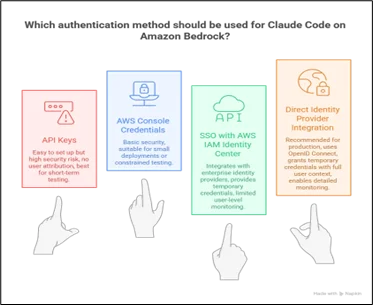
A key first choice when deploying Claude Code is how developers authenticate to Amazon Bedrock. The decision impacts security, monitoring, and manageability:
- API Keys – Easiest to set up but high security risk, no user attribution, and best suited only for short-term testing.
- AWS Console Credentials via aws login – Provides basic security and is suitable for small deployments or constrained testing environments.
- SSO with AWS IAM Identity Center – Integrates with enterprise identity providers and provides temporary credentials with single sign-on capabilities, but limited user-level monitoring.
- Direct Identity Provider (IdP) Integration – Recommended for production. This uses OpenID Connect federation to grant AWS temporary credentials with full user context, enabling detailed monitoring and audit trails.
A comparison of these options shows trade-offs in session duration, security, setup complexity, and monitoring support.
Architectural Decisions
Public Amazon Bedrock Endpoints
Deploying Claude Code typically uses Amazon Bedrock’s managed public endpoints. These are easy to configure, scalable, and AWS handles the infrastructure and availability. Adding OpenTelemetry metrics and Amazon CloudWatch dashboards can provide per-developer usage metrics and insights into cost and performance trends without operating complex infrastructure.
LLM Gateway Pattern
Some organizations use an intermediary LLM gateway to connect developers to Amazon Bedrock. This layer can:
- Route requests to multiple providers (e.g., Amazon Bedrock, OpenAI).
- Apply real-time policy enforcement.
- Provide custom middleware features.
However, it introduces operational overhead, including containers, load balancers, caching layers, and potential points of failure. It is best suited for complex governance needs beyond AWS IAM and AWS CloudTrail controls.
Organizational Deployment Patterns
Single Dedicated Account
A recommended pattern is to centralize Claude Code access within a dedicated AWS account. The benefits include:
- Unified quotas and usage tracking in one place
- Clear cost visibility and allocation
- Simplified security and AWS CloudTrail monitoring
- Isolation from production workloads to prevent quota exhaustion
Cross-account AWS IAM roles can still allow development accounts to invoke Claude Code while enforcing policies.
Best Practices for Deployment
- Start with small pilot groups to validate authentication and metrics collection.
- Enable OpenTelemetry early for detailed insight into user behavior and cost attribution.
- Use direct IdP integration where enterprise security, audit, and cost allocation matter most.
- Consider an LLM gateway only when additional custom controls or cross-provider routing are needed.
- Centralize Claude Code in a dedicated account to simplify quotas, costs, and governance.
Conclusion
Deploying Claude Code with Amazon Bedrock offers powerful capabilities for developer productivity and AI-assisted coding. However, as teams scale beyond proofs of concept, deployment patterns matter deeply. Choosing the right authentication method, architectural strategy, and monitoring approach ensures secure, cost-effective, and observable AI workflows. By following recommended patterns such as direct IdP integration, dedicated accounts, and layered monitoring, organizations can confidently deploy Claude Code at enterprise scale with clarity and control.
Drop a query if you have any questions regarding Claude Code and we will get back to you quickly.
Empowering organizations to become ‘data driven’ enterprises with our Cloud experts.
- Reduced infrastructure costs
- Timely data-driven decisions
About CloudThat
FAQs
1. Why not use API keys in production?
ANS: – API keys are easy to create but present security risks, lack user attribution, and do not provide robust monitoring, so they should be limited to short-term testing.
2. What benefits does direct IdP integration provide?
ANS: – It delivers secure, temporary credentials with user context, supporting monitoring, cost allocation, and audit logs.
3. Do I need an LLM gateway?
ANS: – Only if you need cross-provider support, custom middleware, or request-level policy enforcement beyond what AWS IAM can offer.


WRITTEN BY Sridhar Andavarapu
Sridhar Andavarapu is a Senior Research Associate at CloudThat, specializing in AWS, Python, SQL, data analytics, and Generative AI. He has extensive experience in building scalable data pipelines, interactive dashboards, and AI-driven analytics solutions that help businesses transform complex datasets into actionable insights. Passionate about emerging technologies, Sridhar actively researches and shares knowledge on AI, cloud analytics, and business intelligence. Through his work, he strives to bridge the gap between data and strategy, enabling enterprises to unlock the full potential of their analytics infrastructure.


 PREV
PREV












Comments