

 Login
Login


 March 18, 2026
|
Voiced by Amazon Polly |
If you are trying to learn AWS today, confusion is almost guaranteed. There is free content everywhere. YouTube playlists, blogs, documentation, certification dumps, bootcamps, AWS Skill Builder courses, AWS Educate modules, and structured AWS training and certification programs all promise results. Everyone claims their method works.
Sooner or later, every learner faces the same question: Should I self-learn AWS or join a structured AWS training program to get hired?
After training working professionals, career switchers, and freshers, and after seeing how interviews really unfold, here is the honest answer. Not marketing. Not hype. What hiring reality looks like.
Start Learning In-Demand Tech Skills with Expert-Led Training
- Industry-Authorized Curriculum
- Expert-led Training
The Reality of Self Learning AWS
Most people begin with self-learning. That usually includes AWS Skill Builder, AWS Educate learning paths, free hands-on labs, and certification preparation guides. It feels logical. It is flexible, affordable, and accessible. You can move at your own pace, revisit concepts, and prepare directly for AWS training and certification exams without external pressure.
For disciplined learners, this approach builds familiarity. You learn service names, use cases, pricing basics, IAM concepts, networking terminology, and exam patterns. Over time, you start recognizing how AWS services connect. That foundation matters.
However, familiarity is not the same as job readiness.
Where self-learning typically breaks down is not effort. It is direction. Many learners study services in isolation, without understanding the architectural flow. They complete AWS Skill Builder modules but never pause to ask why one service would be chosen over another in a real environment. They prepare for AWS training and certification exams, but focus more on passing the questions than on understanding trade-offs.
In interviews, this gap becomes visible. I have spoken to candidates who completed multiple courses yet struggled to explain why S3 would be selected instead of EFS, how IAM design differs between development and production, what happens during a regional outage, or how cost decisions are evaluated under scaling pressure.
Self-learning works best when the learner already understands system design principles and knows what employers expect. Most beginners do not start there.
What Structured AWS Training Changes
Good AWS training is not about covering more services or memorizing additional features. It is about learning how cloud systems are designed, defended, and optimized.
In structured AWS training, you do not just launch services and follow instructions. You are expected to explain why you chose them. You discuss trade-offs between managed and unmanaged services. You evaluate cost impact, think through security boundaries, and consider failure scenarios. That shift from execution to reasoning changes everything.
Structured environments also expose blind spots. An instructor challenges your design. They ask why you selected one architecture over another. They push you to justify decisions around networking, scaling, monitoring, and recovery. That kind of questioning rarely happens when studying alone through AWS Skill Builder or AWS Educate.
This pressure builds confidence. Not exam confidence. Interview confidence. And interviews test thinking, not memory.
The Hiring Reality Most Blogs Avoid
AWS certification alone does not guarantee a job. That statement may be uncomfortable, but it is consistently accurate.
Even candidates who complete AWS training and certification tracks sometimes struggle to design a basic VPC layout, explain routing decisions, discuss high availability patterns, or debug a simple cloud failure scenario. They know definitions. They struggle with applications.
Recruiters do not reject candidates for missing certifications. They reject candidates because explanations lack clarity. When a hiring manager asks why a load balancer was chosen, or how multi-AZ deployment reduces risk, they are not looking for textbook lines. They are assessing reasoning.
Across companies, interviewers expect strong fundamentals, clear logic, comfort discussing trade-offs, and a realistic understanding of cloud limitations. They want to see whether you can think through architecture decisions under constraints.
This is where structured AWS training becomes valuable. It forces you to practice thinking out loud. It builds structured reasoning instead of isolated knowledge.
The Cloud Skills Gap
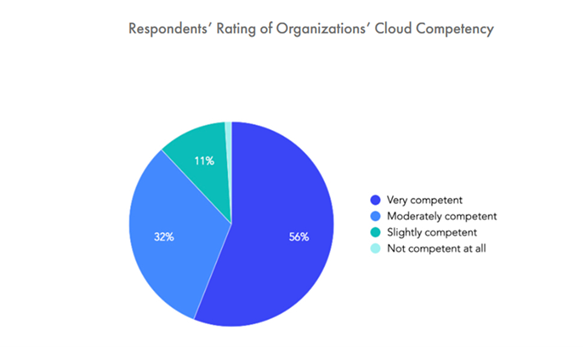
Fig 1: Skill gap in employees.
Workforce studies consistently report cloud skill shortages across industries. The issue is not that people are not studying AWS. The issue is that many learners stop at the certification level without building applied capability.
Organizations invest in instructor-led AWS training and scenario-based learning because cloud roles require decision-making rather than memorization. In markets like India and across the Asia Pacific, cloud computing remains one of the most in-demand skills. Yet hiring managers repeatedly report the same challenge. Candidates understand AWS services in theory but struggle with architecture-level thinking.
Learning material is everywhere. Applied capability is not. That gap explains why certifications alone do not solve hiring problems.
Where AWS Skill Builder and AWS Educate Fit
AWS Skill Builder and AWS Educate are strong foundational platforms. They help learners understand service capabilities, build exam preparation knowledge, and navigate AWS certification paths in a structured way. For beginners, they especially provide clarity and guided exposure to core services. But they are learning tools, not complete career solutions.
To move from certification to employability, learners must practice real-world design discussions. They must clearly explain trade-offs, handle failure scenarios confidently, and understand the cost, security, scalability, and compliance implications. That layer of applied reasoning often requires structured AWS training that simulates real project environments. Structured training does not replace AWS Skill Builder or AWS Educate. It is built on top of them.
So Which Path Gets You Hired
Self-learning works well for professionals who already work in IT, understand networking and system design, can build and troubleshoot independently, and clearly know what employers expect. In such cases, AWS Skill Builder combined with focused AWS training and certification preparation may be enough to bridge gaps.
Structured AWS training becomes more effective for career switchers, freshers, and professionals without real project exposure. If you need guided hands-on practice, interview preparation, accountability, and feedback on your architectural thinking, structure accelerates progress.
Most successful candidates follow a hybrid approach. They use AWS Skill Builder or AWS Educate to build foundational knowledge. They pursue AWS training and certification to validate that knowledge. Then they rely on structured AWS training environments to sharpen applied capability. That combination builds clarity and confidence.
From Learning to Hiring
Suppose your goal is simply to learn AWS services; self-learning works. If your goal is to pass an AWS certification exam, AWS Skill Builder and AWS Educate are excellent tools. But if your goal is to get hired in cloud roles, structure matters more than volume. Self-learning builds awareness. AWS training and certification validate knowledge. Structured training builds employability.
The candidates who receive offers are not the ones who consume the most content. They are the ones who can explain decisions clearly, discuss trade-offs confidently, and think like architects.
That clarity, not just certificates, is what turns AWS knowledge into real jobs.
Upskill Your Teams with Enterprise-Ready Tech Training Programs
- Team-wide Customizable Programs
- Measurable Business Outcomes
About CloudThat


WRITTEN BY Priya Kanere
Priya Kanere is an AWS Subject Matter Expert and Champion AWS Authorized Instructor at CloudThat, specializing in cloud technologies, Python, data analytics, machine learning and generative AI. With extensive experience in training and mentoring, she has trained over 3,000 professionals to upskill in emerging technologies. Known for simplifying complex concepts through hands-on teaching and connecting theory with real-world applications, she brings deep technical knowledge and practical insights into every learning experience. Priya’s passion for empowering learners reflects in her unique approach to learning and development.


 PREV
PREV












Comments