

 Login
Login


 May 14, 2026
|
Voiced by Amazon Polly |
Overview
Modern applications increasingly depend on efficient search capabilities to retrieve relevant information from large volumes of textual data. Whether powering product catalogs, knowledge bases, or log analytics systems, full-text search plays a critical role in delivering fast and accurate results.
While MySQL provides built-in full-text search (FTS) functionality, scaling it effectively in cloud environments such as Amazon RDS for MySQL and Amazon Aurora MySQL requires careful optimization. Without proper tuning, search workloads can lead to high latency, increased resource consumption, and degraded user experience.
This blog explores key challenges and practical strategies to optimize full-text search performance in managed MySQL environments on AWS.
Pioneers in Cloud Consulting & Migration Services
- Reduced infrastructural costs
- Accelerated application deployment
Challenges with Default Full-Text Search Implementations
Out-of-the-box full-text search works well for smaller datasets, but performance issues emerge as data volume and query complexity grow.
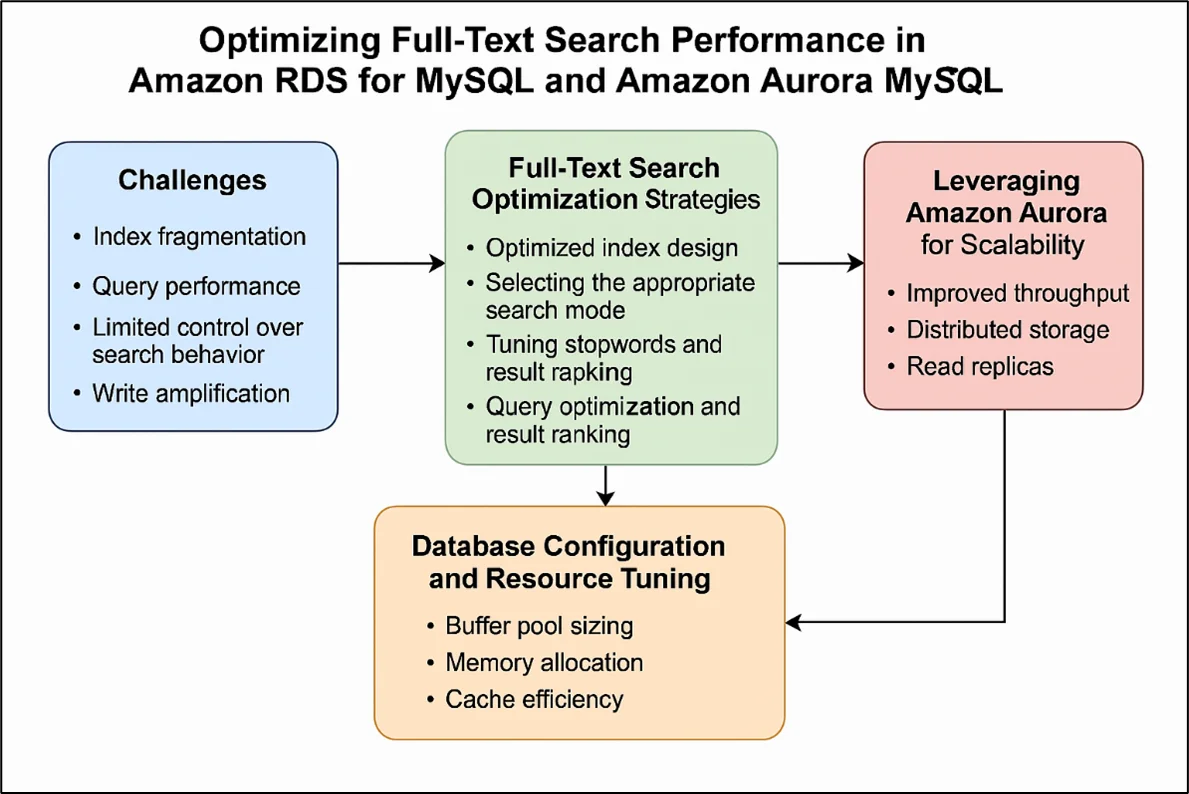
- Index Fragmentation and Maintenance Overhead
- Full-text indexes require continuous updates as data changes. Frequent inserts, updates, and deletes can fragment indexes, slowing query execution and increasing maintenance costs.
- Query Performance Degradation
- Improperly structured queries or missing indexes can result in full table scans, significantly increasing response times and CPU utilization.
- Limited Control Over Search Behavior
- Default configurations, such as stopwords and minimum word length, can exclude important terms, reducing search accuracy and relevance.
- Write Amplification
- Maintaining full-text indexes during high write operations can introduce latency, impacting overall database performance.
Full-Text Search Optimization Strategies
- Optimized Index Design
Efficient indexing is the foundation of performant full-text search.
- Create FULLTEXT indexes only on necessary columns
- Avoid redundant or overly broad indexing
- Ensure indexes align with query patterns
Proper index design reduces unnecessary scanning and improves query execution efficiency.
- Selecting the Appropriate Search Mode
MySQL supports multiple search modes:
- Natural Language Mode for simple queries
- Boolean Mode for precise control
- Query Expansion for broader matching
Boolean mode is particularly effective for controlled searches, enabling inclusion, exclusion, and weighting of terms.
- Tuning Stopwords and Token Length
Default configurations may ignore relevant search terms.
Key parameters to review:
- Minimum word length
- Stopword lists
Customizing these settings ensures critical keywords are indexed and searchable, improving result relevance.
- Query Optimization and Result Ranking
Efficient query design significantly impacts performance.
- Use MATCH…AGAINST with appropriate modes
- Avoid unnecessary conditions that prevent index usage
- Leverage relevance scoring for sorting results
Proper ranking improves both performance and user experience by prioritizing meaningful results.
- Managing Write Operations
High-frequency write workloads can degrade index performance.
Recommended approaches:
- Batch updates where possible
- Monitor index update overhead
- Balance read and write workloads
This ensures that indexing does not become a bottleneck in transactional systems.
- Database Configuration and Resource Tuning
System-level configuration plays a critical role in performance.
Important areas include:
- Buffer pool sizing
- Memory allocation
- Cache efficiency
Optimizing these parameters ensures that frequently accessed data and indexes remain in memory, reducing disk I/O.
- Leveraging Amazon Aurora for Scalability
Amazon Aurora MySQL provides architectural advantages for search workloads:
- Improved throughput compared to standard MySQL
- Distributed storage for high availability
- Read replicas for scaling query workloads
These features make Aurora a strong choice for applications requiring high-performance search at scale.
Implementation Considerations
Optimizing full-text search in AWS environments requires a combination of database tuning and architectural decisions.
Monitoring and Observability
Continuously track:
- Query latency
- Index usage
- Resource consumption
Using AWS monitoring tools helps identify bottlenecks and proactively optimize performance.
Partitioning for Large Datasets
Partitioning large tables can reduce search scope and improve query efficiency, especially for time-based or segmented data.
Testing and Benchmarking
Evaluate performance under realistic workloads to ensure configurations meet application requirements.
Real-World Application Scenarios
Application Search Features
E-commerce platforms and content-driven applications rely on fast and relevant search results to enhance user experience.
Log and Event Analysis
Full-text search enables efficient querying of logs and operational data for troubleshooting and monitoring.
Knowledge Management Systems
Organizations use FTS to index and retrieve documents, enabling quick access to information.
Reporting and Analytics
Search-based filtering improves data exploration and reporting workflows.
Comparison: Amazon RDS vs Amazon Aurora for FTS (Full-Text Search)
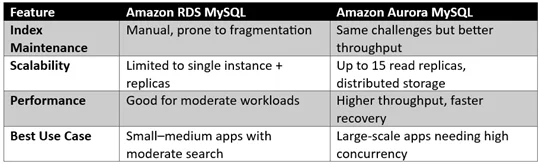
When to Consider External Search Solutions?
While MySQL full-text search is effective for many use cases, it has limitations for advanced requirements, such as:
- Fuzzy matching
- Complex ranking algorithms
- Real-time autocomplete
For such scenarios, integrating with dedicated search services like Amazon OpenSearch provides enhanced capabilities and scalability.
Conclusion
Full-text search in Amazon RDS for MySQL and Amazon Aurora MySQL is a powerful feature, but achieving optimal performance requires more than default configurations.
By focusing on index design, query optimization, parameter tuning, and system monitoring, organizations can significantly improve search efficiency and scalability.As application demands continue to grow, combining optimized database search with scalable cloud architecture ensures consistent performance and a better user experience.
Drop a query if you have any questions regarding Amazon RDS and we will get back to you quickly.
Empowering organizations to become ‘data driven’ enterprises with our Cloud experts.
- Reduced infrastructure costs
- Timely data-driven decisions
About CloudThat
FAQs
1. What is the primary factor affecting full-text search performance?
ANS: – Efficient index design and maintenance are the most critical factors influencing performance.
2. Which MySQL search mode provides the most control?
ANS: – Boolean mode offers precise control over search queries, including the inclusion and exclusion of terms.
3. When should I use Amazon Aurora instead of Amazon RDS for search workloads?
ANS: – Amazon Aurora is preferred for high-scale applications requiring better performance, scalability, and read distribution.


WRITTEN BY Manjunath Raju S G
Manjunath Raju S G works as a Research Associate at CloudThat. He is passionate about exploring advanced technologies and emerging cloud services, with a strong focus on data analytics, machine learning, and cloud computing. In his free time, Manjunath enjoys learning new languages to expand his skill set and stays updated with the latest tech trends and innovations.


 PREV
PREV












Comments