

 Login
Login


 August 10, 2026
|
Voiced by Amazon Polly |
Overview
In today’s data-driven world, organizations rely on data for decision-making, analytics, machine learning, and regulatory compliance. As data changes over time through updates, corrections, and deletions, maintaining consistency and accuracy becomes increasingly difficult. This is where data versioning plays a vital role.
Data versioning preserves historical versions of datasets, allowing teams to track changes, restore previous states, compare versions, and ensure reproducible results. By implementing versioning in modern data platforms, organizations improve data reliability, collaboration, governance, and overall operational efficiency.
Pioneers in Cloud Consulting & Migration Services
- Reduced infrastructural costs
- Accelerated application deployment
Introduction
Traditional data platforms often overwrite existing datasets, making it difficult to recover from errors, accidental deletions, or failed pipelines. Modern technologies like Delta Lake, Apache Iceberg, and Apache Hudi address this by maintaining historical versions of data, enabling rollback, auditing, and time travel. As cloud-native data platforms continue to evolve, data versioning has become an essential feature for ensuring reliable and trustworthy data management.
Data Versioning
Data versioning is the process of storing multiple versions of datasets while maintaining a history of every modification. Each version represents the state of the data at a specific point in time.
Instead of permanently overwriting data, every insert, update, merge, or delete operation creates a new snapshot. Users can retrieve previous versions whenever required.
Common operations include:
- Viewing historical versions
- Comparing dataset changes
- Restoring previous versions
- Tracking schema evolution
- Auditing data modifications
Why Data Versioning Matters?
- Ensures Data Reliability
Data pipelines process millions of records daily. If an ETL job introduces incorrect transformations, versioning enables teams to roll back to a previous stable version without rebuilding the entire dataset.
- Supports Time Travel
Modern data platforms allow users to query historical versions of a dataset. For example:
- View customer data as it existed last week.
- Compare monthly snapshots.
- Validate business reports generated in the past.
This capability is particularly useful for auditing and financial reporting.
- Improves Collaboration
Data engineers, analysts, and data scientists often work on the same datasets. Versioning ensures:
- Multiple users can work safely.
- Previous versions remain accessible.
- Experimental changes don’t impact production data.
- Teams can reproduce each other’s results.
- Simplifies Debugging
Suppose yesterday’s dashboard displayed correct sales figures, but today’s report is incorrect. Without versioning, identifying the issue becomes difficult. With data versioning, teams can:
- Compare versions.
- Identify changed records.
- Trace faulty transformations.
- Restore working datasets.
- Enhances Data Governance
Many industries must comply with regulations requiring historical data retention. Versioning provides:
- Complete audit trails
- Historical snapshots
- Data lineage
- Change tracking
This improves compliance with governance standards and regulatory policies.
How Data Versioning Works?
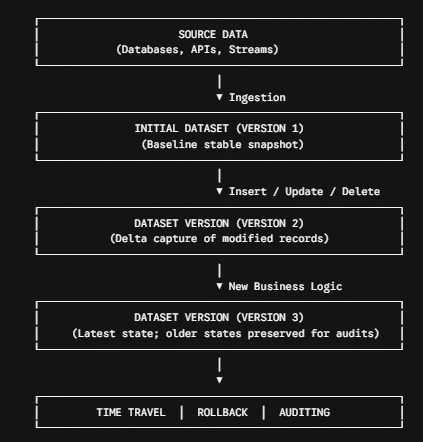
Below is a conceptual workflow mapping the lifecycle and snapshot lineage of datasets in a modern version-controlled architecture.
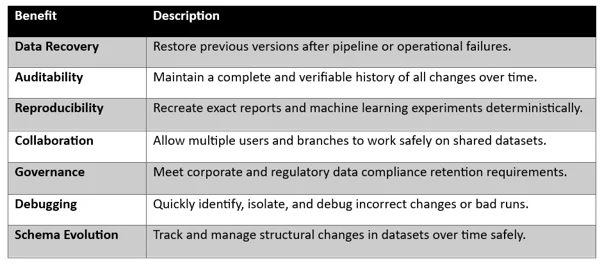
Benefits of Data Versioning
Popular Technologies Supporting Data Versioning
Several modern data lake technologies provide built-in version control out of the box:
- Delta Lake
- ACID transactions
- Time travel queries
- Schema enforcement and validation
- Automated transaction log history
- Apache Iceberg
- Snapshot-based decoupled architecture
- Hidden partitioning optimization
- Efficient metadata-driven management
- Native rollback support
- Apache Hudi
- Streamlined incremental processing
- Fast upserts and deletes
- Record-level version tracking
- Near real-time analytic support
These technologies have become key components of modern lakehouse architectures.
Best Practices for Implementing Data Versioning
Organizations should follow these practices to maximize the benefits of data versioning:
- Store immutable historical versions whenever architectural constraints allow.
- Enable automatic, platform-managed metadata tracking.
- Retain sufficient version logs and history to meet auditing requirements.
- Monitor storage usage footprint and prune obsolete versions via explicit retention policies.
- Integrate version snapshots cleanly with CI/CD and automated data production pipelines.
- Maintain exact documentation mapping for structural schema evolution over time.
Real-World Example
Consider an e-commerce company that updates its global product pricing daily.
- Without data versioning: Previous prices are instantly lost, historical sales margin analysis becomes permanently skewed, and rogue pricing updates cannot be cleanly or safely reversed.
- With data versioning: Every single pricing adjustment generates a new timestamped snapshot. Data analysts can map historical price curves precisely, bad updates can be rolled back immediately, and financial dashboards remain correct.
Conclusion
As modern cloud data architecture continues to expand, managing underlying data states efficiently is a baseline requirement. Data versioning provides the exact safety mechanism needed to track modifications, restore past states, and support strict governance rules.
Drop a query if you have any questions regarding Data versioning, and we will get back to you quickly.
Empowering organizations to become ‘data driven’ enterprises with our Cloud experts.
- Reduced infrastructure costs
- Timely data-driven decisions
About CloudThat
FAQs
1. What is data versioning?
ANS: – It is the method of maintaining multiple distinct historical states of a dataset so modifications can be tracked, audited, compared, or safely rolled back at any given point.
2. Which open table formats natively support data versioning?
ANS: – Delta Lake, Apache Iceberg, and Apache Hudi all provide native snapshot architectures optimized for versioning and time travel queries.
3. Why should an organization care?
ANS: – It minimizes data pipeline downtime, accelerates debugging workflows, meets external regulatory compliance requirements, and ensures data science reproducibility.

WRITTEN BY Anusha
Anusha works as a Subject Matter Expert at CloudThat. She handles AWS-based data engineering tasks such as building data pipelines, automating workflows, and creating dashboards. She focuses on developing efficient and reliable cloud solutions.


 PREV
PREV










Comments