

 Login


 October 29, 2026
|
Voiced by Amazon Polly |
Introduction
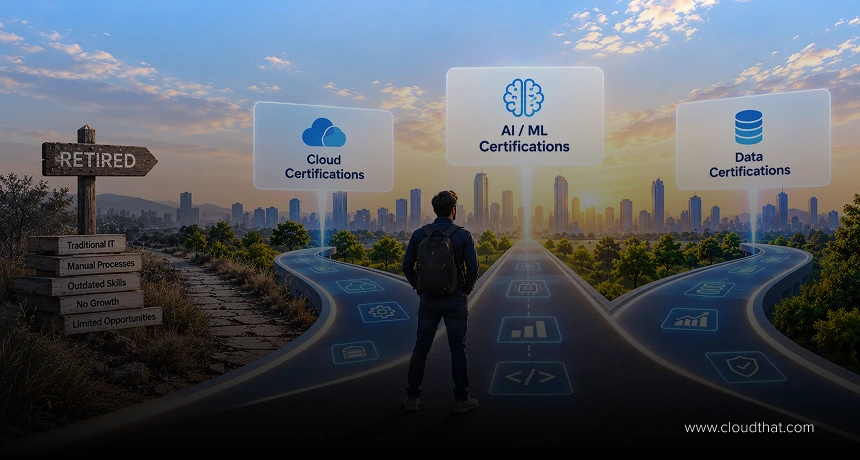
The right AI ML certification roadmap for developers and cloud professionals in 2026 has three levels. Start with a foundational credential, move to a role-based associate exam, then earn a professional credential that matches your stack.
- Foundational: AWS Certified AI Practitioner (AIF-C01) or Microsoft Azure AI Fundamentals (AI-901)
- Associate: AWS Certified Machine Learning Engineer Associate (MLA-C01) or Microsoft AI-103 (Azure AI App and Agent Developer)
- Professional: AWS Certified Generative AI Developer Professional or Google Cloud Professional Machine Learning Engineer
- Budget 2 to 4 months per level, with hands-on labs, not just practice tests
Last year, a developer bookmarked the AWS Machine Learning Specialty exam.
Saved the study guide. Blocked every Sunday morning.
This year, that exam does not exist.
AWS retired it on March 31, 2026. Microsoft retired the AI-102 and AI-900 exams three months later. The map changed while people were still reading it.
That is why you need an AI ML certification roadmap, not a random list of exams. This guide shows you which exam to take first, what comes next, and how to build a path that still makes sense a year from now.
Already in IT? Switch to Cloud & Earn 55% More
- Weekend Batches
- Dedicated Career Support
- Official AWS Labs
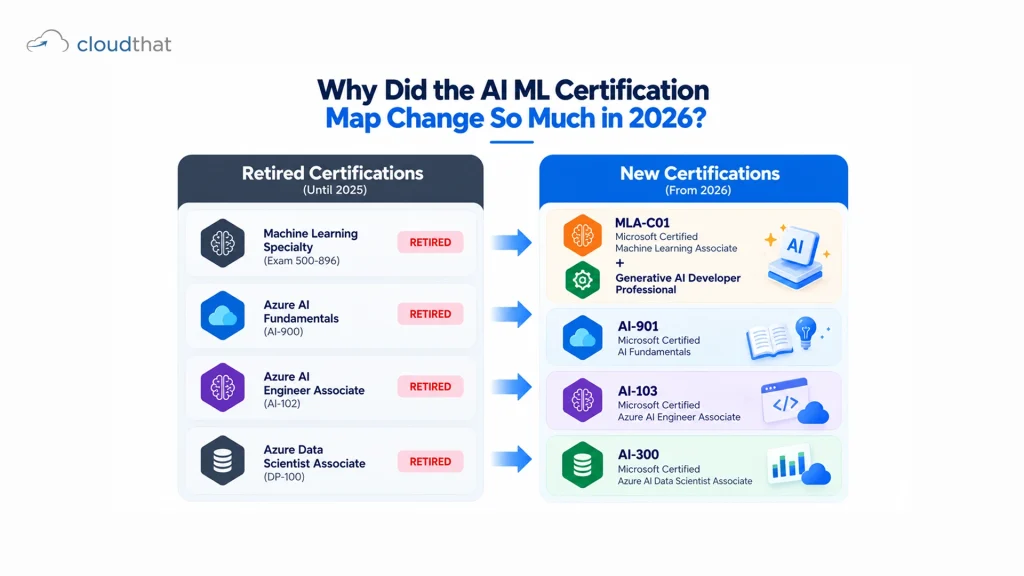
Why Did the AI ML Certification Map Change So Much in 2026?
Because the job changed. Cloud providers retired exams built around classic model training and replaced them with role-based tracks for people who deploy, operate, and build products on top of AI.
Here is the plot twist most study plans missed.
The AWS Certified Machine Learning Specialty took its last exam on March 31, 2026. If you already hold it, it stays valid for three years from your test date. If you were planning to take it, that door is closed.
AWS now runs a cleaner ladder. AI Practitioner at the bottom, Machine Learning Engineer Associate in the middle, and the new AWS Certified Generative AI Developer Professional at the top, covering Amazon Bedrock, RAG architectures, and vector databases.
Microsoft did the same thing, just louder.
| Old Exam | Status | What Replaced It |
| AWS Machine Learning Specialty | Retired March 31, 2026 | ML Engineer Associate + Generative AI Developer Professional |
| Microsoft AI-900 | Exam retired June 30, 2026 | AI-901 (Azure AI Fundamentals) |
| Microsoft AI-102 | Retired June 30, 2026 | AI-103 (Azure AI App and Agent Developer Associate) |
| Microsoft DP-100 | Retired June 1, 2026 | AI-300 (MLOps Engineer Associate) |
Notice the pattern? Agents. MLOps. Generative AI apps.
The exams did not get easier. They got closer to your actual job.
And that changes where you should begin.
Where Should You Start Your AI ML Certification Journey?
Start at the foundational level only if AI concepts are new to you. If you already ship code or run workloads on a cloud platform, skip ahead to an associate-level AI ML certification.
Collecting three fundamentals badges is not progress. It is a very organized waiting room.
If You Are a Developer New to AI
Pick one foundational exam on the cloud your company already uses.
The AWS Certified AI Practitioner exam prep course covers foundation models, prompt engineering, responsible AI, and where services like Amazon Bedrock and SageMaker fit. On Azure, AI-901 does the same job.
One foundational badge is enough. Then move.
If You Are Already a Cloud Professional
You already know IAM, VPCs, cost controls, and why a misconfigured endpoint ruins a Friday night.
So go straight to the associate tier. An AWS Solutions Architect can step into MLA-C01. An Azure administrator can aim for AI-103, and the Azure AI engineer training track builds the Azure OpenAI, AI Search, and agent skills that exam expects.
Your existing cloud knowledge is not a side detail. It is your shortcut.
What Does a Complete AI ML Certification Roadmap Look Like?
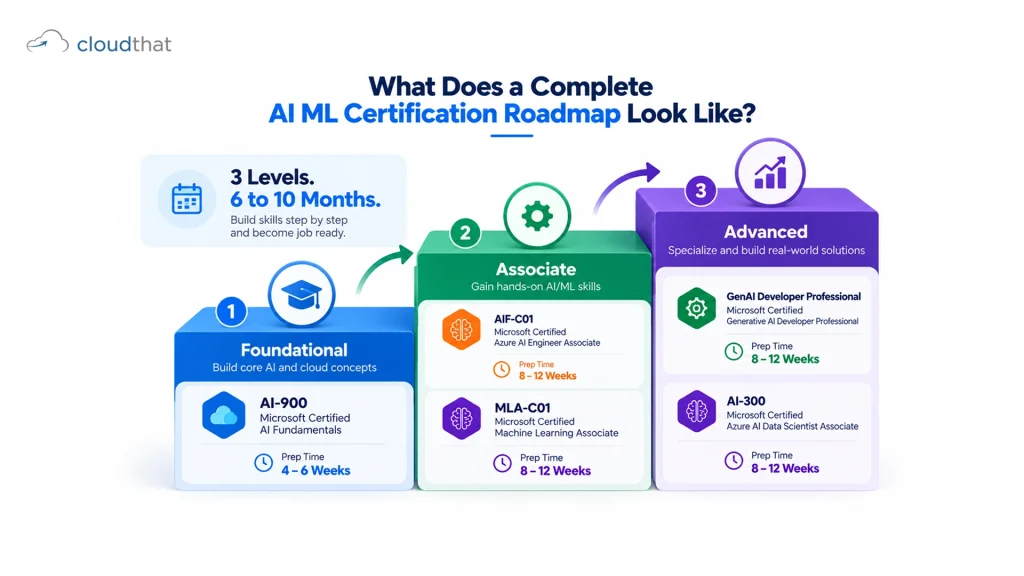
A complete AI ML certification roadmap has three stages: foundational, associate, and professional. Most professionals finish it in 6 to 10 months while working full time.
| Stage | AWS | Microsoft Azure | Google Cloud | Typical Prep Time |
| Foundational | AI Practitioner (AIF-C01) | AI-901 | Generative AI Leader | 3 to 6 weeks |
| Associate | ML Engineer Associate (MLA-C01) | AI-103 | Associate Cloud Engineer (cloud base) | 2 to 3 months |
| Advanced | Generative AI Developer Professional | AI-300 (MLOps depth after AI-103) | Professional Machine Learning Engineer | 3 to 4 months |
A few rules that save months:
- Go deep on one cloud before you go wide.
- Add a second provider only when a project or client demands it.
- Pair AWS work with the Security Specialty (SCS-C03), which now covers generative AI and ML security.
- Add an NVIDIA credential only if you work close to GPUs, model training, or inference tuning.
Here is the part nobody puts on the roadmap poster.
The certificate is the receipt. The labs are the meal.
Which AI ML Certification Course Fits Your Role?
The right AI ML certification course depends on what you do every day, not on what is trending on LinkedIn this week.
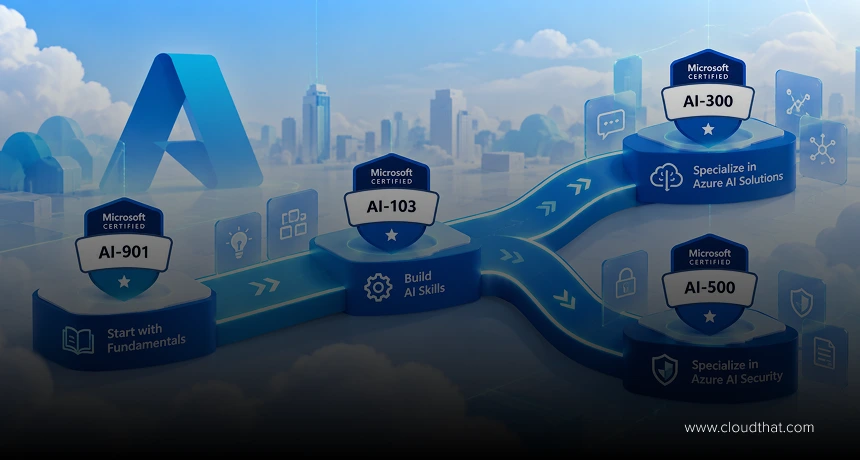
- Application developers: Build toward AI-103 or the AWS Generative AI Developer Professional. Your work is agents, RAG, and APIs.
- Data and ML engineers: Target MLA-C01, AI-300, or Google’s Professional Machine Learning Engineer. Your work is pipelines, training jobs, and model monitoring.
- Cloud architects and ops engineers: Pair AIF-C01 with MLA-C01, then add SCS-C03. Your work is making AI workloads secure, observable, and affordable.
For data and ML engineers on AWS, the Machine Learning Engineer Associate exam prep is the natural next step after foundations. It covers data preparation, SageMaker model deployment, and the MLOps practices the exam tests heavily.
Choose by role, and every exam you take builds on the last one.
Choose by hype, and you end up with five badges and no story to tell in an interview.
Which brings us to the uncomfortable part.
Why Do People Pass the Exam and Still Freeze in Interviews?
Because practice tests train recall, and interviews test judgment. An AI ML certification proves you know the services. It does not prove you can fix one at 2 AM.
Picture the scene.
You cleared the exam. Interview day arrives.
The interviewer asks: “Your SageMaker endpoint latency doubled after deployment. Walk me through what you check first.”
Silence. Not because you did not study. Because you never actually broke anything.
That gap has hidden costs too:
- A failed attempt means paying the full exam fee again
- Weeks of evenings spent on content written for an exam that has since retired
- Interview cycles lost because the resume says certified and the answers say theory
The fix is not more mock tests. It is more hands-on hours.
How Do You Pick an AI ML Certification Course That Actually Works?
Pick a course that is mapped to the current exam codes, runs at least half of its hours as hands-on labs, and is taught by someone who has deployed AI in production.
Run any course through this checklist:
- Current exam codes: AIF-C01, MLA-C01, AI-103, AI-300. Anything still teaching AWS ML Specialty or AI-102 as a target is selling you yesterday.
- 50 to 60% hands-on labs: Real Bedrock calls, real SageMaker endpoints, real cost alerts.
- Practitioner trainers: People who have run migrations and GenAI rollouts, not just read the exam guide.
- A capstone project: Something you can explain in an interview without notes.
Get these four right and the exam takes care of itself.
Why Developers Choose CloudThat for Their AI ML Certification Path
CloudThat is an AWS Premier Tier Training Partner, a Microsoft Partner, a Google Cloud Training and Consulting Partner, and an NVIDIA Training Partner. That means one team can guide your certification path across all four ecosystems, with 23 dedicated AI/ML courses. The trainers are practising consultants from a firm that holds AWS competencies in Machine Learning, MLOps, Generative AI, and Agentic AI.
For developers ready to build beyond the exam, the Mastering Generative AI on AWS program goes deep on Bedrock, RAG, and agent workflows. Career switchers who want the full data science base can take the Integrated Program in AI and Data Science. Teams that need production experience can see how the GenAI Innovation Center takes proofs of concept to live deployments, the same work that feeds back into every classroom.
For L&D leaders upskilling a cohort, the Capability Development Framework turns engineers into billable, deployable AI resources in 1 to 60 days, with skill assessments, custom pathways, and hands-on labs built in. Over 1.1 million professionals and 850+ corporates have already trained this way.
Conclusion
The certification landscape will keep shifting. Exams will retire, new ones will launch, and the badge names will change again.
What does not change is the order: one strong foundation, one role-based associate exam, one professional credential that matches your stack. Choose an AI ML certification course built around labs, and every certificate you earn will hold up when someone asks, “Okay, but have you actually built it?”
Key Takeaways
- AWS retired the Machine Learning Specialty exam on March 31, 2026, so update your study plan.
- Microsoft replaced AI-900, AI-102, and DP-100 with AI-901, AI-103, and AI-300 in 2026.
- Every strong AI ML certification roadmap follows a foundational, associate, then professional progression.
- Skip foundational exams if you already work hands-on with a cloud platform.
- Choose your AI ML certification course based on your role, not on trends.
- Developers should aim for AI-103 or the AWS Generative AI Developer Professional.
- Data and ML engineers should target MLA-C01, AI-300, or Google’s Professional ML Engineer.
- Go deep on one cloud before adding a second provider.
- Look for courses with 50 to 60% hands-on labs and practitioner trainers.
- Certifications open interviews, but production-style projects close them.
Ready to Map Your Next Certification?
Find your next live batch on the CloudThat training calendar and start with the track that fits your role.
Click here to get a quote for your team’s AI ML certification program, or call us at +91 8880002200 to talk to a learning advisor.
No Job After Graduation? Cloud Engineering is Your Answer
- Beginner Friendly
- 92% Placement Rate
- Live Instructor-Led
About CloudThat
FAQs
1. Which AI ML certification should a beginner take first?
ANS: – Start with AWS Certified AI Practitioner (AIF-C01) or Microsoft AI-901, based on the cloud your team uses. Both cover AI concepts, generative AI, and responsible AI without heavy coding.
2. Is the AWS Machine Learning Specialty still worth it?
ANS: – You cannot take it anymore. AWS retired the exam on March 31, 2026. Existing holders keep it for three years, and new candidates should target MLA-C01 and the Generative AI Developer Professional instead.
3. How long does an AI ML certification take to complete?
ANS: – A foundational exam usually takes 3 to 6 weeks of prep. Associate and professional levels take 2 to 4 months each, depending on your cloud and coding experience.
4. Do I need coding skills for an AI ML certification course?
ANS: – Not for foundational exams. Associate and professional tracks expect working Python, SDK usage, and comfort with APIs, so build those skills alongside your prep.
5. Should I certify on AWS, Azure, or Google Cloud?
ANS: – Choose the cloud your current or target employer runs on. Go deep on one provider first, then add a second only when a project needs it.
6. Does an AI ML certification guarantee a job?
ANS: – No certification guarantees a role. Certifications get your resume shortlisted, while hands-on projects and clear answers about real deployments get you the offer.

WRITTEN BY Himisha Raval
Himisha Raval is a Digital Marketing Manager at CloudThat with a strong command of search engine optimization, web analytics, link building, and content strategy. She brings a data-driven approach to digital marketing, helping IT companies strengthen their online presence, improve search rankings, and generate consistent leads across channels. Beyond execution, she plays an active role in ideation, campaign strategy, and website performance optimization. Outside of work, she balances her analytical side with a love for travel, nature painting, and dancing.


 PREV





Comments