

 Login
Login


 August 10, 2026
|
Voiced by Amazon Polly |
Overview
Modern organizations generate vast amounts of structured, semi-structured, and unstructured data every day. As businesses increasingly rely on data-driven decision-making, the demand for scalable, high-performance, and collaborative data platforms continues to grow. While AWS Glue has been a trusted serverless ETL service for building data pipelines within the AWS ecosystem, many enterprises are now adopting Databricks to meet evolving analytics, governance, and AI requirements.
This shift is not simply a replacement of one ETL tool with another. Instead, it reflects the transition from traditional data integration platforms to modern Lakehouse architectures that unify data engineering, analytics, machine learning, and governance.
Pioneers in Cloud Consulting & Migration Services
- Reduced infrastructural costs
- Accelerated application deployment
AWS Glue
AWS Glue is a fully managed, serverless data integration service provided by Amazon Web Services. It simplifies the process of discovering, transforming, and loading data without requiring users to manage infrastructure. Its serverless nature allows organizations to focus on ETL logic rather than cluster provisioning or maintenance.
Glue integrates seamlessly with other AWS services, including Amazon S3, Amazon Redshift, Amazon Athena, and AWS Lake Formation, making it an attractive choice for organizations already operating within the AWS ecosystem. Features such as Glue Crawlers, the Glue Data Catalog, Job Bookmarks, and Glue Workflows help automate schema discovery, metadata management, and pipeline orchestration.
For organizations with straightforward batch ETL requirements, AWS Glue remains a reliable and cost-effective solution.
Databricks
Databricks is a unified data and AI platform built on Apache Spark. Unlike platforms that focus solely on ETL, Databricks combines data engineering, SQL analytics, machine learning, streaming, and governance into a single collaborative environment.
One of its defining characteristics is the Lakehouse architecture, which combines the scalability of a data lake with the reliability and performance traditionally associated with data warehouses. By integrating technologies such as Delta Lake, Unity Catalog, Auto Loader, and Databricks Workflows, the platform enables organizations to manage the entire data lifecycle from ingestion to analytics and AI.
Rather than treating ETL as an isolated process, Databricks supports end-to-end data management within a unified ecosystem.
Why Are Organizations Making the Shift?
Several industry trends have accelerated the adoption of Databricks.
First, businesses increasingly require real-time insights rather than relying solely on scheduled batch processing. Modern applications generate continuous streams of data that need to be processed quickly for operational reporting, customer personalization, and fraud detection.
Second, organizations are investing heavily in artificial intelligence and machine learning. These workloads require close integration between data engineering and model development, which is easier to achieve on a unified platform.
Third, data governance has become a top priority due to growing regulatory requirements and increasing concerns around data security. Enterprises need centralized access control, lineage, auditing, and metadata management across all data assets.
Finally, organizations seek platforms that encourage collaboration among data engineers, analysts, scientists, and business users rather than maintaining separate tools for each discipline.
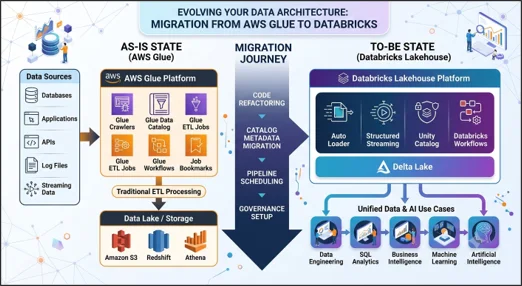
The diagram highlights the evolution from a dedicated ETL service to a unified data platform that supports multiple business functions.
The Role of Lakehouse Architecture
A major factor influencing migration is the emergence of the Lakehouse architecture.
Traditional data lakes provide inexpensive and scalable storage but often lack transactional consistency, governance, and performance optimization. Data warehouses solve many of these challenges, but are typically designed for structured data and analytical workloads.
The Lakehouse architecture combines the strengths of both approaches. It enables organizations to store all types of data while supporting ACID transactions, schema enforcement, scalable analytics, and machine learning from a single platform.
This architectural approach reduces data duplication, simplifies data management, and creates a consistent foundation for modern analytics.
Governance and Security
As organizations process increasingly sensitive information, governance is no longer optional.
Modern governance extends beyond user authentication. It includes centralized metadata management, fine-grained access control, audit trails, data lineage, and regulatory compliance.
Databricks addresses these requirements through Unity Catalog, which provides centralized governance across datasets, notebooks, machine learning models, and workflows. This unified governance model improves visibility and simplifies security management across enterprise data assets.
Collaboration Across Teams
Data projects today involve diverse teams working together throughout the data lifecycle. Data engineers build pipelines, analysts create dashboards, data scientists develop predictive models, and business users consume insights.
Platforms designed only for ETL often require separate environments for each activity. Databricks promotes collaboration by providing a shared workspace where multiple teams can work on engineering, analytics, and AI projects within the same environment.
This unified approach reduces operational complexity and accelerates project delivery.
Is AWS Glue Still Relevant?
Absolutely. AWS Glue remains an excellent choice for organizations seeking a serverless ETL service that integrates seamlessly with AWS services. Businesses with relatively simple batch workloads or organizations fully invested in the AWS ecosystem may find Glue sufficient for their needs.
The growing adoption of Databricks should not be viewed as a replacement for AWS Glue in every scenario. Instead, it reflects changing business requirements, in which organizations need a broader platform that supports analytics, governance, streaming, and AI alongside traditional data engineering.
Conclusion
The migration from AWS Glue to Databricks represents the evolution of enterprise data platforms rather than the decline of traditional ETL services. As organizations embrace Lakehouse architectures, unified governance, and AI-driven analytics, they increasingly seek platforms that consolidate multiple capabilities into a single ecosystem.
Drop a query if you have any questions regarding Databricks, and we will get back to you quickly.
Making IT Networks Enterprise-ready – Cloud Management Services
- Accelerated cloud migration
- End-to-end view of the cloud environment
About CloudThat
FAQs
1. Why are organizations adopting Databricks alongside AWS Glue?
ANS: – Organizations use Databricks to support unified analytics, streaming, machine learning, and AI workloads on a single platform while continuing to leverage AWS Glue for ETL where appropriate.
2. Does adopting Databricks mean AWS Glue is outdated?
ANS: – No. AWS Glue remains a reliable serverless ETL service, and the choice depends on an organization’s architecture, workload, and business requirements.
3. What is the key difference between AWS Glue and Databricks?
ANS: – AWS Glue is primarily a serverless ETL service, whereas Databricks is a unified Lakehouse platform that supports data engineering, analytics, governance, and AI.


WRITTEN BY Anusha
Anusha works as a Subject Matter Expert at CloudThat. She handles AWS-based data engineering tasks such as building data pipelines, automating workflows, and creating dashboards. She focuses on developing efficient and reliable cloud solutions.


 PREV
PREV






Comments