

 Login


 November 18, 2026
|
Voiced by Amazon Polly |
Microsoft Ignite 2026 opened in San Francisco on 17 November with one central message. AI agents are moving from answering questions to doing the work. Day 1 brought major updates to Microsoft Copilot, Microsoft IQ, Microsoft Foundry, Agent 365, and Azure. CloudThat’s trainers were in the sessions, and this is what stood out.
Start Learning In-Demand Tech Skills with Expert-Led Training
- Industry-Authorized Curriculum
- Expert-led Training
Microsoft Ignite 2026 Day 1 key takeaways
- Context matters more than bigger models. Microsoft IQ grounds AI agents in business data, and Microsoft argues this adds more value than a more advanced model.
- Copilot is the new operating system for work. Chat, Cowork, Code, and Autopilot now sit in one place, with full Word, Excel, and PowerPoint built in.
- Agentic AI is entering IT operations. Agents now fix bugs on GitHub, help run Oracle and SAP workloads, and operate on AKS from cloud to edge.
- Retrieval is getting smarter. Foundry IQ knowledge graphs outperformed standard RAG on complex enterprise questions in Microsoft’s tests.
- AI governance is built in. Agent 365, Microsoft Entra Agent ID and admin-approved plugins give IT control over every agent.
What is Microsoft Copilot becoming?
Microsoft now positions Copilot as the operating system for work. In the opening keynote, Satya Nadella and Judson Althoff showed Copilot bringing chat, Cowork, Code, and Autopilot together with full Word, Excel, and PowerPoint. Autopilot works as a long-running digital teammate, and Workspaces let people and AI agents work together in one shared space, a theme repeated at Live at Microsoft Ignite.
The Plugins for Copilot, Sébastien Levert and Garry Trinder showed how one plugin can bundle agents, skills, MCP servers, and connectors and run across Microsoft 365 Copilot, Copilot Chat, and Cowork, with centralized admin controls.
What is Microsoft IQ, and why does context matter?
Microsoft IQ is Microsoft’s enterprise context platform for AI agents, now generally available. It combines Work IQ, Fabric IQ, Foundry IQ and Web IQ with more than 350 third-party connectors.
Speakers at What’s new in Work IQ argued that business context matters more than a more advanced model. Microsoft’s figures for Work IQ showed 1.7 to 3.9 times as many tasks completed and a 40 to 74% lower cost per task.
What’s new in Microsoft Foundry?
Microsoft Foundry now offers more than 11,000 AI models and a self-improving loop that connects evaluation, optimization, and post-training. Build your self-improving AI platform with Microsoft Foundry, adding GPT-6.2 Astra and Sol, MAI Code 2, generally available Managed Compute, and a preview Agent Optimizer. Microsoft says MAI Code 2 reaches 98% of GPT-6.1 Sol’s quality at about 40% of the cost, averaged across four coding benchmarks.
In The shift from RAG to context: Grounding agents with Foundry IQ, Pablo Castro showed where basic RAG breaks down, such as when counting questions or when facts are spread across documents. In Microsoft’s tests, Foundry IQ’s new knowledge graphs (public preview) answered 93.5% of questions correctly, compared with 26.1% for standard RAG, while using 64.3% fewer tokens.
How are AI agents being used in IT operations?
Three sessions showed agentic AI moving into day-to-day IT operations.
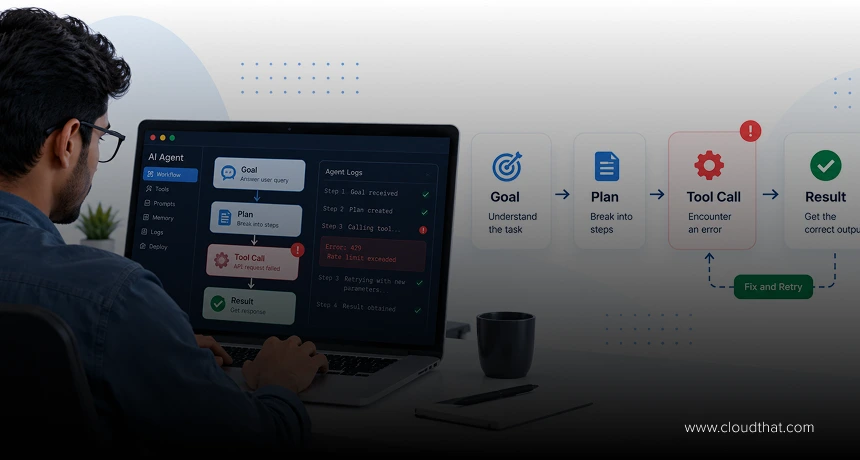
- GitHub Copilot. In Agent-native engineering with developers and agents on GitHub, automations turned an Azure Monitor exception into an issue, reproduced the bug, proposed a fix, and tested it before attaching visual evidence to the pull request. The engineer only reviewed and merged.
- Oracle and SAP on Azure. In Bring agentic operations to Oracle and SAP on Azure, Microsoft said that about half of operational time is spent on manual detection and triage. Azure Workload Centers and run agents, now in limited preview, give agents a live view of the whole workload.
- Azure Kubernetes Service (AKS). The AKS session ran fine-tuned models from the cloud to GPU machines on a factory floor, with sandboxing and network policy keeping agents contained.
What changed in Azure infrastructure and Windows?
Build integrated AI apps with Azure HorizonDB showed how Azure HorizonDB, a PostgreSQL-based database now generally available, can call AI models directly from SQL and combine vector search, full-text search, and knowledge graphs in one place.
How Azure Networking is ready for the next generation of AI solutions explained why networking matters for AI workloads. When GPUs wait on data, expensive hardware sits idle, so Microsoft is adding capacity and cutting network hops across its global network.
On the desktop, Stefan Kinnestrand and Bhavya Chopra introduced Copilot Fusion. With the user’s permission, Copilot on Windows can use local PC context and on-device AI models for supported tasks, combining local and cloud intelligence. Windows 365 for Agents gives agents secure Cloud PC access, dedicated Microsoft Entra identities, and Intune-managed security.
How is Microsoft approaching AI governance?
Agent 365 is Microsoft’s observability and governance platform for AI agents… New features include an agent map, Action Center, idle-agent cleanup, and spending alerts with hard limits. With Microsoft Entra Agent ID, each agent gets its own identity, so IT can see, restrict, and block it like a user account.
What should teams do after Microsoft Ignite 2026?
The gap between AI models keeps shrinking. What now separates teams is how well they connect their data, set agent permissions, and measure results. Those are skills, and skills can be taught.
Upskill Your Teams with Enterprise-Ready Tech Training Programs
- Team-wide Customizable Programs
- Measurable Business Outcomes
About CloudThat
FAQs
1. What were the biggest announcements at Microsoft Ignite 2026?
ANS: – Microsoft positioned Copilot as the new operating system for work, made Microsoft IQ generally available, expanded Microsoft Foundry to more than 11,000 AI models, and added new governance features to Agent 365. Across the event, the common theme was AI agents moving from answering questions to doing the work.
2. What is Microsoft IQ?
ANS: – Microsoft IQ is Microsoft’s enterprise context platform for AI agents. It combines Work IQ, Fabric IQ, Foundry IQ, and Web IQ with more than 350 third-party connectors, so agents can work with an organization’s own data while the organization retains ownership. It became generally available at Microsoft Ignite 2026.
3. How does Agent 365 help IT teams govern AI agents?
ANS: – Agent 365 is Microsoft’s observability and governance platform for AI agents. It includes an agent map, an Action Center, idle-agent cleanup, and spending alerts with hard limits. With Microsoft Entra Agent ID, each agent gets its own identity, so IT can see, restrict, and block it the same way it manages a user account.

WRITTEN BY Priyasha
Priyasha is a Content Writer at CloudThat with a talent for turning briefs into content that lands. She handles blogs, paid ads, social media, and LinkedIn and Meta marketing, while staying deeply involved in ideation, strategy, and brand storytelling across B2B and B2C spaces. Her love for storytelling doesn't stop at work; she's equally at home dissecting a film, binge-watching anime, or getting lost in a video game.


 PREV



Comments