

 Login
Login


 April 20, 2026
|
Voiced by Amazon Polly |
Introduction
Conversational AI systems, ranging from voice assistants to real-time customer support bots, are increasingly expected to respond instantly and naturally. However, traditional text-to-speech (TTS) systems often introduce latency that disrupts the conversational flow. To address this, Amazon Polly introduced a Bidirectional Streaming API, enabling real-time speech synthesis where text and audio flow simultaneously. This marks a significant shift from batch-based TTS to streaming-first architectures, designed for modern AI systems powered by large language models (LLMs). As user expectations evolve toward human-like interactions, reducing response latency is no longer optional, it is a core requirement. This is where streaming-based speech synthesis becomes critical.
Pioneers in Cloud Consulting & Migration Services
- Reduced infrastructural costs
- Accelerated application deployment
Background: Limitations of Traditional TTS
Traditional TTS systems operate on a request-response model:
- Generate the complete text
- Send it to the TTS engine
- Wait for full audio synthesis
- Begin playback
This workflow introduces delays, especially in LLM-based systems that generate text token by token.
For conversational AI, even small delays degrade user experience. Human conversations typically expect responses within a few hundred milliseconds, anything longer feels unnatural. Additionally, traditional pipelines often require buffering strategies and complex orchestration to minimize delays, which increases engineering overhead and system complexity.
Bidirectional Streaming in Amazon Polly
The Bidirectional Streaming API enables full-duplex communication between client applications and Amazon Polly over a single connection.
Instead of waiting for full text input:
- Text can be sent incrementally
- Audio is received in real time
- Both streams operate simultaneously
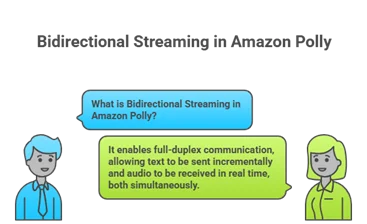
This fundamentally changes how speech synthesis integrates with conversational pipelines. It allows systems to start speaking while still “thinking,” closely mimicking how humans communicate in real life.
Key Features
- Incremental Text Input
Applications can stream partial text (e.g., LLM tokens) as soon as they are generated, without waiting for completion.
- Real-Time Audio Output
Audio is synthesized and streamed back immediately, enabling near-instant playback.
- True Duplex Communication
A single HTTP/2 connection handles both input and output streams concurrently, simplifying the architecture.
- Fine-Grained Control
Developers can control when buffered text is synthesized using flush mechanisms.
- Improved Responsiveness
Because audio playback can begin earlier, users perceive the system as significantly faster and more interactive, even if total processing time remains similar.
Architecture Overview
Traditional Approach
- Multiple API calls
- Middleware for text chunking
- Audio stitching and buffering
- Higher complexity and latency
Bidirectional Streaming Approach
- Single persistent connection
- Native streaming (input + output)
- Reduced infrastructure overhead
- Lower latency and faster response times
This shift not only improves performance but also reduces the need for custom engineering solutions that were previously required to simulate streaming behavior.
Core Streaming Events
The API introduces structured event types:
- TextEvent → Send text chunks to Polly
- AudioEvent → Receive synthesized audio chunks
- CloseStreamEvent → Signal end of input
- StreamClosedEvent → Confirm stream completion
This event-driven model aligns well with streaming architectures in modern AI systems and enables better control over the synthesis lifecycle.
Performance Improvements
The key advantage of bidirectional streaming is latency reduction:
- Eliminates wait time for full text generation
- Enables faster “time-to-first-audio”
- Supports continuous playback while text is still being generated
This is especially impactful when paired with LLMs, which produce responses that are inherently incremental. In many cases, users can begin hearing a response almost immediately after a query is processed, significantly improving engagement and satisfaction.
Integration with LLM-Based Systems
Modern conversational AI pipelines typically include:
- Speech-to-text (ASR)
- LLM for response generation
- Text-to-speech (TTS)
The new API fits naturally into this pipeline:
- LLM generates tokens → streamed to Polly
- Amazon Polly generates audio → streamed to the user
This enables continuous, overlapping processing, significantly improving responsiveness and perceived intelligence. It also reduces idle time between components, making the entire system more efficient.
Use Cases
- Voice Assistants
Deliver faster, more natural responses without awkward pauses.
- Customer Support Bots
Enable real-time conversational experiences in call centers.
- Gaming and Virtual Characters
Characters can speak dynamically as dialogue is generated, enhancing immersion.
- Real-Time Translation
Supports live multilingual communication with immediate audio feedback.
- Education and Accessibility
Interactive learning systems can deliver spoken feedback instantly, improving engagement and inclusivity.
Developer Experience and Integration
Developers can access the API via:
- AWS SDKs
- REST APIs
- AWS Management Console
The simplified architecture reduces the need for:
- Custom chunking logic
- Parallel API orchestration
- Audio reassembly pipelines
This results in faster development cycles, easier debugging, and improved maintainability. It also lowers the barrier to entry for building sophisticated voice-enabled applications.
Benefits Summary
- Lower latency → Faster user responses
- Simpler architecture → Reduced engineering overhead
- Better UX → More natural conversations
- LLM compatibility → Ideal for generative AI systems
- Scalable → Built on AWS infrastructure
Future Scope
Bidirectional streaming is a foundational step toward fully real-time conversational AI systems. Future advancements may include:
- Emotion-aware speech synthesis
- Multi-speaker dynamic conversations
- Seamless integration with multimodal AI (text, audio, video)
- Edge deployment for ultra-low latency
As AI systems evolve toward human-like interaction, streaming-first architectures will become the default rather than the exception. The ability to process and respond in real time will define the next generation of intelligent systems.
Conclusion
Amazon Polly’s Bidirectional Streaming API represents a major evolution in speech synthesis. By enabling real-time, duplex communication between text generation and audio playback, it removes one of the biggest bottlenecks in conversational AI.
As conversational interfaces continue to grow, adopting streaming-based approaches will be key to delivering truly natural user experiences.
Drop a query if you have any questions regarding Amazon Polly and we will get back to you quickly.
Empowering organizations to become ‘data driven’ enterprises with our Cloud experts.
- Reduced infrastructure costs
- Timely data-driven decisions
About CloudThat
FAQs
1. What problem does bidirectional streaming solve?
ANS: – It eliminates latency caused by waiting for complete text before synthesis, enabling real-time audio generation.
2. How is it different from traditional TTS?
ANS: – Traditional TTS requires full input before output; bidirectional streaming allows simultaneous input and output.
3. Is it compatible with LLM-based systems?
ANS: – Yes, it is specifically designed to work with incremental outputs from large language models.


WRITTEN BY Daniya Muzammil
Daniya works as a Research Associate at CloudThat, specializing in backend development and cloud-native architectures. She designs scalable solutions leveraging AWS services with expertise in Amazon CloudWatch for monitoring and AWS CloudFormation for automation. Skilled in Python, React, HTML, and CSS, Daniya also experiments with IoT and Raspberry Pi projects, integrating edge devices with modern cloud systems.


 PREV
PREV












Comments