

 Login
Login

 December 16, 2025
|
Voiced by Amazon Polly |
Microsoft Fabric unifies a bunch of data tools, all built upon a foundation of OneLake: a single, logical data lake for your whole organization. Microsoft Fabric portal is the unified platform. There are three essential data stores for analytical workloads: the Fabric Lakehouse, the Data Warehouse and the KQL Database.
All the mentioned data storage options on OneLake come with open formats, and each has a different design, usage, use case and compute engine. Select the option that best meets the business requirements, performance, cost and experience.
While all of them store data in open formats on OneLake, each is fundamentally different in design, primary use cases and underlying compute engines. Choosing the right one is essential for optimal performance, cost and developer experience.
Start Learning In-Demand Tech Skills with Expert-Led Training
- Industry-Authorized Curriculum
- Expert-led Training
Core Differences: Architecture and Skillset
The critical differentiators come down to primary language/skill set and the transactional behaviour they support.
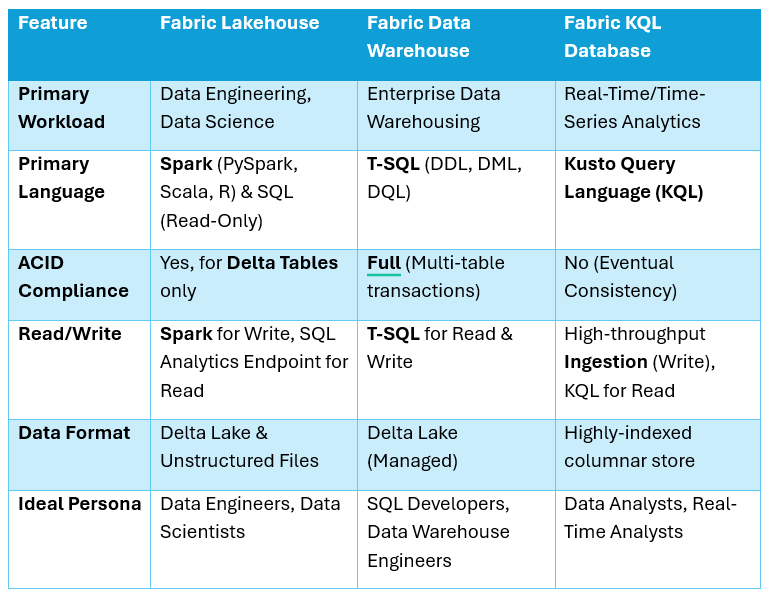
When to Choose Which Data Store
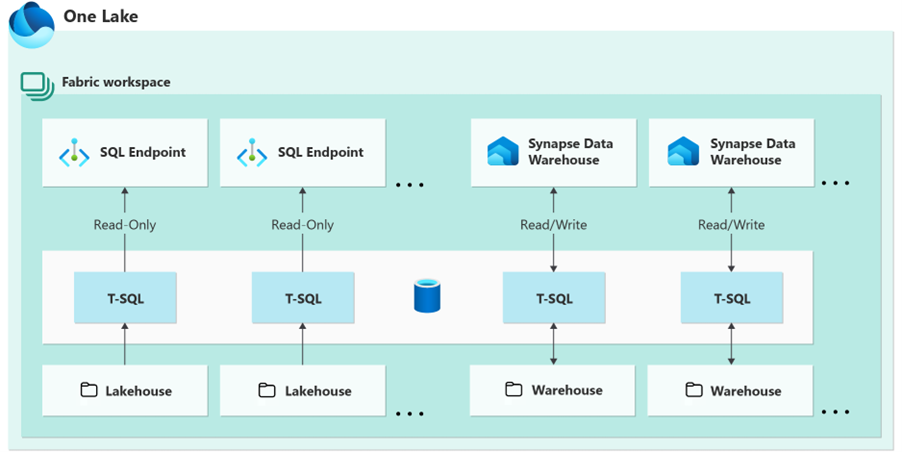
Source: Microsoft Learn
It’s not about one being “better,” it’s which best fits your task and the skill set of your team.
- The Fabric Lakehouse: Flexibility and File Focus
The Lakehouse is the centerpiece of the Fabric Data Engineering experience and is designed to handle all types of data. It is ideal for cases where different tools need to be used in the processing of data.
Choose the Lakehouse:
- Your team’s primary skillset is Spark (PySpark/Scala) for ETL/ELT.
- You must work with a variety of data: structured, semi-structured and unstructured.
- You will build a Medallion Architecture (Bronze/Silver/Gold layers) that has the Silver and Gold layers as Delta Tables and the Bronze layer as raw files.
- You want to use the SQL Analytics Endpoint for performing read-only T-SQL querying and consumption by BI tools.
- The Fabric Data Warehouse:
The Fabric Data Warehouse provides a similar enterprise data warehousing experience for those heavily invested in T-SQL. It has full DDL/DML support and is the only Fabric store that guarantees multi-table transactionality.
Choose the Fabric Data Warehouse when:
- Most data roles require the implementation of complicated SQL DML transformations, such as INSERT, UPDATE and DELETE, and T-SQL is the strongest skill set.
- For mission-critical reporting tables, it enables complete transactional assurances and ACID compliance.
- Using pre-existing stored procedures and functions while migrating an existing SQL-based data warehouse.
- If it requires a dedicated, managed SQL environment for enterprise BI and reporting.
- The Fabric KQL Database: Speed for Real-time Analytics
KQL Database forms part of the Real-Time Intelligence workload and is engineered for lightning-fast ingestion and low-latency query of high-volume, time-series and telemetry data.
Choose the KQL Database when:
- When working with high-velocity streaming data, such as logs, telemetry and IoT sensor data.
- Need to run near-real-time analytics.
- Analysis needs special functions for time series, for example, binning and interpolation. Full-text search is also something KQL is good at.
- To analyze the vast amount of data without processing it in real-time.
Choosing the Right Fabric Store
Fabric Lakehouse is the natural starting point for most modern data engineering scenarios due to its flexibility, openness and ability to support both file-based processing and Delta Lake transactions. The Fabric Data Warehouse excels when organisations require robust governance, enterprise-grade modelling and comprehensive T-SQL capabilities with guaranteed transactional integrity. Meanwhile, the KQL Database stands apart as the purpose-built engine for high-volume, real-time analytics that demand sub-second query performance.
Ultimately, the choice is not about which technology is superior, but about aligning the right engine to the right workload. Many enterprises will benefit from using all three together, leveraging Lakehouse for transformation, Warehouse for governed BI and KQL for operational insights, unified seamlessly through OneLake. This convergence is what makes Microsoft Fabric powerful: a single platform where diverse analytical needs coexist, complement each other and deliver a truly end-to-end data ecosystem.
Upskill Your Teams with Enterprise-Ready Tech Training Programs
- Team-wide Customizable Programs
- Measurable Business Outcomes
About CloudThat


WRITTEN BY Mohan Krishna Kalimisetty
Mohan Krishna is a Subject Matter Expert at CloudThat. He has 10+ years of experience as a Power BI developer and he has worked on different projects and various technologies like Power BI, SQL Server, Azure Analysis Services, SQL Integration Services, Excel, etc. He has developed Visualization, Dashboard and reports using reporting tools. He loves training people on cutting-edge technologies.


 PREV
PREV




Comments