

 Login
Login


 September 7, 2026
|
Voiced by Amazon Polly |
Introduction
Retrieval-Augmented Generation, or RAG, has become one of the most practical ways to make LLM applications more useful by incorporating private, up-to-date information. Instead of asking a model to answer based solely on its training data, RAG retrieves relevant information from external sources and provides that context to the model.
But not every RAG system works the same way. A basic RAG pipeline follows a mostly linear retrieval-and-generation flow. Agentic RAG adds planning, tool use, iteration, and validation. Multi-Agent RAG takes this a step further by distributing work across multiple specialized agents.
The goal is the same, better answers, but the level of reasoning, orchestration, and autonomy is different.
Pioneers in Cloud Consulting & Migration Services
- Reduced infrastructural costs
- Accelerated application deployment
Traditional RAG: Simple and Straightforward
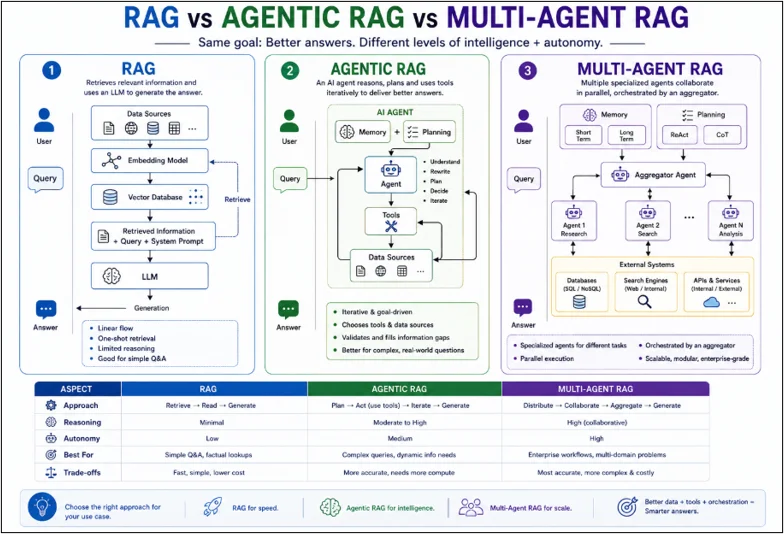
A traditional RAG system is designed around a relatively simple flow. The user asks a question; the system converts the query into an embedding, searches a vector database, retrieves relevant information, and passes that information, along with the original query and system instructions, to the LLM.
The LLM then generates the final response using the retrieved context.
- Linear flow
- Usually one-shot retrieval
- Works well for straightforward questions and answers
- Easy to build, operate, and troubleshoot
Agentic RAG: RAG with Planning and Iteration
Agentic RAG introduces an AI agent between the user and the underlying data and tools. Instead of following a single fixed retrieval path, the agent can understand the request, plan what needs to be done, select tools or data sources, evaluate the information it receives, and iterate as necessary.
The agent effectively turns RAG from a fixed pipeline into a goal-driven workflow.
- Understands and potentially rewrites the query
- Plans the steps required to answer the question
- Chooses appropriate tools or data sources
- Iterates when the first result is insufficient
- Can validate information and fill knowledge gaps
Multi-Agent RAG: Specialized Agents Working Together
Multi-Agent RAG extends the idea by using multiple specialized agents, coordinated by an orchestrator or aggregator agent. Each agent can focus on a particular task or information source while the aggregator combines their findings into a final response.
For example, one agent might search internal documentation, another might query databases or APIs, and another might investigate observability data. Their results can then be brought together for the final generation step.
- Specialized agents for different tasks
- Parallel execution can reduce overall workflow time
- An aggregator or orchestrator coordinates the agents
- Can integrate databases, APIs, files, search engines, and cloud services
- More modular for complex enterprise workflows
RAG vs Agentic RAG vs Multi-Agent RAG
- RAG → retrieve relevant information and generate an answer.
- Agentic RAG → retrieve, reason, plan, use tools, validate, and iterate.
- Multi-Agent RAG → coordinate multiple specialized agents to solve different parts of a complex task.
Choosing the Right Approach
More sophisticated does not automatically mean better. Choose based on the problem.
Use Traditional RAG When
- Questions are relatively simple and well-defined.
- The answer is usually available in a small set of documents.
- You want a predictable and easier-to-operate architecture.
Use Agentic RAG When
- Questions require multiple retrieval steps.
- The system needs to choose between tools or data sources.
- Information may be incomplete and require iterative investigation.
Use Multi-Agent RAG When
- The problem naturally breaks into specialized tasks.
- Different agents need different tools, prompts, or expertise.
- Parallel investigation can improve the workflow.
- The environment is sufficiently complex to warrant additional orchestration.
Conclusion
RAG, Agentic RAG, and Multi-Agent RAG represent different levels of capability built around the same fundamental idea: give an LLM access to the right context and data.
RAG provides retrieval. Agentic RAG adds planning, tools, reasoning, and iteration. Multi-Agent RAG adds specialization and orchestration across multiple agents.
For production systems, start with the simplest architecture that solves the problem. Move toward agentic or multi-agent designs when the workload genuinely requires more reasoning, tool use, or specialized collaboration.
Drop a query if you have any questions regarding RAG, and we will get back to you quickly.
Empowering organizations to become ‘data driven’ enterprises with our Cloud experts.
- Reduced infrastructure costs
- Timely data-driven decisions
About CloudThat
FAQs
1. Is Agentic RAG better than traditional RAG?
ANS: – Not always. Traditional RAG is often preferable for simple, predictable Q&A. Agentic RAG is useful when the task requires planning, tool use, or iterative retrieval.
2. What makes Multi-Agent RAG different?
ANS: – It uses multiple specialized agents that can perform different parts of a task, with an orchestrator or aggregator coordinating their results.
3. Does Multi-Agent RAG always require parallel execution?
ANS: – No. Parallel execution is one possible advantage, but agents can also be coordinated sequentially when one requires the output of another.


WRITTEN BY Ayush Agarwal
Ayush Agarwal works as a Subject Matter Expert at CloudThat. He is a certified AWS Solutions Architect Professional with expertise in designing and implementing scalable cloud infrastructure solutions. Ayush specializes in cloud architecture, infrastructure as code, and multi-cloud deployments, helping organizations optimize their cloud strategies and achieve operational excellence. With a deep understanding of AWS services and best practices, he guides teams in building robust, secure, and cost-effective cloud solutions. Ayush is passionate about emerging cloud technologies and continuously enhances his knowledge to stay at the forefront of cloud innovation. In his free time, he enjoys exploring new AWS services, experimenting with technologies, and trekking to discover new places and connect with nature.


 PREV
PREV











Comments