

 Login
Login


 December 9, 2025
|
Voiced by Amazon Polly |
Overview
As organizations continue adopting microservices and containerized architectures, the demand for fast and reliable CI/CD pipelines has never been higher. Traditional CI/CD solutions often rely on heavyweight agents, inconsistent environments, and complex integrations. Drone CI, a lightweight and container-native CI/CD platform, solves these challenges by executing every pipeline step inside Docker containers. This makes Drone CI inherently portable, reproducible, and easy to integrate into modern DevOps ecosystems.
In this blog, we explore how to build an end-to-end CI/CD pipeline using Drone CI, with a focus on multi-stage Docker builds and automated Kubernetes deployments. We will walk through practical examples, real YAML configurations, and container deployment scripts, making this blog hands-on and implementation oriented.
Pioneers in Cloud Consulting & Migration Services
- Reduced infrastructural costs
- Accelerated application deployment
Introduction
Drone CI is a container-native CI/CD tool designed for cloud-native teams. Unlike traditional systems that depend on dedicated build servers or virtual machines, Drone launches every pipeline step using Docker containers. This enables:
- Consistent build environments
- Simple dependency management
- Scalable isolation
- Clear and declarative pipeline definitions using .drone.yml
Drone integrates seamlessly with GitHub, GitLab, Bitbucket, Gitea, and other Git providers, enabling automatic pipeline triggers on commit, pull request, or tag.
This blog focuses on two major capabilities Drone CI excels at:
- Multi-stage Docker Builds
Multi-stage Docker builds help reduce image size, improve security, and optimize runtime environments. This is especially beneficial for production workloads running on Kubernetes.
- Automated Kubernetes Deployments
Drone CI interacts directly with Kubernetes using kubectl, Helm, or Kustomize plugins. This enables fully automated deployments once a Docker image is successfully built and pushed to a registry.
Together, these capabilities help implement a robust end-to-end CI/CD pipeline suitable for enterprise workloads.
Key Features of Drone CI for Docker & Kubernetes Workflows
- First-Class Multi-Stage Docker Build Support
Drone CI runs Docker natively and supports multi-stage builds without any additional configuration. This allows you to:
- Build optimized production images
- Separate build and runtime dependencies
- Improve security by reducing image footprint
- Reduce the attack surface by removing unnecessary packages
Example Multi-Stage Dockerfile:
|
1 2 3 4 5 6 7 8 9 10 11 12 13 |
# -------- Stage 1: Build -------- FROM node:18-alpine AS builder WORKDIR /app COPY package*.json ./ RUN npm install COPY . . RUN npm run build # -------- Stage 2: Runtime -------- FROM nginx:1.25-alpine COPY --from=builder /app/dist /usr/share/nginx/html EXPOSE 80 CMD ["nginx", "-g", "daemon off;"] |
- Automated Kubernetes Deployments (kubectl plugin)
Drone CI provides powerful plugins for Kubernetes, allowing you to:
- Apply Kubernetes manifests
- Patch deployments
- Update container images
- Perform rolling updates
- Verify rollout status
Example Kubernetes Deployment YAML:
|
1 2 3 4 5 6 7 8 9 10 11 12 13 14 15 16 17 18 19 20 21 22 23 24 25 26 27 28 29 30 31 |
apiVersion: apps/v1 kind: Deployment metadata: name: demo-app spec: replicas: 2 selector: matchLabels: app: demo-app template: metadata: labels: app: demo-app spec: containers: - name: demo-app image: your-dockerhub-username/demo-app:latest ports: - containerPort: 80 --- apiVersion: v1 kind: Service metadata: name: demo-service spec: type: ClusterIP selector: app: demo-app ports: - port: 80 targetPort: 80 |
- Simple YAML-Based Pipeline Configuration
Drone pipelines are defined in a .drone.yml file stored alongside your application code. This ensures pipeline-as-code, version control, and easy collaboration.
Drone CI Build + Push Pipeline:
|
1 2 3 4 5 6 7 8 9 10 11 12 13 14 15 |
kind: pipeline type: docker name: build-and-push steps: - name: build image: plugins/docker settings: repo: your-dockerhub-username/demo-app tags: latest dockerfile: Dockerfile username: from_secret: docker_username password: from_secret: docker_password |
- Secure Secrets Handling
Drone CI encrypts secrets such as:
- Docker credentials
- Kubernetes tokens
- API keys
They are never exposed in logs and only injected into the required steps.
- End-to-End CI/CD Pipeline Combining Build + Deploy
Below is a complete Drone CI pipeline that builds a Docker image, pushes it, and deploys it to Kubernetes:
|
1 2 3 4 5 6 7 8 9 10 11 12 13 14 15 16 17 18 19 20 21 22 23 |
kind: pipeline type: docker name: drone-ci-cicd steps: - name: build-and-push image: plugins/docker settings: repo: your-dockerhub-username/demo-app tags: latest dockerfile: Dockerfile username: from_secret: docker_username password: from_secret: docker_password - name: deploy-to-k8s image: bitnami/kubectl:latest environment: KUBECONFIG: from_secret: kubeconfig commands: - kubectl apply -f k8s/deployment.yaml - kubectl rollout status deployment/demo-app |
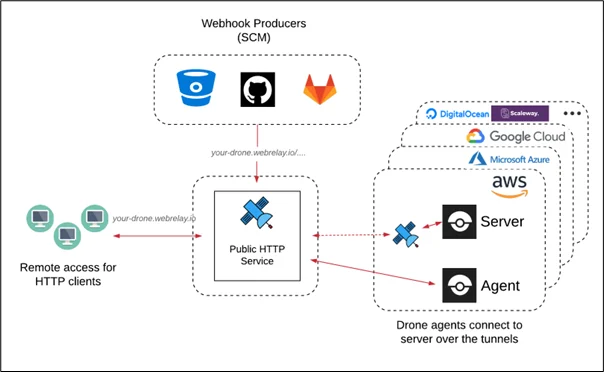
Source: https://webhookrelay.com/images/blog/drone/drone.png
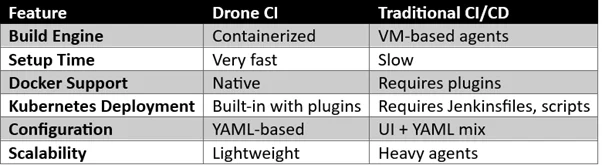
Drone CI vs Traditional CI/CD Pipelines
Conclusion
Drone CI is one of the most efficient and modern CI/CD tools for cloud-native applications. Its container-first approach simplifies dependency management, ensures consistent environments, and improves build performance. By leveraging multi-stage Docker builds, Drone enables the creation of optimized production images, while its Kubernetes integration facilitates seamless automated deployments.
With Drone CI, teams can accelerate release cycles, reduce deployment errors, and standardize their DevOps workflows. As Kubernetes adoption continues to rise, Drone CI stands out as a powerful, flexible, and lightweight CI/CD solution tailored for modern engineering teams.
Drop a query if you have any questions regarding Drone CI and we will get back to you quickly.
Empowering organizations to become ‘data driven’ enterprises with our Cloud experts.
- Reduced infrastructure costs
- Timely data-driven decisions
About CloudThat
FAQs
1. Does Drone CI support multi-stage Docker builds?
ANS: – Yes. Multi-stage Docker builds work seamlessly with Drone CI, as it utilizes Docker for build execution.
2. Can Drone deploy applications directly to Kubernetes?
ANS: – Yes. Using kubectl, Helm, or Kustomize plugins, Drone can fully automate Kubernetes deployments.
3. How secure is secrets handling in Drone CI?
ANS: – Drone encrypts all secrets and injects them only during pipeline runtime.


WRITTEN BY Akshay Acharya
Akshay Acharya works as a Research Associate at CloudThat. He possesses strong analytical thinking and problem-solving skills, knowledge of AWS cloud services, migration, infrastructure setup, and security, as well as the ability to quickly adopt new technologies and learn.


 PREV
PREV












Comments