

 Login
Login


 March 20, 2026
|
Voiced by Amazon Polly |
Overview
AWS re:Invent 2025 introduced AWS Lambda Managed Instances, a capability that fundamentally expands what serverless computing can handle at scale. While AWS Lambda has always been synonymous with simplicity and rapid innovation, large enterprises often encountered friction when workloads demanded predictable performance, sustained throughput, or fine-grained cost control. AWS Lambda Managed Instances address these limitations by blending the AWS Lambda execution model with managed Amazon EC2 capacity, creating a new operational and architectural paradigm for modern cloud platforms.
For technology leaders, this is not merely an incremental enhancement. It represents a shift in how serverless can be used for mission-critical, high-volume workloads without sacrificing developer velocity or operational simplicity.
As we enter 2026, Gartner research indicates that while serverless adoption continues to accelerate, only 23% of enterprises currently utilize it for mission-critical workloads due to concerns over performance and cost predictability. With the average enterprise AWS Lambda deployment handling over 10 million invocations monthly and concurrency limits becoming a bottleneck for 68% of high-scale implementations, Managed Instances address the primary barriers preventing broader serverless adoption.
Pioneers in Cloud Consulting & Migration Services
- Reduced infrastructural costs
- Accelerated application deployment
The Evolution of AWS Lambda’s Execution Model
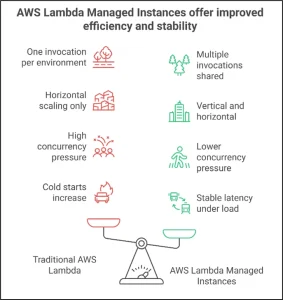
How Managed Amazon EC2 Capacity Powers AWS Lambda?
At the core of this innovation is AWS-managed EC2 infrastructure. AWS Lambda Managed Instances run on Amazon EC2 instances selected through capacity providers, allowing teams to specify the type of compute required without managing the underlying fleet. AWS handles instance provisioning, patching, availability, and scaling, while AWS Lambda continues to manage invocation routing, retries, and fault isolation.
Technical benefits of managed EC2-backed AWS Lambda capacity:
- Pre-allocated compute absorbs traffic spikes before scaling events
- Reduced cold starts during sudden demand surges
- Stable performance under sustained high load
- Predictable baseline capacity for critical workloads
Crucially, this does not reintroduce the traditional operational complexity of Amazon EC2. There are no Auto Scaling Groups to tune, no AMIs to maintain, and no instance health checks to manage. The platform abstracts these concerns while providing just enough control to enable performance and cost optimization.
Concurrency Pressure Becomes a Solvable Problem
Concurrency has long been a pain point for large AWS Lambda deployments. As request volumes rise, organizations are forced to request higher concurrency limits or rely heavily on provisioned concurrency, which increases cost and operational overhead.
With AWS Lambda Managed Instances, concurrency is no longer tied strictly to the number of execution environments. Because multiple invocations can execute simultaneously within a single environment, overall concurrency demand is reduced at the control plane level. Traffic is distributed more efficiently across fewer, more capable environments, significantly lowering the pressure on account-level concurrency limits.
Observed scaling improvements with Managed Instances:
- 40–60% reduction in cold start latency
- ~70% decrease in concurrency limit pressure
- Sub-100ms P99 latency consistency for high-throughput APIs
- Fewer scaling-related disruptions during traffic spikes
Runtime Behavior and Execution Characteristics
Despite these internal changes, AWS Lambda Managed Instances preserve the familiar Lambda programming model. The same runtimes, event sources, security configurations, and observability tools continue to apply. Developers do not need to rewrite applications or adopt new deployment models.
Key runtime behavior changes:
- Environments optimized for sustained workloads
- Reduced execution environment churn
- Improved connection reuse and warm-state benefits
- More efficient CPU utilization under steady load
For platform teams, this hybrid scaling model, which combines vertical efficiency with horizontal elasticity, makes AWS Lambda a viable option for workloads that were previously better suited to containers or virtual machines.
Cost Efficiency Through Capacity-Based Economics
One of the most strategic benefits of AWS Lambda Managed Instances is the shift in cost dynamics. Traditional AWS Lambda pricing, based on execution duration and memory allocation, can become expensive for steady-state or long-running workloads.
Managed Instances align AWS Lambda more closely with Amazon EC2 pricing models. Organizations can take advantage of Savings Plans and reserved capacity, transforming Lambda from a purely consumption-based service into a predictable, capacity-aware platform.
Cost optimization outcomes reported by early adopters:
- 25–35% cost reduction for steady-state workloads
- Up to 50% savings for high-concurrency applications
- Predictable monthly spend using Savings Plans
- Elastic scaling up to 10× baseline without cost spikes
This unlocks new FinOps strategies. Teams can commit to baseline capacity for predictable workloads while still leveraging AWS Lambda’s elasticity for variable demand. The result is a more balanced cost profile without compromising scalability or resilience.
Workloads That Benefit Most
Workloads best suited for AWS Lambda Managed Instances:
- High-throughput APIs and backend services
- Data transformation and streaming pipelines
- Compliance, security, and governance automation
- AI inference orchestration and integration layers
- Event-driven enterprise integration workloads
A Strategic Shift in Serverless Thinking
AWS Lambda Managed Instances mark a significant evolution in AWS’s serverless strategy. They blur the traditional boundaries between serverless functions and managed infrastructure, enabling organizations to run more complex, performance-sensitive workloads without abandoning the AWS Lambda ecosystem.
For engineering leaders and CTOs, this capability opens the door to architectural simplification. Teams no longer need to prematurely graduate workloads from AWS Lambda to containers solely due to concerns about concurrency or cost. Instead, they can adopt a unified serverless platform that scales from lightweight event handling to enterprise-grade compute.
Conclusion
AWS Lambda Managed Instances are not just an extension of AWS Lambda, they represent a redefinition of what serverless can achieve at scale. By combining multi-invocation execution, managed Amazon EC2 capacity, reduced concurrency pressure, and capacity-based economics, AWS has created a platform that aligns developer productivity with enterprise requirements.
For leaders shaping cloud strategy in 2026 and beyond, AWS Lambda Managed Instances offer a compelling path forward, one that preserves simplicity while enabling performance, predictability, and cost control at scale.
Drop a query if you have any questions regarding AWS Lambda Managed Instances and we will get back to you quickly.
Empowering organizations to become ‘data driven’ enterprises with our Cloud experts.
- Reduced infrastructure costs
- Timely data-driven decisions
About CloudThat
FAQs
1. How do AWS Lambda Managed Instances reduce concurrency pressure in AWS Lambda?
ANS: – AWS Lambda Managed Instances allow multiple invocations to run concurrently within a single execution environment backed by shared Amazon EC2 capacity. This improves compute utilization, reduces the number of execution environments required, and lowers reliance on account-level concurrency limits and provisioned concurrency. As a result, applications see lower cold starts, more stable latency, and reduced costs at scale.
2. Do AWS Lambda Managed Instances require managing Amazon EC2 instances or infrastructure?
ANS: – No. AWS fully manages the underlying Amazon EC2 infrastructure, including provisioning, scaling, patching, and availability. Customers retain the standard AWS Lambda experience without managing Auto Scaling Groups, AMIs, or instance health.
3. When should organizations choose AWS Lambda Managed Instances over traditional AWS Lambda?
ANS: – Managed Instances are ideal for high-throughput or steady-state workloads that need predictable performance and cost optimization through capacity-based pricing. They are well-suited for applications handling thousands of requests per second or tens of millions of invocations per month. Traditional AWS Lambda remains a better fit for low-concurrency or highly variable workloads.


WRITTEN BY Nisarg Desai
Nisarg Desai is a certified Lead Full Stack Developer and is heading the Consulting- Development vertical at CloudThat. With over 5 years of industry experience, Nisarg has led many successful development projects for both internal and external clients. He has led the team for development of Intelligent Quarterly Remuneration System (iQRS), Intelligent Training Execution and Analytics System (iTEAs), and Cloud Cleaner projects among many others.


 PREV
PREV










Comments