

 Login
Login


 September 25, 2026
|
Voiced by Amazon Polly |
What Is the True Cost of Free Learning Platforms?
Free learning platforms can reduce direct course fees, but they do not eliminate the cost of enterprise learning. The true cost includes employee time, low completion rates, content curation, manager oversight, skills verification, governance, and the opportunity cost of delayed workforce readiness.
Every organization wants to build a future-ready workforce without dramatically increasing training budgets. Free learning platforms, therefore, look compelling: employees receive immediate access to large content libraries, learn at their own pace, and explore topics ranging from artificial intelligence and cloud computing to leadership and data analytics.
For enterprise teams, however, access is only the starting point. Learning creates value when employees complete relevant pathways, demonstrate practical capability, and apply new skills to business priorities. Course price alone does not capture that outcome.
Start Learning In-Demand Tech Skills with Expert-Led Training
- Industry-Authorized Curriculum
- Expert-led Training
Why Do Free Learning Platforms Appeal to Enterprises?
Free platforms offer speed, choice, and a low barrier to entry. They can work well for exploration, foundational awareness, and self-directed development, especially when an organization has not yet selected a formal learning solution.
- No or minimal upfront course fees
- Rapid access without a long procurement cycle
- Large catalogs across technical and business domains
- Flexible, self-paced participation
- Opportunities for employees to follow personal interests
These advantages are real. The risk begins when leaders equate content availability with capability building. An enterprise learning strategy must also define who needs which skills, by when, at what proficiency level, and for which business outcome.
Hidden Cost 1: What Does Low Completion Cost?
Low completion converts learning hours into sunk productivity cost. When employees enroll but disengage before mastering a skill, the organization absorbs the time spent without receiving a reliable capability outcome.
Research on online learning shows why enrollment alone is a weak measure of success. A joint MIT and Harvard investigation covered 68 certificate-granting courses, 1.7 million participants, 10 million participant-hours, and 1.1 billion logged events. It was also found that almost half of the registrants were not interested in certification or were unsure about it.
For enterprise teams, the practical lesson is not that every open course performs poorly. Registration, participation, and completion represent different levels of engagement. L&D dashboards should therefore track meaningful milestones such as active participation, assessment performance, project completion, certification, and on-the-job application.
Hidden Cost 2: What Happens Without Role Alignment?
Unstructured catalogs can produce scattered learning rather than targeted capability. Employees may choose interesting courses that do not address the skills their role, team, or business strategy requires.
A cloud architect, data engineer, cybersecurity analyst, sales leader, and project manager need different competencies. Effective enterprise learning connects content to job roles, proficiency levels, career pathways, project demand, and transformation priorities.
Without that structure, organizations pay for selection time, duplicated courses, and learning that cannot be deployed where it matters. L&D teams can reduce this cost by creating curated role academies, prerequisite maps, and clear definitions of beginner, practitioner, and advanced proficiency.
Hidden Cost 3: Can a Certificate Prove Skill?
A course completion certificate confirms an activity, not necessarily workplace competence. Enterprise leaders need evidence that employees can apply knowledge in realistic scenarios and deliver work to an agreed standard.
Video completion and short quizzes can check exposure or recall. They do not, by themselves, demonstrate that an employee can design a secure cloud architecture, analyze a business dataset, respond to a cyber incident, or build a production-ready AI use case.
A stronger validation model combines knowledge checks with hands-on labs, simulations, observed practice, capstone projects, manager feedback, and recognized credentials where appropriate. The right mix depends on the role and the risk of incorrect performance.
Hidden Cost 4: How Much Manager Time Is Required?
Self-directed learning still requires coordination. If the platform does not provide role pathways, reporting, and assessment, managers and L&D teams must supply those functions manually.
That work may include comparing courses, recommending sequences, checking progress, answering learner questions, validating assignments, and documenting outcomes. None of these activities appears in the course’s price, yet each consumes skilled employee time.
Organizations should include internal administration in the total cost of ownership. A simple estimate can be obtained by multiplying the monthly hours spent by learners, managers, L&D, subject-matter experts, and platform administrators by their loaded hourly cost. This creates a more accurate comparison with structured enterprise programs.
Hidden Cost 5: Is the Content Current and Consistent?
A large catalog can contain strong, average, duplicated, and outdated material. The enterprise bears the cost of determining which content is accurate, up to date, instructionally sound, and relevant to its technology environment.
The need for current learning is substantial. The World Economic Forum’s Future of Jobs Report 2025 says employers expect 39% of workers’ core skills to change by 2030. It also reports that 50% of the workforce had completed training as part of long-term learning strategies, compared with 41% in 2023.
When skills evolve rapidly, curation becomes an ongoing responsibility rather than a one-time task. L&D teams need content review dates, named subject-matter owners, version controls, learner feedback, and a process for retiring obsolete courses.
Hidden Cost 6: Can Leaders Measure Business Impact?
Learning without usable analytics is difficult to manage and difficult to defend. Enterprise leaders need visibility beyond enrollments and watch time, including proficiency growth, role readiness, project contribution, and business application.
Limited reporting can force L&D teams to combine spreadsheets, survey responses, line-manager feedback, and certification records. This manual consolidation increases administrative effort and makes consistent workforce planning harder.
Before selecting a platform, leaders should define the decisions the data must support. Examples include identifying deployment-ready talent, monitoring mandatory completion rates, prioritizing skill investments, and demonstrating how learning contributes to productivity, quality, innovation, revenue, or risk reduction.
Hidden Cost 7: What Are the Governance Risks?
Enterprise learning may require identity controls, privacy safeguards, audit records, accessibility, approved content, and reliable compliance reporting. A free platform may not provide all the controls an organization needs.
The relevant requirements vary by industry, geography, employee population, and the type of learning data collected. Procurement, information security, privacy, legal, accessibility, and compliance stakeholders should review the platform before it becomes part of a formal enterprise program.
The costs of weak governance can include duplicate accounts, incomplete records, unmanaged data sharing, inconsistent evidence of mandatory learning, and rework when the organization later migrates to an approved system.
Why Is Opportunity Cost the Largest Hidden Expense?
The highest hidden cost may be the delay in business value while employees consume content without becoming ready to perform. Slow or inconsistent capability building can affect project delivery, transformation programs, customer commitments, and innovation.
The World Economic Forum’s Future of Jobs Report 2025 draws on the perspectives of more than 1,000 employers representing over 14 million workers across 22 industry clusters and 55 economies. Its scale reinforces that workforce transformation is an enterprise concern, not simply an individual learning preference.
For example, if a business needs AI practitioners for a defined initiative, the relevant outcome is not the number of AI videos watched. It is the number of people who can safely frame use cases, work with data, build or evaluate solutions, manage risks, and deliver measurable value within the required timeframe.
How Should Enterprises Calculate the True Cost?
Leaders should compare learning options using the total cost of ownership and expected business value. This approach accounts for direct fees, internal effort, completion, skill validation, governance, and speed to proficiency.
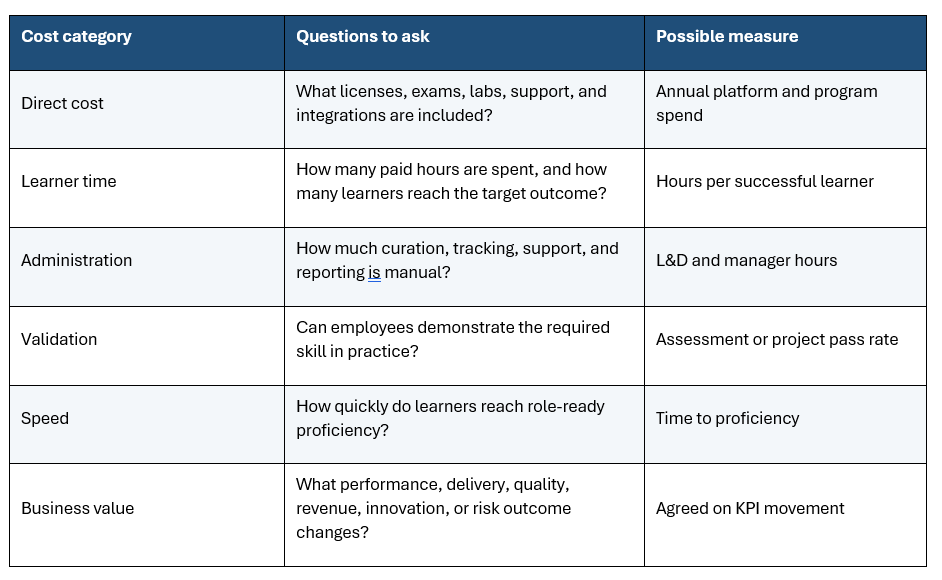
A useful comparison metric is cost per verified, role-ready learner rather than cost per enrollment. Organizations can also compare time-to-proficiency and the percentage of learners who apply the skill in a project over a defined period.
What Should Enterprise Teams Evaluate Instead?
The best solution is not necessarily the most expensive platform. It is the option that builds the required capability at an acceptable speed, with evidence, governance, and total cost.
- Structured role pathways: Map content to job roles, proficiency levels, prerequisites, and business priorities.
- Hands-on practice: Use labs, simulations, projects, and workplace assignments to turn knowledge into performance.
- Credible validation: Combine assessments, observed outputs, capstones, and recognized certifications where they add value.
- Enterprise analytics: Track engagement, completion, proficiency, credentials, and application against a defined skills taxonomy.
- Manager enablement: Give managers practical tools to recommend learning, protect learning time, coach application, and review progress.
- Content governance: Assign owners, review dates, quality standards, accessibility checks, and retirement rules.
- Outcome measurement: Connect each priority pathway to a business KPI or workforce-readiness measure.
Measure Learning’s True Cost
Free learning platforms can play a valuable role in enterprise development. They can encourage curiosity, extend access, support foundational awareness, and complement formal programs.
But free content is not the same as free capability. Organizations still pay through employee time, curation, incomplete learning, weak validation, manual administration, limited analytics, governance effort, and delayed business outcomes.
The most useful procurement question is therefore not, “How much does the course cost?” It is, “What will it cost us to produce one verified, role-ready employee, and how quickly will that capability create value?”
Upskill Your Teams with Enterprise-Ready Tech Training Programs
- Team-wide Customizable Programs
- Measurable Business Outcomes
About CloudThat
FAQs
1. Are free learning platforms useful for enterprise learning?
ANS: – Yes. They can support exploration, foundational awareness, and continuous learning. Organizations usually need added structure, curation, assessment, analytics, and governance to convert access into measurable workforce capability.
2. What is the highest hidden cost of free learning platforms?
ANS: – The highest hidden cost is often opportunity cost. If employees spend time learning but do not become role-ready, the organization delays the projects, productivity gains, or transformation outcomes that the training was meant to support.
3. Can free courses replace professional training programs?
ANS: – Free courses can complement professional programs, but they may not provide the role alignment, hands-on practice, verified assessment, reporting, support, or governance needed for an enterprise priority.
4. How can organizations maximize value from free learning resources?
ANS: – Organizations can curate approved content into role-based pathways, assign managers and subject-matter owners, protect learning time, add practical projects, validate skills, and track workplace application.
5. What metric should L&D leaders use to compare platforms?
ANS: – Cost per verified, role-ready learner is more informative than cost per enrollment. Time to proficiency and application of the skill to a real project provides additional decision value.


WRITTEN BY Rashmi R Kulkarni
Rashmi Kulkarni is a Technical Lead at CloudThat, specializing in Microsoft Azure Infrastructure & Architecture and AI-driven Productivity Solutions. With over 10 years of experience in cloud technologies, enterprise infrastructure, and digital transformation, she has trained more than 10,000 professionals in Microsoft Azure, Microsoft 365 Copilot, Cloud Architecture, and Digital Transformation technologies. Known for simplifying complex technical concepts and translating them into practical, business-focused outcomes, she brings deep technical expertise and real-world application into every learning experience. Rashmi's passion for continuous learning and technology evangelism is reflected in her unique approach to empowering individuals and organizations to embrace innovation, accelerate cloud adoption, and unlock AI-powered productivity.


 PREV
PREV












Comments