

 Login
Login

 September 25, 2026
|
Voiced by Amazon Polly |
Imagine walking into a huge library and asking a librarian:
“What is our company’s latest policy for canceling a customer subscription?”
The librarian doesn’t know every book in the library by heart. Instead, they understand your question, find the relevant document, look up the information, and explain the answer to you.
Modern AI applications increasingly work in a similar way.
Large language models can understand questions and generate remarkably human-like responses, but they don’t automatically know everything about an organization’s private or recently updated information. This is where RAG (Retrieval-Augmented Generation) becomes important.
At its simplest, RAG gives an AI application a way to find relevant information before generating an answer.
Start Learning In-Demand Tech Skills with Expert-Led Training
- Industry-Authorized Curriculum
- Expert-led Training
Why Does AI Need RAG?
AI needs RAG because large language models only know what they learned during training, so they can’t reliably answer questions about your company’s private or recently updated information. RAG solves this by retrieving relevant information from an external source at the time of the question and providing it to the model.
Consider a bank with thousands of internal documents covering KYC policies, customer procedures, product information, compliance guidelines, and operational processes.
An employee asks:
“What documents are currently required for KYC verification?”
A general-purpose AI model may know what KYC means, but it may not know the bank’s latest internal requirements.
Retraining the model every time a policy changes would be expensive and impractical.
RAG offers another approach: keep the organization’s information in an external knowledge source and retrieve the relevant information when someone asks a question.
The basic idea is simple:
Retrieve → Add relevant context → Generate an answer
This approach helps ground an AI response in information supplied by the organization rather than relying entirely on what the model learned during training.
Where Do Vector Embeddings Come In?
Vector embeddings are used in the retrieval step of RAG. They turn text into numbers that capture meaning, so an application can find relevant information based on meaning rather than the exact words used.
Finding the right information sounds easy until you have millions of documents.
Suppose an employee asks:
“How do I cancel my subscription?”
The company’s documentation might contain an article titled:
“Ending Your Plan”
A basic keyword search may struggle because the words “cancel” and “subscription” don’t appear in the title.
Humans can easily understand that the two phrases mean almost the same thing. Computers need a way to represent that meaning mathematically.
This is the problem that vector embeddings solve.
An embedding model converts information such as text into a numerical representation called a vector. Content with similar meanings can have vectors that are close to each other in the embedding space. This allows applications to search based on meaning rather than relying only on exact words.
Think of it as creating a map of meaning.
On this map, “car” and “automobile” would be relatively close because they describe similar concepts, while “car” and “bank account” would be much farther apart.
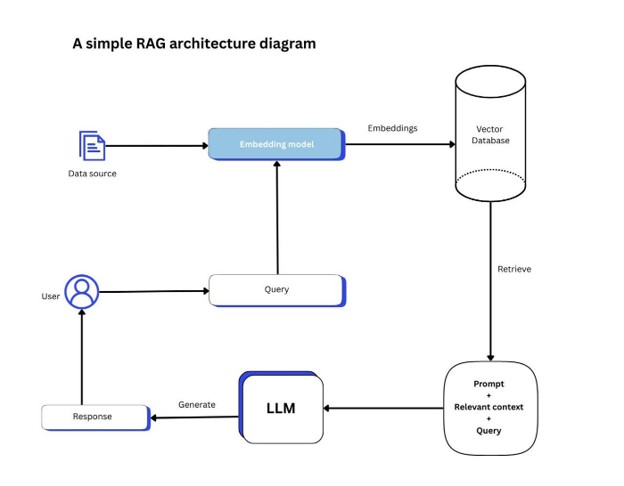
Fig 1: How RAG and vector embeddings help AI retrieve relevant knowledge and generate accurate responses.
What is the Difference Between Keyword Search and Semantic Search?
Keyword search matches the exact words in a query, while semantic search matches the meaning behind them.
Traditional keyword search asks:
“Does this document contain the words I searched for?”
Semantic search asks something closer to:
“Does this document contain information related to what I mean?”
For example, someone might search for, “How can I end my mobile plan?” While the organization’s document says, “Procedure for terminating an active customer account.” The wording is different, but the intent is related.
Vector-based semantic search helps identify that relationship.
Modern search platforms can also combine traditional text search with vector search. This is known as hybrid search, and it can be useful when a query contains both concepts and exact terms such as product names, policy numbers, customer IDs, or technical terminology.
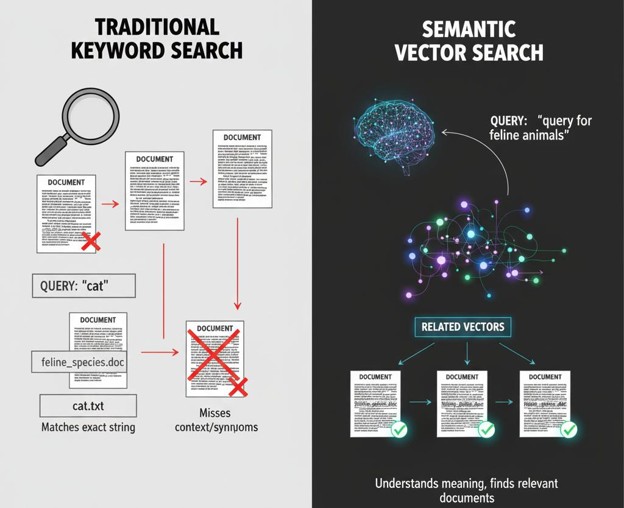
Fig 2: Keyword search matches words, while semantic search understands meaning and intent.
How does conversion from Documents to an AI Answer happen?
Documents are prepared, converted into embeddings, and indexed. When a question arrives, the most relevant content is retrieved and passed to the language model, which generates the answer.
Imagine the bank’s documents are stored in a searchable data platform.
The documents are prepared and divided into useful sections. Those sections can then be converted into embeddings and indexed for search.
When an employee asks a question, the application searches for relevant information. The retrieved content is then provided to the language model as context, allowing the model to generate an answer based on that information.
A simplified RAG architecture looks like this:
Business Documents
↓
Content Preparation
↓
Embeddings + Search Index
↓
User Question
↓
Relevant Information Retrieved
↓
Language Model
↓
Grounded Response
Platforms such as Azure AI Search support vector search and hybrid search, allowing vector and traditional searchable content to coexist in the same search index.
Why RAG Matters in the Real World?
RAG matters because it lets AI assistants answer questions using an organization’s current, trusted information, which is especially valuable when information changes frequently.
Think about:
- Banking policies
- Healthcare documentation
- Insurance procedures
- Product manuals
- Customer support knowledge
- Legal documents
- Internal company policies
Instead of expecting employees to search through hundreds of documents, an AI assistant can help them find relevant information and explain it in natural language.
However, RAG isn’t a magic solution.
If the wrong document is retrieved, the AI may still produce a poor answer. Document quality, chunking, embeddings, retrieval strategy, security, and data freshness all influence the final result.
That is why production AI systems need to treat retrieval as an important part of the overall application architecture.
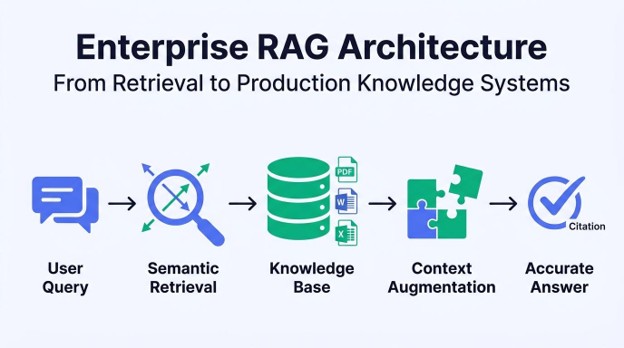
Fig 3: How RAG connects enterprise knowledge to deliver accurate, context-aware AI answers.
Is RAG Being Replaced?
No, RAG isn’t being replaced; it’s evolving. Hybrid search, knowledge graphs, agents, and more sophisticated retrieval systems build on the retrieve-then-generate idea rather than replace it.
Modern AI applications can combine semantic search, keyword search, reranking, structured data, and knowledge graphs depending on the problem they need to solve.
For example, vector search can help find information with similar meaning, while a knowledge graph can help identify relationships between entities.
The goal remains the same:
Give the AI the right information at the right time.
For professionals looking to explore how RAG fits into modern AI application development, AI-200: Develop AI Solutions on Azure includes RAG, enterprise knowledge integration, and production-ready AI application development.
The Bigger Picture
Building useful AI isn’t just about choosing a powerful language model; it’s about connecting it to the right data.
- Language Model: Intelligence
- Knowledge Base: Information
- Embeddings: Search by meaning
- Retrieval: Fetching relevance
- RAG: Grounding the final response
The smartest AI isn’t the one that knows everything, it’s the one that finds the right information when it matters.
The smartest AI isn’t necessarily the one that knows everything. It’s the one that can find the right information when it matters.
Building Smarter AI Retrieval
RAG and vector embeddings are transforming how AI delivers accurate, context-aware answers by connecting language models to relevant, up-to-date information. Instead of relying solely on what a model learned during training, these technologies enable AI to search, retrieve, and generate responses grounded in trusted data. As organizations continue to adopt AI-powered solutions, understanding RAG, semantic search, and vector embeddings will be essential for building intelligent systems that provide the right information at the right time.
Upskill Your Teams with Enterprise-Ready Tech Training Programs
- Team-wide Customizable Programs
- Measurable Business Outcomes
About CloudThat


WRITTEN BY Shyla J
Shyla is an MCT and works on cloud platforms like AWS and Azure. She is certified as an Azure Administrator and works on DevOps tools like Ansible, and Terraform, to create and deploy highly available infrastructure on AWS and Azure.


 PREV
PREV












Comments