

 Login
Login

 September 25, 2026
|
Voiced by Amazon Polly |
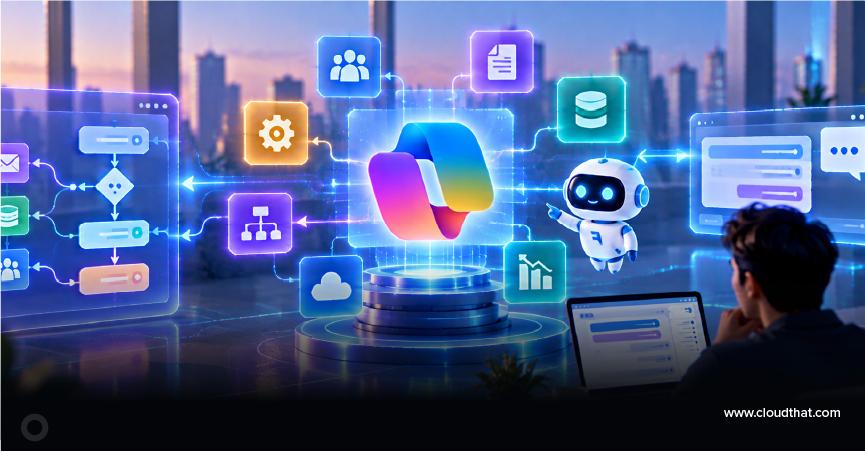
Most AI agents struggle when tasks require multiple decisions, workflows, and business systems. Microsoft’s new Copilot Studio experience is designed to solve that problem. This update introduces a new orchestration framework that helps AI agents reason, plan, and complete complex business processes with greater accuracy and autonomy.
Start Learning In-Demand Tech Skills with Expert-Led Training
- Industry-Authorized Curriculum
- Expert-led Training
What is the new Copilot Studio experience?
The new Copilot Studio experience is Microsoft’s redesigned environment for building AI agents that can do more than answer questions. It shifts Copilot Studio from a chatbot-building tool into a broader agent-building and business automation platform.
The biggest change is the new agentic orchestration engine. Rather than following predefined conversation paths, agents can determine which actions to take, which data sources to consult, and how to complete a user’s request.
Why did Microsoft rebuild Copilot Studio?
Microsoft rebuilt Copilot Studio because enterprise AI needs have moved beyond basic chatbot conversations. Businesses now need AI agents that can understand goals, leverage company data, trigger workflows, integrate with multiple systems, and complete tasks end-to-end.
The older experience was better suited for guided conversations and predefined logic. The new Copilot Studio is designed for more complex, agent-based automation where an AI agent can plan, reason, choose actions, use tools, and manage multi-step work.
Organizations no longer want chatbots that answer simple questions. They need agents that can:
- Analyze documents
- Access business data
- Trigger workflows
- Coordinate actions across systems
- Complete end-to-end business processes
The new Copilot Studio experience addresses these requirements by combining AI reasoning, workflow automation, and enterprise integrations in a single platform.
How does the new agentic orchestrator improve AI agents?
The new agentic orchestrator improves AI agents by helping them move beyond fixed, rule-based conversation flows. Instead of simply waiting for predefined triggers or scripted paths, the orchestrator enables an agent to understand the user’s goal, determine the necessary steps, select the appropriate tools or knowledge sources, and complete the task through multiple actions.
For example, an agent can analyze a request, retrieve relevant information, initiate a workflow, validate results, and provide a final response without human guidance.
The result is more reliable automation for real business processes rather than isolated conversations.
What is included in the new unified build experience?
One of the most noticeable changes is the simplified authoring environment.
Previously, builders often worked across multiple configuration areas. The new experience brings major components together in one place, including:
- Skills
- Knowledge sources
- Tools
- Connected agents
- Workflows
This unified approach reduces complexity and helps teams develop, manage, and test agents more efficiently.
What are Skills in Copilot Studio?
Skills are reusable packages of instructions and capabilities that can be shared across multiple agents.
Instead of rebuilding the same functionality repeatedly, organizations can create a Skill once and deploy it wherever needed. This improves consistency, governance, and scalability.
For example, a company could create a customer-verification Skill that is used by support, operations, and service agents without duplicating development effort.
For enterprises building large AI ecosystems, Skills can significantly reduce maintenance and accelerate deployment.
How does Memory make agents more useful?
Memory makes agents more useful because it helps them retain relevant context across interactions rather than treating every conversation as brand new.
Without memory, every conversation starts from scratch. With memory, agents can use information from previous interactions to provide more relevant responses and recommendations.
This creates a more personalized experience and reduces the need for users to repeatedly provide the same information.
How do workflows improve business automation?
Workflows improve business automation by providing AI agents with a structured way to complete business processes end-to-end. Instead of only responding to a user’s question, an agent can follow a defined sequence of steps, make decisions, trigger actions, and connect with different systems.
The visual workflow designer allows builders to create structured business processes using a drag-and-drop interface. Workflows can include:
- AI-powered actions
- Conditional logic
- Agent handoffs
- System integrations
- Business process automation
This enables organizations to combine deterministic workflows with AI-driven decision making.
For example, a customer support agent can receive a request, validate information, create a ticket, assist with resolution, and send notifications through a single orchestrated workflow.
The visual approach also helps low-code users build sophisticated automation without extensive development expertise.
What is Microsoft IQ and why does it matter?
Microsoft IQ is Microsoft’s intelligence layer that brings together organizational knowledge, user context, enterprise data, and relationships across Microsoft 365 and connected business systems.
Through Microsoft IQ, agents can work with information from:
- Emails
- Documents
- Calendars
- Teams conversations
- People data
This allows agents to make decisions using enterprise-wide knowledge rather than relying solely on manually configured information sources.
For business users, that means more accurate responses, better recommendations, and greater operational awareness.
What happens to existing Copilot Studio agents?
Existing Copilot Studio agents do not need to be rebuilt immediately. Microsoft designed the transition so that existing agents can continue running while organizations explore the new Copilot Studio experience.
In practice, this means:
- Existing agents can keep functioning in the current experience.
- Organizations can evaluate the new agentic capabilities before migrating or modernizing.
- Teams can adopt the new experience gradually instead of moving everything at once.
- New projects can use the updated experience, while older agents can remain active until there is a clear business reason to update them.
This reduces risk for organizations that already have production agents. Instead of forcing a sudden migration, Microsoft allows teams to plan adoption at their own pace and modernize existing agents when it makes sense.
Who should use the new Copilot Studio?
The new Copilot Studio should be used by teams and organizations that want to build AI agents capable of handling real business processes, not just answering simple questions.
It is especially useful for:
- Enterprise Architects: Design scalable AI-powered business processes with advanced orchestration.
- Automation Developers: Combine workflows and AI reasoning to automate complex operations.
- IT Operations Teams: Create agents that support multi-system operational and support processes.
- Business Users: Build production-ready agents faster using low-code tools, workflows, and reusable Skills.
Why is this update important for the future of AI agents?
This update is important because it shows where AI agents are heading: from simple chatbots to autonomous business assistants that can understand goals, plan steps, use tools, and complete real work across systems.
The new Copilot Studio reflects this shift by enabling agents to:
- Understand business context
- Execute multi-step processes
- Integrate with enterprise systems
- Make informed decisions
- Deliver measurable business outcomes
Rather than acting as a standalone bot-building platform, Copilot Studio is evolving into a platform for enterprise AI automation.
What should organizations do next?
Organizations should take a practical, use-case-driven approach rather than trying to adopt the new Copilot Studio everywhere at once.
They should start by identifying one high-value business process that is repetitive, manual, time-consuming, or error-prone. Then they can build a focused agent around that process, measure the results, and improve it before expanding to more complex scenarios.
Powering Smarter AI Agents
The new Copilot Studio marks a major step forward in how organizations build and use AI agents. By combining agentic orchestration, reusable Skills, Memory, workflows, and enterprise intelligence, Microsoft is turning Copilot Studio into a powerful platform for business automation. For organizations ready to move beyond basic chatbots, this new experience offers a practical path to creating AI agents that can understand context, take action, and support complex work across systems.
Upskill Your Teams with Enterprise-Ready Tech Training Programs
- Team-wide Customizable Programs
- Measurable Business Outcomes
About CloudThat
FAQs
1. What are Skills in Copilot Studio?
ANS: – Skills are reusable packages of instructions and capabilities that can be shared across multiple AI agents, improving consistency and scalability.
2. Does the new experience replace existing Copilot Studio agents?
ANS: – No. Existing agents can continue running while organizations explore and adopt the new experience.
3. Why are workflows important?
ANS: – Workflows allow organizations to visually design multi-step business processes that combine AI actions, automation, conditions, and system integrations into a single solution.


WRITTEN BY Daliya V K
Dr. Daliya V. K. is a Vertical Head at CloudThat with Power App and Automate Division, specialized in Power Platform trainings. She has 14 years of experience in training and has trained over 2000 professionals in various technical domains. She holds Ph.D in Machine Learning area and has published papers in reputed International Journals and conferences. She is a Microsoft Certified Trainer and has worked as technical trainer for Microsoft workshops.


 PREV
PREV







Comments