

 Login
Login

 September 25, 2026
|
Voiced by Amazon Polly |
Artificial intelligence is no longer a niche skill reserved for data scientists and AI researchers. In 2026, AI is becoming a core competency across industries, from software development and cloud engineering to marketing, finance, cybersecurity, and operations. The challenge isn’t whether you should learn AI. The real question is: Which AI certification should you start with?
The answer depends on where you are in your career, what role you currently hold, and what kind of AI work you want to do next. This guide breaks down the best AI certifications for beginners, technical professionals, cloud practitioners, and aspiring AI engineers, helping you choose the right starting point rather than collecting certifications that don’t align with your goals.
Start Learning In-Demand Tech Skills with Expert-Led Training
- Industry-Authorized Curriculum
- Expert-led Training
Why does choosing the right AI certification matter?
Choosing the right AI certification determines how quickly you can move from learning concepts to applying AI in real-world scenarios. A certification that is too advanced can feel overwhelming, while one that is too basic may not create meaningful career opportunities.
According to the World Economic Forum’s Future of Jobs Report, AI and data-related skills remain among the fastest-growing competencies across industries, making structured AI learning more valuable than ever. Organizations are increasingly looking for professionals who can build, govern, deploy, and use AI solutions rather than simply understand the theory behind them.
Instead of asking, “Which certification is the best?”, ask:
- What is my current skill level?
- Do I want to use AI or build AI?
- Am I coming from a cloud, software, business, or non-technical background?
- Which cloud platform or ecosystem do I work with today?
Your answers will help determine the most suitable starting point.
Which AI certification is best for complete beginners?
For professionals with little to no AI experience, Microsoft Certified: Azure AI Fundamentals (AI-901) is often the most practical starting point.
AI-901 introduces foundational AI concepts without requiring programming expertise. It covers machine learning, computer vision, natural language processing, generative AI, responsible AI principles, and Azure AI services in a beginner-friendly format.
Why AI-901 is a strong starting point
- No prerequisite cloud or AI experience required
- Covers both traditional AI and generative AI concepts
- Introduces responsible AI principles
- Suitable for technical and non-technical professionals
- Provides a pathway to advanced Azure AI certifications
Professionals in roles such as business analysis, project management, sales, marketing, training, and IT operations often find AI-901to be the easiest way to build AI literacy before diving into specialization.
Which AI certification should cloud professionals start with?
Cloud professionals already familiar with Azure, AWS, or Google Cloud can move beyond AI fundamentals and focus on certifications that combine cloud infrastructure with AI implementation.
Microsoft Azure AI Engineer Associate (AI-103)
If you already work in the Microsoft ecosystem, AI-103 is often the logical next step after AI-900.
What does AI-103 focus on?
AI-103 validates skills related to:
- Designing and implementing AI solutions
- Building generative AI applications
- Working with Azure AI services
- Developing conversational AI solutions
- Implementing AI governance and security controls
The certification is particularly valuable for cloud engineers, solution architects, and developers building enterprise AI systems.
Who should choose AI-103?
Choose AI-103 if you:
- Work on Azure projects
- Want to build AI-powered applications
- Plan to work with Azure OpenAI Service
- Are interested in AI engineering roles
Should developers start with AI certifications or machine learning certifications?
Developers frequently face this dilemma. The answer depends on what they want to build.
- If you want to use AI in applications
Start with:
- AI-901(Foundational)
- AI-103 (Implementation-focused)
These certifications help developers integrate AI services into applications without requiring advanced mathematical expertise.
- If you want to build machine learning models
Consider certifications focused on machine learning engineering, such as:
- AWS Machine Learning Engineer
- Google Professional Machine Learning Engineer
- Advanced AI or ML specialization programs
These certifications introduce deeper concepts such as:
- Model training
- Feature engineering
- Evaluation metrics
- MLOps
- Model deployment pipelines
For most software developers entering AI in 2026, starting with AI engineering certifications is typically faster and more practical than jumping directly into machine learning specialization.
What if you want to become an AI Engineer?
No, a single certification cannot make them an AI Engineer.
An AI Engineer combines multiple skills:
- Cloud platforms
- Generative AI
- Prompt engineering
- Machine learning fundamentals
- AI deployment
- Infrastructure management
- Responsible AI practices
The most effective roadmap typically looks like this:
Step 1: Learn AI Fundamentals
Start with:
- AI-900
Step 2: Learn Cloud AI Implementation
Move to:
- AI-103
Step 3: Gain Generative AI Experience
Build projects using:
- Azure OpenAI Service
- GPT models
- AI agents
- Retrieval-Augmented Generation (RAG)
Step 4: Learn Advanced AI Operations
Focus on:
- Model deployment
- Monitoring
- Governance
- AI security
This progression develops practical skills rather than just collecting certifications.
Are generative AI certifications worth pursuing in 2026?
Yes, but only after building AI fundamentals.
Many professionals jump directly into generative AI training because of the popularity of tools like ChatGPT, Claude, Gemini, and Microsoft Copilot. While these technologies are transforming workplaces, understanding the fundamentals first creates a much stronger foundation.
Generative AI certifications are most valuable when learners already understand:
- AI concepts
- Model limitations
- Responsible AI practices
- Prompt design
- Enterprise AI architecture
Without these fundamentals, professionals often learn tools without understanding how to use them effectively in production environments.
Which AI certification offers the best career value?
The best career value comes from certifications that align with employer demand and practical implementation skills.
For 2026, the strongest starting certifications typically include:
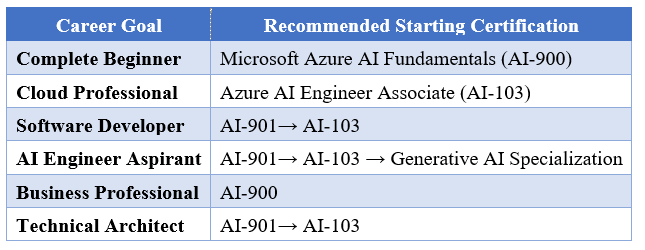
The key is choosing a certification that fits your current role while supporting your future career direction.
How can you prepare for AI certifications effectively?
Learning AI requires more than watching videos or memorizing exam objectives.
A practical preparation strategy includes:
- Learn core AI concepts first.
- Complete guided labs and hands-on exercises.
- Build small AI projects.
- Explore real-world use cases.
- Understand responsible AI practices.
- Practice with generative AI tools.
- Take certification-aligned mock tests.
Professionals who combine certification preparation with project-based learning typically gain stronger skills and perform better in interviews and real-world AI initiatives.
What should you do after earning your first AI certification?
After earning your first AI certification, professionals gain the most value by immediately applying their learning through:
- Building AI applications
- Automating workflows
- Implementing AI copilots
- Experimenting with AI agents
- Creating proof-of-concept projects
- Participating in enterprise AI initiatives
The certification validates your knowledge. Real projects demonstrate your capability.
For professionals looking to accelerate their AI careers, structured learning combined with hands-on implementation can significantly shorten the path from AI learner to AI practitioner.
Build Your Azure AI Path
The best AI certification to start with in 2026 depends on your current experience and career goals. However, for most professionals, Microsoft Azure AI Fundamentals (AI-901) remains one of the most accessible and practical entry points into AI. It provides a strong understanding of AI concepts, introduces generative AI, and lays the foundation for advanced certifications such as the Azure AI Engineer Associate (AI-103).
Rather than chasing every AI certification available, focus on building a learning roadmap that combines foundational knowledge, practical experience, and specialization. AI is evolving rapidly, but the professionals who succeed will be those who understand both the technology and how to apply it to solve real business problems.
If you’re planning your AI learning journey, start with one certification, build one project, and solve one real-world problem. That’s usually where meaningful AI careers begin.
Upskill Your Teams with Enterprise-Ready Tech Training Programs
- Team-wide Customizable Programs
- Measurable Business Outcomes
About CloudThat
FAQs
1. Which AI certification is easiest for beginners?
ANS: – Microsoft Azure AI Fundamentals (AI-901) is widely considered one of the most beginner-friendly AI certifications because it covers core AI concepts without requiring coding or machine learning experience.
2. Is AI-901enough to get an AI job?
ANS: – AI-901 helps you understand foundational AI concepts, but most AI-focused roles also require hands-on project experience and more advanced technical skills.
3. Should I learn generative AI before machine learning?
ANS: – For many professionals in 2026, learning AI fundamentals first and then exploring generative AI provides a stronger foundation than immediately jumping into advanced machine learning concepts.
4. Which AI certification is best for cloud professionals?
ANS: – Azure AI Engineer Associate (AI-103) is a strong choice for professionals working in Microsoft Azure environments because it focuses on implementing enterprise AI solutions.
5. Are AI certifications still valuable in 2026?
ANS: – Yes. Certifications provide structured learning paths and validate skills, particularly when combined with practical AI projects and real-world experience.


WRITTEN BY Keerthish N
Keerthish N is a Technical Content Writer with over 4 years of experience in technical content development and learning operations. He specializes in creating engaging content on cloud computing, AI, Azure, and AWS technologies. Known for simplifying complex concepts, Keerthish is passionate about knowledge sharing, emerging technologies, and process automation.


 PREV
PREV











Comments