

 Login
Login

 September 24, 2026
|
Voiced by Amazon Polly |
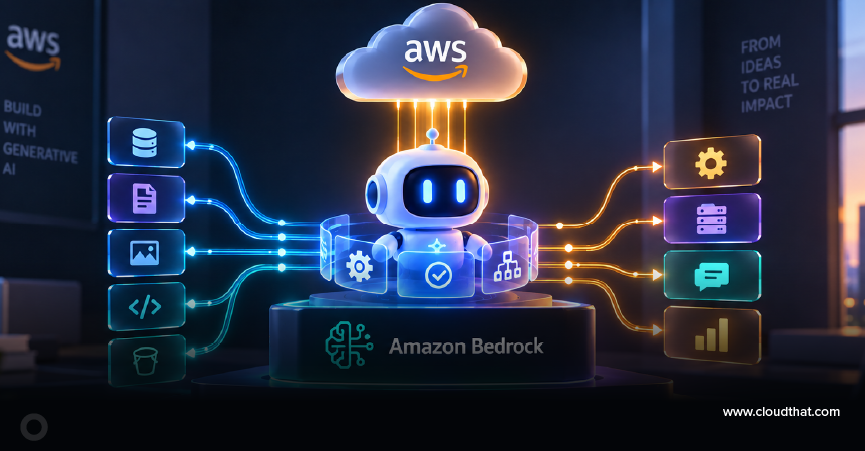
Amazon Bedrock AgentCore helps organizations move from simple generative AI applications toward production-ready AI agents that reason, use tools, access enterprise data, and execute multi-step workflows securely. While traditional applications merely generate responses to prompts, production-ready agents require robust infrastructure to maintain security, observability, identity controls, and system reliability. This guide examines how Amazon Bedrock AgentCore provides a fully managed platform for deploying, connecting, and governing enterprise AI agents at scale.
Traditional generative AI models process a prompt and return a static answer. An AI agent goes further by determining what information it needs, selecting appropriate tools, executing multi-step actions, and evaluating results to reach a goal.
AWS positions Amazon Bedrock AgentCore as a fully managed platform for operating these complex systems. For enterprises, the infrastructure surrounding an AI agent is just as vital as the foundation model powering it.
Start Learning In-Demand Tech Skills with Expert-Led Training
- Industry-Authorized Curriculum
- Expert-led Training
What Is Agentic AI on AWS?
Agentic AI on AWS refers to systems that reason about goals, plan action sequences, use connected tools, and adapt based on intermediate results. Rather than responding to single prompts, these agents participate in continuous decision-making loops across enterprise systems.
For example, an enterprise procurement assistant can authenticate employees, check inventory, evaluate delays, create escalation tickets, and summarize outcomes autonomously. AWS services like Amazon Bedrock, AWS Lambda, Amazon S3, Amazon API Gateway, AWS Step Functions, and Amazon DynamoDB support these workflows, with AgentCore providing managed operational control.
Why Agentic AI requires more than a powerful model
A foundation model is only one component of an enterprise agent system. Operational agents require infrastructure for:
- Secure Execution & Identity: Authenticating users and enforcing strict permission boundaries.
- Memory Management: Maintaining conversational context across long-running sessions.
- System Connectivity: Connecting to external enterprise APIs and database tools safely.
- Observability & Policy: Monitoring execution flows, enforcing compliance, and evaluating outputs.
What Is Amazon Bedrock AgentCore?
Amazon Bedrock AgentCore is a fully managed AWS platform designed to deploy, connect, and operate AI agents securely at scale. It decouples agent reasoning logic from the surrounding operational infrastructure, supporting multiple models and frameworks such as LangChain, Strands Agents, and the OpenAI Agents SDK.
Key capabilities of Amazon Bedrock AgentCore
- AgentCore Runtime: Purpose-built infrastructure for executing multi-step, longer-running agent sessions.
- AgentCore Memory: Retains short-term conversational context and long-term user history.
- AgentCore Gateway: Connects agents to enterprise APIs with centralized access controls.
- AgentCore Identity: Manages authentication and ensures agents act with least-privilege permissions.
- AgentCore Observability: Traces multi-step decision loops to simplify debugging and performance monitoring.
- Policy and Evaluation Capabilities: Enforces organizational safety boundaries and evaluates output quality.
How Does Amazon Bedrock AgentCore Support Production AI Agents?
Amazon Bedrock AgentCore reduces the operational overhead of transitioning AI agents from prototypes to production. By offloading memory, connectivity, identity, and governance to managed AWS infrastructure, developers can focus entirely on core business logic.
A simplified production architecture
A typical AWS enterprise agent architecture incorporates:
- Entry Point: User or application passing requests through an authentication layer.
- Reasoning Engine: Amazon Bedrock provides a foundation model for intelligence.
- Execution & Memory: AgentCore Runtime handles execution while AgentCore Memory preserves context.
- Governance & Integration: AgentCore Gateway and Identity connecting securely to AWS services, databases, and enterprise APIs.
How to Build AI Agents Using Amazon Bedrock AgentCore
Building production AI agents requires defining business objectives and configuring security, memory, and tools around that core goal. Starting with a focused, measurable use case ensures higher reliability and smoother deployment.
- Define the agent’s objective: Target a specific, measurable task (e.g., an IT support assistant or financial anomaly agent).
- Choose the model and framework: Select an underlying model based on latency and cost, alongside your preferred agent SDK.
- Define necessary tools: Limit API and database connections strictly to what the agent needs.
- Configure identity and access: Implement clear authentication rules and restrict authorization per user role.
- Set up memory and context: Determine whether the agent requires short-term session context or persistent user history.
- Deploy, observe, and evaluate: Track tool calls, latency, errors, and policy adherence continuously post-launch.
How to Deploy Secure AI Agents on AWS
Deploying secure AI agents requires identity-aware access, strict tool boundaries, continuous monitoring, and structured policy controls. Enterprise architectures must treat agents as powerful execution components rather than simple text generators.
- Apply Least Privilege: Grant agents access only to the exact APIs required for their approved tasks.
- Protect Data Boundaries: Enforce explicit rules on what data can be sent to models or external tools.
- Use Controlled Tool Connectivity: Use AgentCore Gateway to secure all API integrations.
- Monitor Workflows: Trace intermediate reasoning steps via AgentCore Observability to catch failures early.
- Test Adversarial Scenarios: Validate agent resilience against prompt injections, unauthorized tool requests, and permission bypasses.
Amazon Bedrock Agents vs. AgentCore: What Is the Difference?
Amazon Bedrock Agents and AgentCore meet related needs, but AgentCore provides a broader, framework-agnostic platform for operating production AI agents. While Bedrock Agents provides a tightly integrated workflow, AgentCore offers greater flexibility across custom models, runtime environments, and enterprise governance tools. According to the Official AWS Documentation, architectural choices depend on required customization, governance depth, and framework choice.
What’s New for Agentic AI on AWS in 2026?
In 2026, AWS introduced major enhancements to Amazon Bedrock AgentCore to streamline developer operations and strengthen production security. These developments reflect an industry-wide shift toward managing full-fledged autonomous systems.
- AgentCore Harness & CLI: Streamlines local testing and deployment loops for developers.
- Web Search Integration: Enables agents to dynamically retrieve live, cited web information.
- Managed Knowledge Bases: Simplifies high-scale enterprise data retrieval.
- Persistent Runtimes: Supports long-running execution for complex enterprise tasks.
- AWS Agent Registry: Improves cross-team management and sharing of enterprise agents.
Real-World Use Cases for Agentic AI on AWS
Agentic AI excels when business processes involve multi-step decisions, system queries, and automated actions.
- IT Operations: Investigating incidents, gathering system logs, and suggesting remediation steps.
- Customer Support: Authenticating users, looking up order statuses, and filing support tickets automatically.
- Security Operations: Correlating security alerts, gathering evidence, and drafting incident summaries.
- Finance Operations: Reviewing complex invoices, flagging anomalies, and routing approvals.
Build Secure AI Agents
Agentic AI on AWS enables organizations to build systems that reason, act, and solve multi-step challenges at enterprise scale. Success requires focusing on secure execution, observability, identity controls, and proper governance. By leveraging Amazon Bedrock AgentCore, enterprises can build reliable, resilient, and fully compliant AI agent architectures.
Upskill Your Teams with Enterprise-Ready Tech Training Programs
- Team-wide Customizable Programs
- Measurable Business Outcomes
About CloudThat
FAQs
1. What is Amazon Bedrock AgentCore?
ANS: – Amazon Bedrock AgentCore is a fully managed AWS platform for building, running, scaling, and governing production AI agents across diverse frameworks and models.
2. What is the difference between agentic AI and generative AI?
ANS: – Generative AI creates content such as text or code based on prompts, while agentic AI uses reasoning to plan steps, call external tools, execute tasks, and adapt to achieve specific goals.
3. What is the difference between Amazon Bedrock Agents and AgentCore?
ANS: – Amazon Bedrock AgentCore provides a broader, framework-flexible infrastructure for operating production agents with advanced memory, gateway, runtime, and policy controls.
4. Can Amazon Bedrock AgentCore use different AI models and frameworks?
ANS: – Yes, AgentCore is framework- and model-agnostic, supporting popular frameworks such as LangChain and Strands Agents, as well as custom models.
5. How can organizations secure AI agents on AWS?
ANS: – Organizations secure agents by enforcing least-privilege permissions, securing API gateways, isolating sensitive data, tracing decision paths, and running adversarial test scenarios.


WRITTEN BY Nizamuddin Shamsuddin
Nizamuddin GS is a Champion AWS Authorized Instructor and Technical Lead at Cloudthat, specializing in Amazon Web Services and Microsoft Azure. With 20 years of experience in Architecting on AWS, he has trained over 3,000 professionals/students to upskill in cutting-edge technologies like AWS and Azure. Known for hands-on teaching and industry insights, he brings deep technical knowledge and practical application into every learning experience. Nizamuddin's passion for public speaking reflects in his unique approach to learning and development.


 PREV
PREV







Comments