

 Login
Login


 September 24, 2026
|
Voiced by Amazon Polly |
Generative AI has unlocked a new era of productivity, creativity, and automation. Yet as organizations move from experimentation to real-world deployment, one challenge consistently stands in the way: trust and reliability.
Consider this: a 2024 McKinsey Global Survey on AI found that only 21% of organizations report deploying generative AI at scale in production, with the top barriers being accuracy concerns and a lack of governance frameworks. For every impressive chatbot demo, there are dozens of pilots that never make it to production because the AI simply cannot be trusted in high-stakes situations.
Enter Reinforcement Fine-Tuning (RFT) in Amazon Bedrock, a major advancement that helps enterprises move beyond “good responses” toward consistently correct, policy-aligned, production-ready AI systems. This blog explores how RFT works, why it matters, and how it significantly improves model accuracy for enterprise use cases.
Start Learning In-Demand Tech Skills with Expert-Led Training
- Industry-Authorized Curriculum
- Expert-led Training
What is the Enterprise AI Reliability Problem
Most organizations quickly discover a critical gap when deploying generative AI in real business workflows. The difference is stark:
A chatbot that is 90% accurate is impressive. A compliance assistant that is 90% accurate is a liability.
In regulated industries, that 10% error rate translates to real consequences, regulatory fines, incorrect medical documentation, or flawed contract analysis. According to Gartner’s 2024 AI Risk Report, more than 40% of enterprises that have attempted to deploy LLMs in compliance-sensitive workflows have had to pause or roll back due to accuracy and auditability concerns.
Why Standard LLMs Struggle in Enterprise Environments
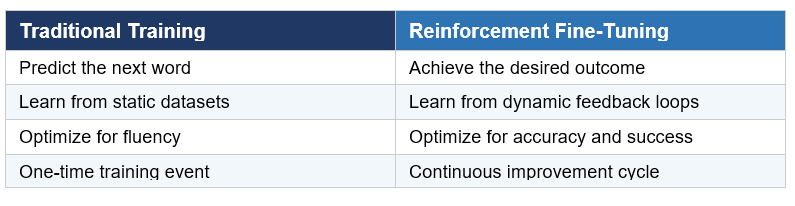
Traditional foundation models are trained to predict likely next words, generate fluent responses, and optimize for general knowledge. But enterprise-grade AI must operate differently. It must:
- Follow strict internal policies and regulatory requirements
- Produce consistent, auditable outputs every single time
- Optimize for task success, not just linguistic fluency
- Improve continuously from real-world operational feedback
This gap is precisely where Reinforcement Fine-Tuning becomes transformative.
What Is Reinforcement Fine-Tuning?
Traditional fine-tuning teaches a model what good answers look like. Reinforcement Fine-Tuning teaches a model what constitutes successful outcomes.
Instead of learning from static datasets alone, RFT-trained models receive reward signals based on real business performance, very much like how a new analyst learns: not just from a training manual, but from feedback on actual work submitted.
The Conceptual Shift
Why RFT Matters for Enterprise Accuracy
Enterprises need AI systems that are predictable, auditable, policy-aligned, and continuously improving. RFT enables models to optimize across four critical dimensions simultaneously.
1. Accuracy – Moving from Probable to Preferred
Standard LLMs choose the statistically most likely response. RFT models learn the preferred response, the one that satisfies specific business criteria. In practice, this means significantly fewer hallucinations and near-elimination of off-policy outputs in well-trained domains.
2. Compliance – Policy as a Reward Signal
Rather than relying on prompt instructions alone (which can drift or be circumvented), RFT encodes compliance rules directly into the reward loop. In financial services, for example, this means an AI system can be trained to never recommend products outside a client’s risk profile, not because it was told to in a prompt, but because non-compliant outputs consistently receive low reward scores during training.
3. Domain Expertise – Learning What ‘Good’ Looks Like
Every industry has unwritten standards that are difficult to encode in static datasets. RFT allows domain experts to provide continuous feedback that shapes the model’s sense of quality, whether that’s the right level of clinical precision in a medical note or the correct tone in a legal brief.
4. Decision Quality – Optimizing for Outcomes, Not Words
Perhaps the most important shift: RFT moves AI evaluation from linguistic quality (“does this sound right?”) to business outcome quality (“did this achieve the right result?”). This aligns AI performance directly with KPIs.
How Reinforcement Fine-Tuning Works in Amazon Bedrock
Amazon Bedrock provides a fully managed pipeline to apply reinforcement learning techniques to foundation models, without requiring ML infrastructure expertise. Here is how the workflow typically looks:
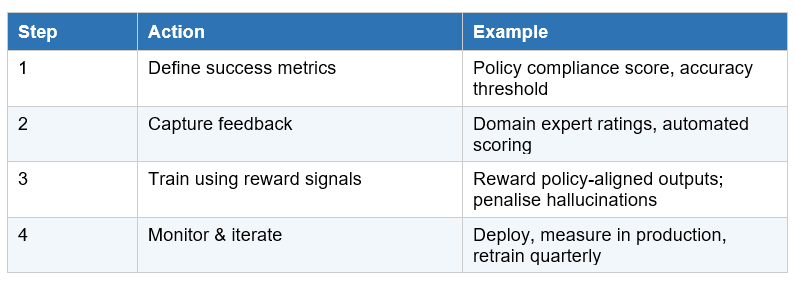
This creates a closed-loop learning system; the more the model is used in production, the more feedback it generates, and the smarter it becomes.
Key Insight: Unlike traditional fine-tuning, which requires a complete retraining cycle, RFT in Amazon Bedrock is designed for continuous iteration. Teams can push new reward signals and retrain on a regular cadence without rebuilding the entire pipeline.
What are Some Real-World Enterprise Use Cases?
Financial Services: Regulatory Compliance at JPMorgan Chase
Large financial institutions face enormous pressure to ensure every piece of customer-facing or internally generated content meets compliance standards. JPMorgan Chase’s AI platform, CoiN (Contract Intelligence), has demonstrated how AI trained with outcome-oriented feedback can process legal documents in seconds that previously required 360,000 hours of manual lawyer time annually (Harvard Business Review, 2023).
Applying the RFT approach in Amazon Bedrock to similar workflows means:
- Credit risk summaries are reviewed and approved significantly faster
- Audit-ready outputs with compliance metadata attached
- Drastic reduction in back-and-forth between AI systems and human compliance reviewers
RFT transforms AI from a productivity tool into a trusted decision-support system, one that regulators can scrutinize.
Healthcare: Clinical Documentation at NHS Trusts
Healthcare documentation is arguably the highest-stakes environment for AI accuracy. In the UK, several NHS Trusts have piloted AI-assisted clinical note generation, with early results suggesting a potential 20-30% reduction in clinician documentation time (NHS England Digital, 2024).
With RFT, these models can be specifically trained to:
- Use preferred terminology from each Trust’s clinical style guide
- Follow ICD-11 and SNOMED CT coding conventions in documentation
- Flag ambiguous symptoms for clinician review rather than guessing
Without RFT, a clinical documentation AI might produce fluent but imprecise notes. With it, the model learns from clinician corrections over time, narrowing the gap between AI output and what a senior doctor would actually write.
Legal: Contract Analysis at Enterprise Law Firms
Leading law firms and in-house legal teams are increasingly using AI for contract review. Companies like Luminance and Harvey AI have reported that AI-assisted contract review can reduce first-pass review time by up to 50%, but accuracy is paramount (Financial Times, 2024).
With RFT, legal AI models in Bedrock can learn:
- Which clause interpretations senior partners prefer in specific contexts
- How to calibrate risk scores based on the firm’s actual risk appetite
- When to flag a clause for human review versus when to pass it automatically
The result is not just faster reviews, it is a defensible, consistent analysis that can be presented to clients with confidence.
Customer Support: Reducing Escalations at Scale
A global telecommunications company deploying RFT-enhanced support AI in Amazon Bedrock can train the model using actual customer resolution data, meaning the reward signal is whether the customer’s issue was resolved on first contact, not just whether the response was polite.
Over time, RFT-trained support models can:
- Reduce escalation-to-human rates by learning which solutions actually work
- Adjust tone dynamically based on customer sentiment signals
- Improve first-contact resolution rates quarter over quarter
This is the compounding advantage of reinforcement-based training: performance improves as real interactions accumulate.
RFT vs Prompt Engineering vs RAG vs Fine-Tuning
Organizations often ask how RFT compares to other GenAI optimization techniques. The answer is that they are complementary, not competing:
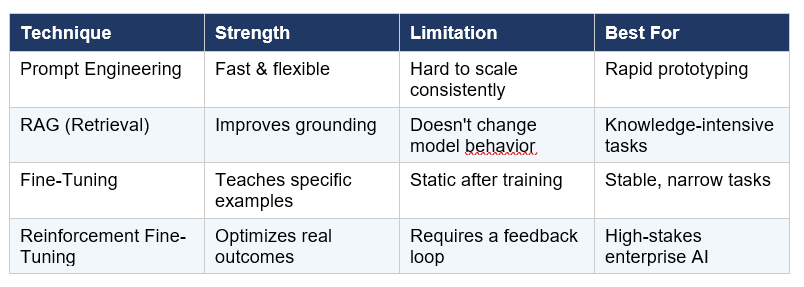
The strongest enterprise AI systems do not choose between these approaches. They layer them: prompt engineering for flexibility, RAG for grounding outputs in current knowledge, fine-tuning for domain vocabulary, and RFT for continuously improving on real outcomes.
Example: A financial services firm might use RAG to pull current regulatory documents, fine-tuning to learn internal terminology, and RFT to ensure outputs are consistently compliant, with each layer reinforcing the others.
Why AWS Is Investing in Reinforcement Fine-Tuning
AWS is positioning Amazon Bedrock as a complete enterprise AI lifecycle platform, not just a place to access foundation models. RFT fills the critical gap between experimentation and scalable production deployment.
This is consistent with Amazon’s broader strategy: in its 2024 re: Invent keynote, AWS CEO Andy Jassy emphasized that “the next frontier of AI is not about making models bigger, it is about making them more reliably useful in specific business contexts.” RFT is a direct expression of that vision.
With Bedrock handling the infrastructure complexity, enterprise teams can focus on defining business outcomes and capturing feedback, rather than managing ML pipelines.
The Future of Enterprise AI
Generative AI began as a creativity revolution, a tool for brainstorming, drafting, and ideating. Reinforcement fine-tuning is driving an operations revolution: a foundation for mission-critical systems that businesses and regulators can trust.
The future of enterprise AI will not be defined by which organization has the largest model or the most parameters. It will be defined by who can align AI most precisely with real business outcomes and do so continuously at scale, with full governance visibility.
AWS and Amazon Bedrock are building the infrastructure for that future. RFT is one of its most important enablers.
Upskill Your Teams with Enterprise-Ready Tech Training Programs
- Team-wide Customizable Programs
- Measurable Business Outcomes
About CloudThat
FAQs
1. How is RFT different from standard fine-tuning?
ANS: – Standard fine-tuning teaches a model using labeled examples of correct inputs and outputs. RFT goes a step further: it trains models using reward signals tied to actual outcomes and success metrics, allowing models to learn not just what correct answers look like but also what successful business results look like. Think of fine-tuning as teaching from a textbook, and RFT as learning from real job performance reviews.
2. Which use cases benefit most from RFT?
ANS: – RFT delivers the greatest ROI in high-accuracy, high-risk workflows, particularly where errors carry regulatory, financial, or clinical consequences. This includes compliance checking, contract analysis, clinical documentation, financial report generation, and customer support in regulated industries. For lower-stakes applications such as content summarisation or internal knowledge Q&A, standard RAG or fine-tuning may be sufficient.
3. Is reinforcement fine-tuning difficult to implement?
ANS: – Amazon Bedrock provides managed tooling that significantly simplifies the RFT workflow, abstracting away infrastructure complexity so teams can focus on defining reward metrics and capturing domain feedback. The main investment is in designing a robust feedback mechanism and in involving domain experts in the reward-definition process. Most enterprises can complete an initial RFT pilot within 8 to 12 weeks.
4. How often should models be retrained using RFT?
ANS: – This depends on how quickly the underlying business environment changes and how rapidly feedback accumulates. As a general rule, quarterly retraining cycles are a sensible starting point for most enterprise deployments. High-volume environments such as customer support operations , where thousands of feedback signals accumulate daily , may benefit from monthly or even more frequent cycles.


WRITTEN BY Shruti Bijawat
Shruti Bijawat is a Business Unit Head at CloudThat Technologies Private Limited, with deep specialization in Generative AI and Machine Learning. She is a Champion Amazon Authorized Instructor and a NVIDIA Certified Instructor, bringing over 16 years of combined industry and academic experience. Shruti has enabled thousands of professionals to upskill in cloud architecture, GenAI, and ML, delivering programs that balance strong conceptual foundations with real-world implementation. Known for her ability to customize training delivery based on participant profiles, she consistently translates complex technical concepts into practical, outcome-driven learning experiences. Her passion for learning and development is reflected in her structured, hands-on, and impact-focused teaching approach.


 PREV
PREV











Comments