

 Login
Login

 September 24, 2026
|
Voiced by Amazon Polly |
For most of its history, Amazon Web Services operated with a straightforward, if unstated, philosophy: the best cloud strategy is an AWS-only strategy. The message, reinforced across product announcements, pricing structures, and partnerships, was clear. AWS was built to be self-sufficient, and customers were expected to stay within its walls.
That stance has now fundamentally changed.
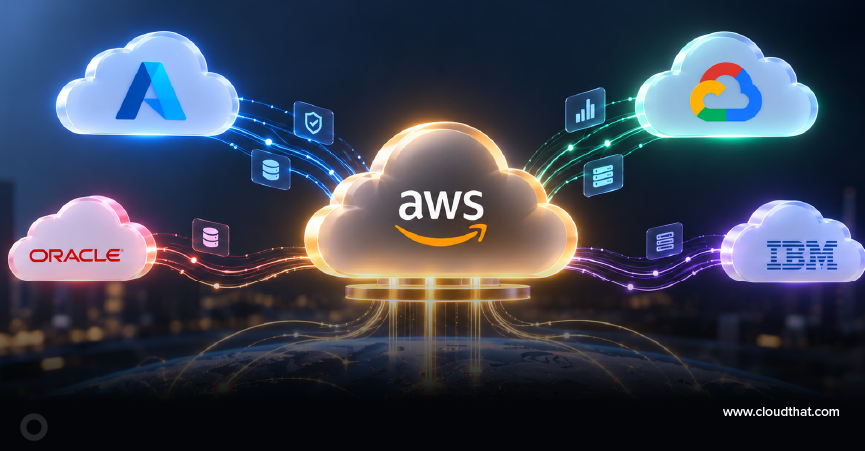
At AWS re: Invent 2025, Amazon announced AWS Interconnect – multicloud: a purpose-built, managed service that enables private, high-speed network connections between AWS and other major cloud providers, starting with Google Cloud, and with Microsoft Azure planned for later in 2026. It is the most significant strategic pivot AWS has made in its relationship with the multi-cloud world, and it signals a new era for enterprise cloud architecture.
This blog explores what drove the shift, what AWS Interconnect actually delivers, and what it means for enterprises navigating complex multi-cloud environments.
Start Learning In-Demand Tech Skills with Expert-Led Training
- Industry-Authorized Curriculum
- Expert-led Training
What Is AWS Interconnect – Multicloud?
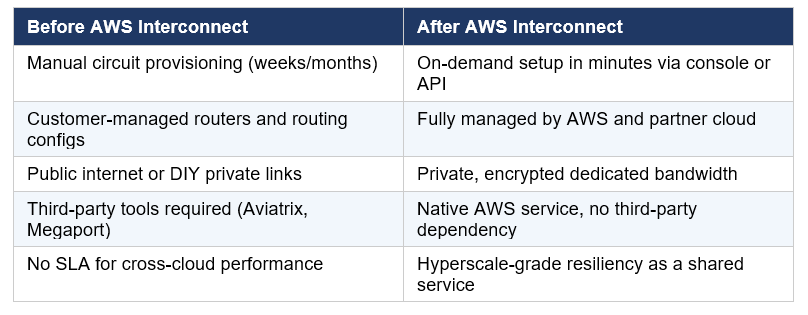
AWS Interconnect – multicloud is the first purpose-built product of its kind from a hyperscaler. Rather than routing cross-cloud traffic through the public internet or requiring customers to manually configure physical circuits and routing tables, it delivers a fully managed, private connectivity layer between cloud environments.
The flagship launch pairs AWS Interconnect with Google Cloud’s Cross-Cloud Interconnect, built on a jointly engineered open interoperability specification that other cloud providers can adopt as well. The technical architecture is designed for enterprise-grade reliability:
- MACsec encryption between AWS and Google Cloud edge routers
- Quad-redundancy across physically separate interconnect facilities
- Continuous joint monitoring by both AWS and Google Cloud
- On-demand bandwidth provisioning from 1 to 100 Gbps
- Connectivity established in minutes, compared to the weeks or months required by DIY approaches
For AWS networking, this plugs directly into familiar services, AWS Transit Gateway, AWS Cloud WAN, and Amazon VPC, removing the need to manage separate network overlays or third-party appliances for basic cross-cloud connectivity.
Why Did AWS Change Course Now?
The timing of this pivot reflects several converging pressures that AWS could no longer ignore.
- Regulatory Pressure
European regulators, particularly under the EU Cloud Switching Code of Conduct and ongoing scrutiny under the Digital Markets Act, have been applying pressure on hyperscalers to reduce technical barriers to switching and to operating across providers. Network World noted that the new connectivity capability goes some way toward addressing regulatory criticism that AWS does too little to help enterprises operate across multiple clouds.
- The AI Workload Reality
Generative AI has complicated the single-cloud equation in ways AWS could not have anticipated at scale. Enterprises building AI pipelines increasingly need to combine AWS’s compute depth with Google Cloud’s Vertex AI capabilities, or Azure’s OpenAI Service integrations. Running these pipelines across providers over the public internet introduced unacceptable latency and data transfer costs. AWS Interconnect resolves this directly.
- Data Egress Fee Reform
In 2024, AWS waived data transfer charges for all customers moving data out of AWS, a significant policy reversal. AWS Interconnect is the infrastructure counterpart to that pricing change: it removes both the cost and the complexity barriers that had previously made multi-cloud painful.
- Competitive Positioning
Google Cloud and Microsoft Azure have both made multi-cloud interoperability a strategic differentiator. Google’s Anthos and Microsoft’s Azure Arc positioned both competitors as the “friendly” multi-cloud option. AWS Interconnect is a direct competitive response, reclaiming the narrative by making AWS the central hub of a multi-cloud architecture rather than a walled garden.
The Technical Architecture: What Makes It Different
Most previous approaches to cross-cloud connectivity fell into one of two categories: public internet routing (fast to set up, poor performance and security) or dedicated physical circuits via colocation facilities like Equinix (excellent performance, months to provision, expensive). AWS Interconnect introduces a third model: a cloud-native managed private connection that combines the performance of dedicated circuits with the agility of software-defined networking.
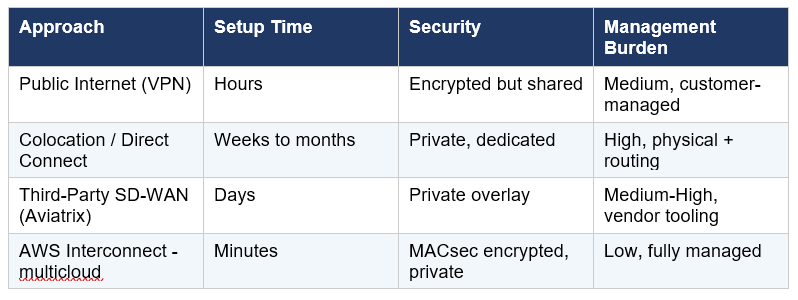
The open API specification is particularly significant for long-term industry impact. By publishing interoperability standards that any cloud provider can adopt, AWS and Google Cloud are effectively proposing a new infrastructure layer for the cloud industry, one in which cross-cloud connectivity becomes a commodity rather than a competitive moat.
What does This Mean for Enterprise Cloud Strategy?
For enterprises that have been wrestling with multi-cloud complexity, AWS Interconnect changes the calculus in several important ways.
- Workload Placement Becomes a Business Decision, Not a Technical Constraint
Previously, the friction of cross-cloud connectivity meant that workload placement decisions were heavily influenced by technical limitations. Now, an enterprise can genuinely ask: which cloud offers the best service for this specific workload? , and act on the answer without incurring weeks of network engineering work.
- Third-Party Multi-Cloud Networking Vendors Face Disruption
Companies like Aviatrix, Megaport, and Alkira have built successful businesses solving exactly the problem AWS Interconnect now addresses natively. While these vendors offer capabilities that go well beyond basic connectivity, policy management, cost optimization, and visibility dashboards, the commoditization of the core connectivity layer will significantly pressure their value propositions.
- AI Pipeline Architecture Is Unlocked
One of the most immediate beneficiaries of AWS Interconnect will be AI/ML engineering teams. The ability to run training workloads on Google Cloud’s TPU infrastructure while serving inference from AWS, over a private, low-latency link, opens architectural possibilities that were previously impractical at production scale.
Industry Perspective: ‘This collaboration between AWS and Google Cloud represents a fundamental shift in multi-cloud connectivity. Customers no longer need to worry about any heavy lifting to create their desired connectivity.’, Robert Kennedy, VP of Network Services, AWS (AWS re: Invent 2025)
Enabling Multi-Cloud Strategy
AWS’s embrace of multi-cloud connectivity is more than a product announcement; it is an acknowledgment that the cloud market has matured beyond the single-provider model. Enterprise workloads are distributed, AI architectures are hybrid, regulatory requirements are complex, and the idea that any one cloud can be “best” for every use case has been conclusively disproved by real-world experience.
AWS Interconnect – multicloud does not mean AWS is conceding ground. It means AWS is repositioning itself as the central, trusted hub of the enterprise multi-cloud world, the provider that makes everything work together, rather than the one that demands you stay inside its walls.
For enterprises, the practical implication is significant: multi-cloud architecture just became dramatically easier to justify, implement, and govern. The era of painful cross-cloud connectivity is ending. The era of cloud interoperability, on enterprise terms, has begun.
Upskill Your Teams with Enterprise-Ready Tech Training Programs
- Team-wide Customizable Programs
- Measurable Business Outcomes
About CloudThat
FAQs
1. Is AWS Interconnect - multicloud generally available?
ANS: – AWS Interconnect, multicloud, launched in preview at AWS re: Invent in December 2025, with Google Cloud as the first partner. It reached general availability on 14 April 2026. Microsoft Azure integration is planned for later in 2026, and Oracle Cloud connectivity was also announced in April 2026 across 26 interconnected partner cloud regions.
2. How does AWS Interconnect differ from AWS Direct Connect?
ANS: – AWS Direct Connect provides dedicated private connectivity between on-premises data centers and AWS. AWS Interconnect – multicloud provides dedicated private connectivity between AWS and other public cloud providers. They serve different purposes and can be used together: Direct Connect for on-premises-to-AWS connectivity, and Interconnect for AWS-to-Google Cloud or AWS-to-Azure connectivity.
3. Does AWS Interconnect eliminate the need for third-party multi-cloud networking tools?
ANS: – Not entirely. AWS Interconnect addresses the core connectivity layer, private, encrypted, managed links between cloud providers. Third-party tools like Aviatrix and Megaport still provide additional value in areas such as unified policy management across clouds, cost visibility and optimization, advanced traffic engineering, and support for more complex multi-cloud topologies. For straightforward connectivity between AWS and a single partner cloud, however, native Interconnect may be sufficient.
4. What security standards does AWS Interconnect use?
ANS: – AWS Interconnect – multicloud uses MACsec (Media Access Control Security) encryption between the AWS and partner cloud edge routers, providing Layer 2 encryption on dedicated links. Both providers engage in continuous joint monitoring to proactively detect and resolve network issues. The quad-redundant physical architecture across separate interconnect facilities also ensures high availability by default.


WRITTEN BY Shruti Bijawat
Shruti Bijawat is a Business Unit Head at CloudThat Technologies Private Limited, with deep specialization in Generative AI and Machine Learning. She is a Champion Amazon Authorized Instructor and a NVIDIA Certified Instructor, bringing over 16 years of combined industry and academic experience. Shruti has enabled thousands of professionals to upskill in cloud architecture, GenAI, and ML, delivering programs that balance strong conceptual foundations with real-world implementation. Known for her ability to customize training delivery based on participant profiles, she consistently translates complex technical concepts into practical, outcome-driven learning experiences. Her passion for learning and development is reflected in her structured, hands-on, and impact-focused teaching approach.


 PREV
PREV











Comments