

 Login
Login


 September 24, 2026
|
Voiced by Amazon Polly |
AI skills for freshers are easiest to build in a clear sequence rather than jumping between tools. This guide covers Python, data, machine learning, generative AI, projects, and specialization.
The World Economic Forum’s Future of Jobs Report 2025 says AI and big data are among the fastest-growing skill areas through 2030, while analytical thinking remains a core skill for employers.
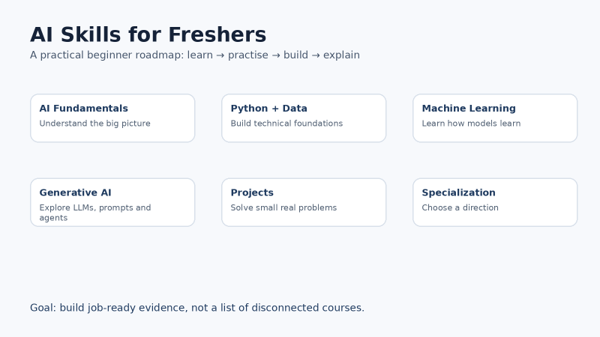
Fig 1: AI skills roadmap for freshers.
Start Learning In-Demand Tech Skills with Expert-Led Training
- Industry-Authorized Curriculum
- Expert-led Training
What AI skills should freshers learn first?
The AI and machine learning training catalog offers paths from fundamentals into machine learning, generative AI, and application-focused topics. Use that progression as a practical starting sequence: fundamentals → Python and data → machine learning → generative AI → projects → specialization.
- AI fundamentals: Learn the main AI workloads and responsible-use considerations.
- Python and data: Build the programming and data-handling foundation that machine learning studies expect.
- Machine learning: Learn how models learn from data and how you evaluate model results.
- Generative AI: Learn large language models, prompting, application programming interfaces (APIs), retrieval-augmented generation (RAG), and AI agents.
- Projects: Apply the skills to a defined problem and document your approach.
- Specialization: Compare AI engineering, machine learning, data science, generative AI, computer vision, and cloud AI paths with your interests and career goals.
Do you need to learn Python before starting AI?
You do not need advanced Python before learning AI concepts, but Python becomes important when you start building applications or working with machine learning.
- Variables and data types
- Conditions and loops
- Functions
- Lists and dictionaries
- File handling
- Basic error handling
- Using libraries
- Basic data manipulation
If you want structured support as you build these foundations, AI and machine learning courses offer beginner-to-advanced learning paths.
What AI fundamentals should a beginner understand?
A beginner should understand the major AI workloads before choosing a specialization. Microsoft Learn’s beginner AI path covers AI concepts alongside generative AI and agents, natural language processing, speech, computer vision, information extraction, and responsible AI.
- Artificial intelligence
- Machine learning
- Deep learning
- Natural language processing
- Computer vision
- Generative AI and LLMs
- AI agents
- Responsible AI
How much mathematics do freshers need for AI?
The amount of mathematics you need depends on the AI role you want. Application-focused learners can start with basic algebra, statistics, probability, and data interpretation, while deeper machine learning or data science work may require linear algebra and additional mathematics.
- Start: algebra and basic statistics
- Next: probability and data interpretation
- Later, if required: linear algebra and deeper mathematics
Should freshers learn machine learning before generative AI?
Freshers should learn basic machine learning concepts before going deep into generative AI, but they do not need to become machine learning specialists first. Concepts such as training data, predictions, classification, regression, and evaluation provide useful context for understanding modern AI systems.
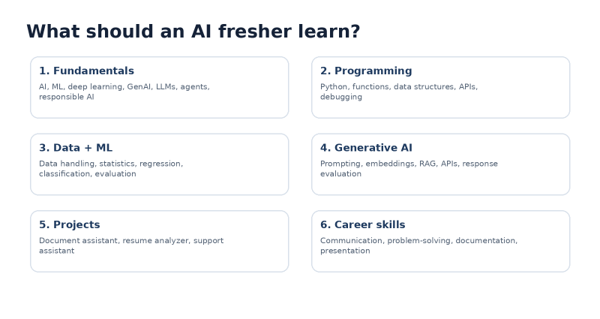
Fig 2: Beginner AI skill stack.
What generative AI skills should freshers learn?
Freshers should understand generative AI at a practical level: how large language models work at a high level, how prompts influence responses, how applications call models, and how retrieval and agents extend what a model can do. Microsoft Learn’s beginner module covers LLMs, prompting, and AI agents, and assumes basic knowledge of AI and machine learning.
- Large language model basics
- Prompt engineering and structured prompts
- AI application programming interfaces (APIs)
- Response evaluation and limitations
- Retrieval-augmented generation (RAG)
- AI agents
- Responsible AI
You do not need to learn every framework immediately. First, understand what each component does, then use it in a small project.
For learners who want to connect data science and AI, Data Science and AI training is another structured learning option.
What projects should AI freshers build?
AI/ML training pages emphasize hands-on and project-based learning, while Google’s Machine Learning Crash Course uses practical exercises. Apply that approach to a few small projects, each with a clear problem, approach, and outcome.
- AI document assistant: answer questions from a defined document set.
- Resume analysis assistant: compare a resume with a job description and identify skills or gaps.
- Customer-support assistant: answer questions from a controlled knowledge base.
For every project, document the problem, data, approach, limitations, evaluation method, and next improvement. That turns a project into evidence of skill rather than just a repository.
When should a fresher choose an AI specialization?
- Programming applications → AI engineering
- Data and statistics → Data science or machine learning
- Language and text → NLP (natural language processing) or generative AI
- Building intelligent assistants → AI agents
- Images and video → Computer vision
- Cloud infrastructure → Cloud AI or MLOps (machine learning operations)
- Business problem-solving → AI solutions and automation
What non-technical skills should AI freshers develop?
Technical AI knowledge is only one part of becoming job-ready. The World Economic Forum identifies analytical thinking as a core skill and also highlights creative thinking, resilience, flexibility, agility, curiosity, and lifelong learning as important skills through 2030.
- Explain technical concepts simply.
- Break complex problems into smaller tasks.
- Question whether an AI response is correct.
- Compare alternative solutions.
- Document your work.
- Present projects clearly.
- Communicate limitations honestly.
What is a practical AI learning roadmap for freshers?
Editorial roadmap: adapt the progression across AI/ML training and the beginner sequences from Google and Microsoft into a 30-day practice plan. The day ranges below are a suggested study schedule, not a published course timetable.
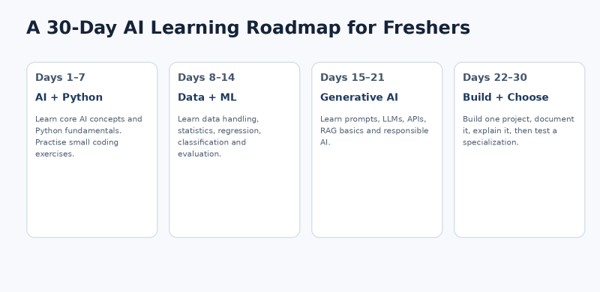
Figure 3. 30-day beginner AI learning roadmap.
- Days 1–7: AI concepts and Python fundamentals — editorial schedule based on AI/ML fundamentals and Google’s Python prerequisite.
- Days 8–14: Data handling, statistics, machine learning basics, and evaluation
- Days 15–21: Generative AI, prompts, application programming interfaces (APIs), retrieval-augmented generation (RAG), and responsible AI, based on Microsoft Learn’s beginner generative AI path.
- Days 22–30: Build one project, document it, explain it, and test a specialization, editorial practice plan informed by a hands-on training approach.
Use the cycle Learn → Practice → Build → Explain → Improve. This keeps learning focused and gives you something concrete to show during interviews.
How can freshers avoid feeling overwhelmed while learning AI?
Training companies offer multiple AI/ML and technology learning paths, so a fresher can reduce overload by choosing one role-oriented path at a time. Use the cycle Learn → Practice → Build → Explain → Improve, then add another technology when it supports the current project.
- Learn one concept.
- Practice it with a small exercise.
- Build a simple application.
- Explain what you built and its limitations.
- Improve it before adding another technology.
You can also use technology training courses to compare learning paths across AI/ML, cloud, data, DevOps, and related technologies.
Where should an AI fresher actually start?
Based on the beginner sequences from Microsoft Learn, Google’s Machine Learning Crash Course, and AI/ML training catalog, a practical starting order is fundamentals → Python/data → machine learning → generative AI → project → specialization.
Remember the roadmap: Fundamentals → Python → Data → Machine Learning → Generative AI → Projects → Specialization.
For additional self-paced reading and examples, AI and technology resources include blogs, case studies, ebooks, and webinars that one can refer to to advance their AI journey.
Upskill Your Teams with Enterprise-Ready Tech Training Programs
- Team-wide Customizable Programs
- Measurable Business Outcomes
About CloudThat
FAQs
1. What skills should I learn to start a career in AI?
ANS: – Start with AI fundamentals, Python, basic data and mathematics concepts, machine learning, and generative AI. Then build practical projects and develop communication and problem-solving skills.
2. Can I learn AI without a computer science degree?
ANS: – Yes. You can begin with AI fundamentals and gradually build programming, data, and mathematical skills. The technical depth you need depends on the AI role you eventually choose.
3. Should I learn Python before generative AI?
ANS: – You can learn basic generative AI concepts without Python, but Python becomes important when you want to build AI applications, work with APIs, manipulate data, or move into technical AI roles.
4. How many AI projects should a fresher build?
ANS: – Focus on a few meaningful projects rather than many unfinished tutorials. Each project should demonstrate a clear problem, your approach, the technology you used, and what you learned.
5. Is learning AI enough to get a job?
ANS: – Learning AI is a starting point, not a guarantee of employment. Combine AI knowledge with practical projects, role-specific technical skills, problem-solving, communication, and the ability to explain your work.


WRITTEN BY Sushravya B.K
Sushravya is a Microsoft Certified Trainer (MCT) and a Subject Matter Expert at CloudThat specialized in Azure and AI/ML. She has won the MCT QUALITY AWARD and one among the Top 100 MCT across the Globe. With a robust foundation in technology and a passion for continuous learning, she has successfully cleared 9 Microsoft certifications, showcasing her expertise in various domains. Her journey in the tech world has been marked by a commitment to excellence and a drive to empower others through knowledge sharing. She had the privilege of delivering multiple training sessions to a diverse audience of over 1000+ participants. These sessions have spanned various topics and skill levels, ensuring that each participant leaves with a deeper understanding and practical skills they can apply immediately.


 PREV
PREV











Comments