

 Login
Login

 March 13, 2026
|
Voiced by Amazon Polly |
Introduction
As generative artificial intelligence has progressed from a basic text-based, question-and-answer system to one able to retrieve company knowledge and reason across multiple tools while performing workflows as an autonomous agent, organizations have begun transitioning from experimentation to generating production-ready systems. As they are doing so, three distinct architectural paradigms have become prevalent:
- Retrieval-Augmented Generation
- Artificial Intelligence Agent
- Agentic RAG / Hybrid System
Understanding these paradigms is especially important for CTOs, AI architects, product teams, and engineers designing the next generation of intelligent systems.
This article will provide an overview of how each of these paradigms differs, where they overlap with each other, and ultimately where generative AI is heading.
Pioneers in Cloud Consulting & Migration Services
- Reduced infrastructural costs
- Accelerated application deployment
Objective
The purpose of this article is to explain RAG, AI Agents, and Agentic RAG in clear architectural terms, compare their respective strengths and limitations, and illustrate each approach with practical architecture diagrams.
Quick Definitions
RAG- Retrieval-Augmented Generation:
RAG enhances large language models (LLMs) by allowing them to retrieve relevant information from external knowledge sources before generating a response.
Instead of relying solely on model training data, RAG systems fetch updated, domain-specific content at query time.
AI Agents:
AI agents are autonomous systems designed not just to generate responses, but to take actions toward achieving a goal. They can plan tasks, invoke tools or APIs, execute multi-step workflows, observe outcomes, and iterate until the objective is completed. Unlike traditional generative models that primarily answer questions, AI agents operate with a sense of workflow and decision-making, enabling them to perform structured actions within real systems rather than simply producing text.
Agentic RAG:
Agentic RAG is a hybrid architecture that combines the grounding strengths of Retrieval-Augmented Generation (RAG) and the autonomy of AI agents. In this model, the agent retrieves verified, contextually relevant knowledge before reasoning, making decisions, or executing actions. By grounding autonomy in trusted data sources, Agentic RAG reduces hallucinations and increases reliability, effectively bringing accountability and evidence-based decision-making to autonomous AI systems.
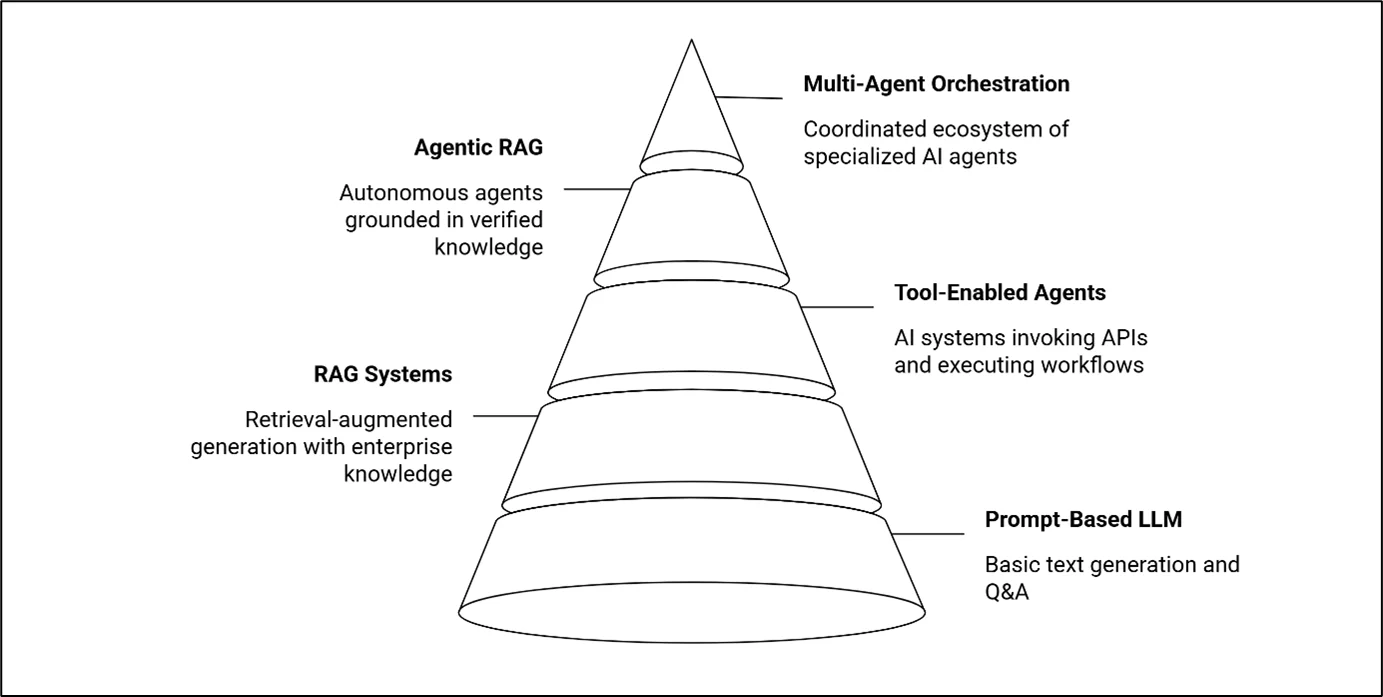
GenAI Maturity Model Pyramid
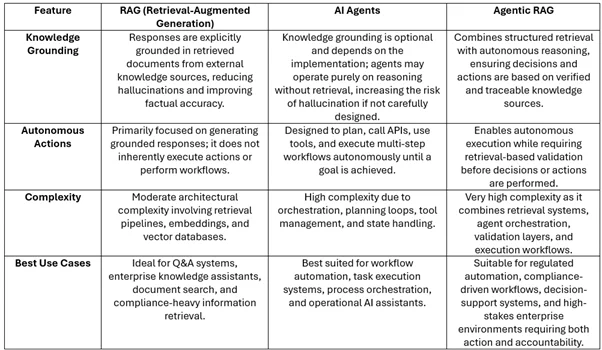
Comparative Analysis
Decision Framework for Choosing the Right GenAI Architecture
To determine whether RAG, AI Agents, or Agentic RAG is the right fit for your use case, consider the following structured decision points:
- Do You Need the System to Perform Actions or Just Generate Responses?
- If the requirement is limited to answering questions, summarizing documents, or generating insights without executing real-world actions, a Retrieval-Augmented Generation (RAG) architecture is typically sufficient.
- If your system must go beyond answering and actively perform tasks, we need an agent-based architecture. In that case, proceed to the next evaluation step.
- Are the Actions Regulated, High-Risk, or Operationally Sensitive?
- If the actions are low-risk, such as updating internal dashboards, sending notifications, a standard AI Agent architecture is appropriate.
- If the actions are regulated, financially impactful, or safety-critical, then Agentic RAG is a stronger choice.
- Is Explainability, Auditability, or Evidence-Based Decision-Making Mandatory?
- If your environment requires detailed traceability, audit logs, and regulatory justification, Agentic RAG provides structured, retrieval-backed accountability.
- If explainability is desirable but not mandatory, and speed or flexibility is a higher priority, a standard AI Agent architecture may be sufficient.
Industry-Specific Mini Case Studies
- Finance: Agentic RAG validates trades against compliance documents before execution.
- Healthcare: Clinical assistant retrieves medical literature before recommending diagnostic workflows.
- Legal: Contract review agent retrieves regulatory clauses before suggesting edits.
- Enterprise SaaS: Support automation retrieves customer history before performing account changes.
Where GenAI Architectures Are Heading?
- Hybrid Systems Will Dominate
Pure RAG or pure agents will rarely operate alone. Most enterprise systems will use layered architectures.
- Governance-First Design
Future architectures will integrate:
- Policy engines
- Access control layers
- Human-in-the-loop checkpoints
- Smaller Models + Smart Retrieval
Instead of massive models, systems will rely on:
- Efficient retrieval
- Domain-tuned smaller models
- Intelligent orchestration
- Multi-Agent Collaboration
Specialized agents (Research Agent, Compliance Agent, Execution Agent) will collaborate in structured workflows.
Conclusion
RAG introduced grounding to generative AI by anchoring responses in retrieved knowledge, while AI agents introduced autonomy through planning and action execution. Agentic RAG now combines both, enabling accountable intelligence that balances retrieval, reasoning, and action. The future of GenAI is not about selecting a single architecture, but about designing modular, safe, and explainable systems that integrate knowledge grounding with autonomous execution. Organizations that embrace this evolution will build AI solutions that are not only intelligent but also trustworthy and scalable.
Drop a query if you have any questions regarding Agentic RAG and we will get back to you quickly.
Empowering organizations to become ‘data driven’ enterprises with our Cloud experts.
- Reduced infrastructure costs
- Timely data-driven decisions
About CloudThat
FAQs
1. Is RAG becoming obsolete with AI Agents?
ANS: – No. RAG remains foundational for grounding. Agents without retrieval are more prone to hallucination.
2. Are AI Agents safe for production?
ANS: – Yes, but only with proper guardrails, policy engines, and human oversight.
3. Is Agentic RAG expensive to build?
ANS: – It is more complex and resource-intensive but provides higher reliability in high-stakes domains.


WRITTEN BY Balaji M
Balaji works as a Research Associate in Data and AIoT at CloudThat, specializing in cloud computing and artificial intelligence–driven solutions. He is committed to utilizing advanced technologies to address complex challenges and drive innovation in the field.


 PREV
PREV











Comments