

 Login
Login


 March 11, 2026
|
Voiced by Amazon Polly |
Overview
Serverless architecture has transformed the way modern applications are built and deployed in the cloud. Instead of managing servers, operating systems, or infrastructure scaling, developers can focus entirely on writing code and delivering business value. AWS Serverless services automatically handle provisioning, scaling, high availability, and fault tolerance behind the scenes.
AWS provides a rich ecosystem of serverless services, including AWS Lambda, Amazon API Gateway, Amazon DynamoDB, Amazon S3, and AWS Step Functions. Together, these services allow organizations to build highly scalable, cost-effective, and event-driven applications without worrying about server management.
In this blog, we will explore what serverless architecture is, the core AWS services involved, and a step-by-step guide to building a basic serverless application on AWS.
Pioneers in Cloud Consulting & Migration Services
- Reduced infrastructural costs
- Accelerated application deployment
Introduction
Serverless architecture is a cloud-native development model in which the cloud provider manages the underlying infrastructure, and users pay only for the compute time they use. Despite the name “serverless,” servers still exist, but they are fully abstracted from developers.
Key AWS Services Used in Serverless Architecture
- AWS Lambda
AWS Lambda lets you run code without provisioning or managing servers. You upload your code, and Lambda executes it in response to events such as API calls, file uploads, or database changes.
- Amazon API Gateway
API Gateway acts as the front door for serverless applications. It allows you to create, publish, and manage REST or HTTP APIs that trigger AWS Lambda functions.
- Amazon DynamoDB
Amazon DynamoDB is a fully managed NoSQL database commonly used in serverless architectures. It offers single-digit millisecond performance at any scale and integrates seamlessly with Lambda.
- Amazon S3
Amazon S3 is often used to store static files and application assets, and to trigger AWS Lambda functions when files are uploaded.
- AWS Step Functions
AWS Step Functions helps coordinate multiple AWS Lambda functions into workflows using state machines, making it easier to build complex serverless applications.
Step-by-Step Guide
Step 1: Create an AWS Lambda Function
- Log in to the AWS Management Console
- Search for AWS Lambda
- Click the Create function
- Choose Author from scratch
Enter:
- Function name (example: hello-serverless)
- Runtime (example: Python 3.10)
- Click the Create function
Add simple code:
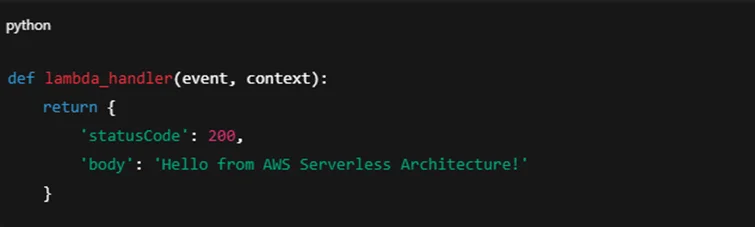
Click Deploy.
Step 2: Create an API Using Amazon API Gateway
- Open API Gateway
- Click Create API
- Choose HTTP API
- Click Build
- Select Add integration
- Choose an AWS Lambda function
- Select your AWS Lambda function
- Create a route (example: GET /hello)
- Click Create
Amazon API Gateway will generate a public endpoint.
Step 3: Test the Serverless Application
- Copy the API endpoint URL
- Open it in a browser
- You should see:

Your serverless application is now live without managing a single server.
Step 4: Monitor Using Amazon CloudWatch
- AWS automatically sends logs and metrics to CloudWatch.
- Go to Amazon CloudWatch
- Open Logs
- Select your AWS Lambda function log group
- Monitor execution time, errors, and request count
Benefits of Serverless Architecture on AWS
- No Server Management – AWS handles provisioning and maintenance
- Automatic Scaling – Scales instantly based on demand
- Pay-as-You-Go Pricing – Pay only for execution time
- High Availability – Built-in fault tolerance
- Faster Development – Focus on code, not infrastructure
Common Use Cases
- REST APIs and backend services
- Event-driven data processing
- Real-time file processing
- IoT backends
- Chatbots and automation tools
- Microservices-based applications
Conclusion
Serverless architecture on AWS enables organizations to build scalable, reliable, and cost-efficient applications without managing servers or infrastructure. By using services like AWS Lambda, Amazon API Gateway, Amazon DynamoDB, and Amazon S3, teams can deploy applications faster while reducing operational complexity.
Whether you are a startup looking to move fast or an enterprise aiming to modernize applications, AWS serverless architecture provides a powerful foundation. With automatic scaling, built-in monitoring, and pay-per-use pricing, serverless is an excellent choice for modern cloud-native development.
Drop a query if you have any questions regarding Serverless architecture and we will get back to you quickly.
Empowering organizations to become ‘data driven’ enterprises with our Cloud experts.
- Reduced infrastructure costs
- Timely data-driven decisions
About CloudThat
FAQs
1. What is Serverless Architecture?
ANS: – Serverless architecture is a cloud computing model where developers run code without managing servers. The cloud provider handles scaling, availability, and infrastructure management.
2. Is AWS Lambda completely free?
ANS: – AWS Lambda offers a free tier, but after that, you are charged based on the number of requests and execution time. Pricing is pay-as-you-go.
3. Does serverless mean no servers at all?
ANS: – No. Servers still exist, but AWS fully manages them. Developers don’t need to provision, configure, or maintain servers.


WRITTEN BY Ravi Kose
Ravi Kose works as a Senior Research Associate at CloudThat. He is a skilled cloud and infrastructure professional with a strong focus on managing infrastructure, security, and cloud migration projects. Ravi has hands-on experience designing secure, scalable, and efficient cloud architectures. With a solid understanding of cloud best practices and tools, he ensures smooth and secure transitions during cloud adoption and modernization initiatives. In his free time, he enjoys exploring emerging cloud technologies and deepening his expertise in DevOps and security practices.


 PREV
PREV












Comments