

 Login
Login


 March 13, 2026
|
Voiced by Amazon Polly |
Multi-Factor Authentication (MFA) is widely recognized as a foundational security control in Microsoft cloud environments. It significantly reduces the risk of password-based attacks and remains a critical first line of defence in identity protection. However, as identity has become the primary attack surface, threat actors have evolved well beyond simple credential theft.
Modern attacks increasingly exploit session tokens, user behavior, compromised devices, and misconfigured cloud policies, areas where MFA alone provides limited protection. This shift highlights why advanced Microsoft Security training must extend beyond MFA and focus on Conditional Access and Threat Analytics, which enable context-aware decisions and automated remediation based on real-time risk.
Start Learning In-Demand Tech Skills with Expert-Led Training
- Industry-Authorized Curriculum
- Expert-led Training
Where MFA Works Well and Where It Falls Short
MFA is highly effective in scenarios such as:
- Blocking unauthorized access using stolen passwords
- Reducing the success rate of brute-force and password-spray attacks
- Adding friction to sign-ins from unfamiliar locations
However, there are specific real-world use cases where MFA alone is insufficient, and relying on it can leave security gaps.
Use case: MFA fatigue attack with partial success
An attacker initiates repeated MFA push notifications to a user. Eventually, the user approves one request out of confusion or urgency. From the MFA’s perspective, authentication was successful even though the sign-in was malicious.
At this point:
- MFA has already been satisfied
- The attacker gains a valid session token
- Traditional MFA cannot detect or remediate the risk
This is where organizations often assume they are protected, but the attack has moved past authentication.
Security Gaps That MFA Cannot Address
Even when properly configured, MFA cannot mitigate several modern identity threats, including:
- Token theft and session hijacking: MFA validates the initial sign-in but does not continuously assess session risk.
- Compromised or unmanaged devices: MFA does not assess device health, compliance, or malware presence.
- Insider threats and risky user behavior: MFA cannot distinguish between legitimate and suspicious behavior once access is granted.
- Overly permissive access configurations: MFA does not enforce least-privilege or contextual access controls.
- Real-time risk changes: MFA is static, while threats are dynamic.
These gaps highlight the need for risk-based controls and automated responses, which are core strengths of Conditional Access and Threat Analytics in Microsoft Entra ID.
Conditional Access: Enabling Risk-Based MFA and Auto-Remediation
Conditional access extends MFA by making it conditional, rather than universal. Instead of enforcing MFA for every sign-in, it evaluates risk signals in real time and applies controls only when needed.
Use case: Risk-based MFA with automatic remediation
Consider an organization that uses Microsoft Entra ID with Identity Protection enabled.
Scenario:
- A user successfully signs in with a username and password.
- Threat Analytics detects abnormal behavior, such as:
- Impossible travel
- Anonymous IP usage
- Sign in from a location associated with previous attacks
How Conditional Access responds:
- The sign-in is flagged as high risk.
- A Conditional Access policy automatically:
- Requires MFA again, or
- Blocks access entirely if risk exceeds a threshold.
This is auto-remediation in action; no manual intervention is required. The policy adapts dynamically based on threat signals, reducing response time and limiting attacker movement.
How Threat Analytics Provides the Missing Context
While Conditional Access enforces controls, Threat Analytics explains why those controls are needed. It analyzes identity signals across the tenant and highlights risks that might otherwise go unnoticed.
Threat Analytics helps security teams understand:
- Which identities are actively targeted
- Which configurations increase exposure
- How attackers progress through identity attack chains
Use case: From detection to enforcement
Scenario:
Threat Analytics identifies repeated MFA push attempts against multiple users as an indicator of MFA fatigue attacks.
What happens next:
- Security teams review affected users and sign-in logs.
- Analytics confirms elevated sign-in risk for specific accounts.
- Conditional Access policies automatically:
- Require phishing-resistant MFA
- Restrict access to compliant or managed devices
- Block sign-ins from high-risk locations
This closed-loop process- analytics → decision → enforcement—is something MFA alone cannot achieve.
professionals aiming to strengthen their detection and response capabilities should consider developing skills aligned with the Microsoft Security Operations Analyst role. Training that emphasizes Conditional Access, Threat Analytics, identity-based attack detection, and automated remediation enables security practitioners to move beyond basic MFA enforcement.
How to Achieve Identity Protection
Rather than relying on isolated lab exercises, advanced Microsoft Security education should focus on scenario-driven implementation. Real-world identity protection is not about clicking through steps; it is about understanding why a control is applied and when it should change.
A mature identity security workflow typically includes:
- Continuous risk evaluation
- Adaptive Conditional Access enforcement
- Automated remediation for high-risk sign-ins
- Ongoing monitoring to refine policies
This approach reflects how Conditional Access and Threat Analytics operate in production environments, not just in labs.
If you would like to explore these identity protection concepts in greater depth, we encourage you to consider the SC-300 Microsoft Identity and Access Administrator course, which focuses on real-world identity protection scenarios.
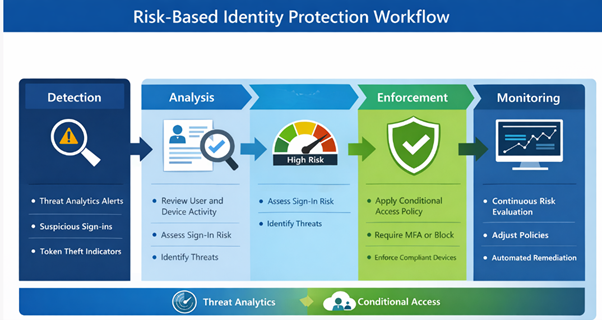
Figure 1: Risk-Based Identity Protection Workflow (Source: Microsoft Security Architecture Guides)
Adaptive Identity Protection
MFA remains an essential security control, but it is no longer sufficient on its own. Modern identity threats exploit gaps that MFA cannot address, such as token theft, compromised devices, and real-time behavioral risks.
By combining Conditional Access and Threat Analytics, organizations can move from static authentication to adaptive identity protection. This is why advanced Microsoft Security courses must emphasize risk-based MFA, automated remediation, and contextual decision-making.
Master Microsoft Security Training: Enhance Your Cyber Defense Skills
- Hands-on Experience
- Certification Prep
- Advanced Threat Detection
About CloudThat


WRITTEN BY Sangeetha S
Sangeetha S is a Subject Matter Expert at CloudThat, specializing in Data, and Networking. She is a Microsoft Certified Trainer with over 10+ years of experience in technical training. She has trained more than 3,000 professionals from India, the United States and the United Kingdom to upskill in Azure cloud services, data engineering and AI technologies. Known for simplifying complex concepts and delivering hands-on, impactful sessions, she brings deep technical knowledge and practical insights into every learning experience. Sangeetha's passion for bridging technology with business outcomes reflects in her unique approach to learning and development. "


 PREV
PREV












Comments