

 Login
Login


 March 13, 2026
|
Voiced by Amazon Polly |
Introduction
As the use of generative AI continues to expand across different types of businesses, a common issue has emerged: how can we ensure that AI-generated responses are reliable, structured, and easy for machines to read?
While LLMs (large language models) can produce excellent natural language responses, many business applications require output in very specific formats (e.g., JSON, XML, Schema-bound) that downstream systems can process with confidence. This is where structured outputs come in.
With AWS (Amazon Web Services) and its fully managed service, Amazon Bedrock, developers can create applications that produce schema-compliant AI output, ensuring the output follows a predefined format.
In this blog post, we will discuss how structured outputs work on AWS in general and Amazon Bedrock specifically; why they are important; and how you can implement them effectively in your own applications.
Pioneers in Cloud Consulting & Migration Services
- Reduced infrastructural costs
- Accelerated application deployment
Objective
By the time you finish reading this blog, you’ll be able to easily differentiate between structured outputs and what they mean regarding generative AI, as well as understand why these are very necessary to create stable, reliable, production-ready systems. You’ll learn why compliance with schemas is extremely important in enterprise-level organizations and how they play a role in automation, validation, and supporting downstream processes.
You’ll also learn how to build structured (machine-readable) outputs from Amazon Bedrock by outlining real-world architectural patterns used in implementation. Additionally, you’ll see examples that demonstrate how structured responses can offer potential benefits and help create scalable automation.
Finally, you will be provided with best-practice recommendations and common mistakes to avoid when designing reliable, schema-compliant AI solutions.
What Are Structured Outputs?
Structured outputs refer to AI-generated responses that conform to a predefined schema.
Instead of receiving:
“John Doe lives in California and his customer ID is 12345.”
We receive:
|
1 2 3 4 5 |
{ "name": "John Doe", "state": "California", "customer_id": 12345 } |
Why Schema-Compliant AI Responses Matter?
- Enterprise Reliability
Contracts that govern the use of generative AI require responses to be reliably predictable. Schema compliance enables this by enforcing a defined structure across all responses. The reliability enabled by schema compliance is critical when creating production-grade systems that deliver stable uptime for continuous operations and yield accurate outputs, both of which directly impact bottom-line revenue and operational efficiency.
- Automation Enablement
Using structured outputs means that generative AI is not just a conversational assistant; it’s ready to be consumed with zero modification between systems and by other applications as an automatable component. When the generated response strictly follows the schema, the generated output can be processed by systems without the need for human interpretation or complicated parsing rules.
- Security and Validation
Enforcing schemas allows organizations to reject any fields that aren’t defined in the specified schema. This practice ensures that any original payloads inserted into a downstream system do not contain hidden or potentially harmful threats. Organizations enforcing schemas will also guarantee that their data types remain consistent; e.g., a numeric data type will remain consistent throughout the life cycle of that data, provided that a valid number is entered at creation, the defined format for the date created is always included, and any required fields are always included.
- Reduced Operational Overhead
With the development of consistent structures, developers can eliminate complex, time-consuming string manipulations and transformation layers. Reduced parsing rules translates to fewer bugs, a shorter time to debug, and shorter sales cycles. This ultimately reduces overall operations costs for the company.
How Structured Outputs Work in Amazon Bedrock?
Amazon Bedrock uses a systematic workflow to implement structured output enforcement at a high level.
- The first step is defining a formal JSON schema that specifies how the downstream systems want the data structured.
- The next step is to embed the schema instructions directly into the model prompt. This ensures that the model understands to follow the specified format.
- Once the model is prompted to use the schema rules, its parameters can be configured to provide the user with as little randomness as possible and as much determinism as possible in the results.
- After generating a response, it is validated programmatically against the schema. If the response does not meet the required format, it is either rejected or “re-tried” until it does.
Architecture Overview
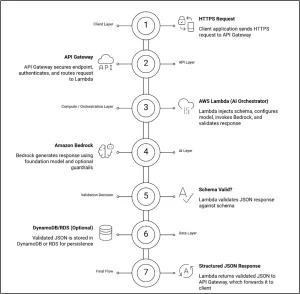
The above architecture illustrates how schema-compliant AI responses are generated, validated, and returned using Amazon Bedrock in a serverless AWS environment.
Client Request
The client application sends an HTTPS request containing the user prompt and required input data to the Amazon API Gateway.
Amazon API Gateway Processing
Amazon API Gateway secures the endpoint, authenticates requests, and routes them to AWS Lambda for orchestration.
AWS Lambda Orchestration
AWS Lambda injects the predefined JSON schema into the prompt, configures model parameters, and invokes Amazon Bedrock.
AI Response Generation
Amazon Bedrock processes the request using a selected foundation model and generates a structured JSON response (with optional guardrails applied).
Schema Validation
AWS Lambda validates the returned JSON against the predefined schema to ensure required fields, correct data types, and proper structure.
Optional Persistence
If the response is valid, the structured JSON can be persisted in Amazon DynamoDB or Amazon RDS for downstream processing.
Structured Response to Client
The validated, schema-compliant JSON response is returned to the client application via Amazon API Gateway.
Real-World Applications
- Financial Risk Assessment
- AI generates structured risk reports
- Directly feeds compliance systems
- Insurance Claims Processing
- Extract structured claim fields
- Automate approval workflows
- Healthcare Data Extraction
- Convert unstructured clinical notes into structured records
- E-commerce Catalog Structuring
- Normalize product descriptions into structured attributes
- Legal Document Summarization
- Extract structured clauses and obligations
Conclusion
Structured outputs play a critical role in building enterprise-grade AI systems, where reliability, predictability, and integration stability are non-negotiable. By leveraging Amazon Bedrock, organizations can enforce strict schema compliance, reduce integration complexity, and enable seamless automation across workflows and APIs.
Drop a query if you have any questions regarding Amazon Bedrock and we will get back to you quickly.
Empowering organizations to become ‘data driven’ enterprises with our Cloud experts.
- Reduced infrastructure costs
- Timely data-driven decisions
About CloudThat
FAQs
1. What is structured output in Amazon Bedrock?
ANS: – It is a mechanism in which model responses conform strictly to predefined schemas, such as JSON, ensuring predictable integration.
2. Does Amazon Bedrock guarantee 100% schema compliance?
ANS: – No model guarantees perfect compliance. Validation layers and retry mechanisms are required.
3. Which models support structured outputs?
ANS: – Most foundation models in Amazon Bedrock support JSON-based structured prompting, though behavior may vary.


WRITTEN BY Balaji M
Balaji works as a Research Associate in Data and AIoT at CloudThat, specializing in cloud computing and artificial intelligence–driven solutions. He is committed to utilizing advanced technologies to address complex challenges and drive innovation in the field.


 PREV
PREV












Comments