

 Login
Login


 December 17, 2025
|
Voiced by Amazon Polly |
The Era of Cloud Pluralism
Cloud computing has moved past the question of whether organizations will migrate to the cloud to how many clouds they will use. Gone are the days when relying on a single vendor was the dominant strategy.
Today’s enterprise landscape is defined by Multi-Cloud – a strategic approach involving the use of two or more public cloud providers such as AWS, Microsoft Azure and Google Cloud Platform (GCP).

This shift isn’t just a niche trend- it’s the new normal. Recent studies show that 90% of businesses now employ a multi-cloud strategy, leveraging each provider’s strengths to maximize agility, performance and innovation.
As a result, the need for professionals who can design, integrate and manage multi-cloud environments is skyrocketing. Specialized Cloud Computing courses have become essential for anyone aiming to stay ahead in the cloud-driven economy.
Start Learning In-Demand Tech Skills with Expert-Led Training
- Industry-Authorized Curriculum
- Expert-led Training
Why Multi-Cloud Skills Are Becoming Essential
The Business Case for Multi-Cloud: Avoiding Vendor Lock-in
The most critical driver is avoiding dependency on a single cloud provider. Multi-cloud strategies give companies leverage and flexibility, offering a safeguard against vendor lock-in and pricing limitations.
Optimization & Best-of-Breed Services
Each cloud excels in different areas:
- AWS for its broad IaaS ecosystem
- Azure for hybrid integrations and identity services
- GCP for advanced AI and analytics tools
Multi-cloud professionals place the right workload on the right platform, ensuring optimal efficiency and performance.
Enhanced Resilience & Risk Mitigation
Distributing workloads across multiple clouds enhances uptime and business continuity. In sectors such as BFSI, this is crucial for compliance and operational resilience.
Regulatory Compliance
Multi-cloud models allow organizations to store and process data in specific regions that meet local regulatory standards (GDPR, HIPAA, etc).
Key Skills Multi-Cloud Professionals Need
Cross-Platform Architecture
Understanding networking, identity and storage across AWS VPCs, Azure VNets and GCP VPCs and designing solutions that interoperate seamlessly.
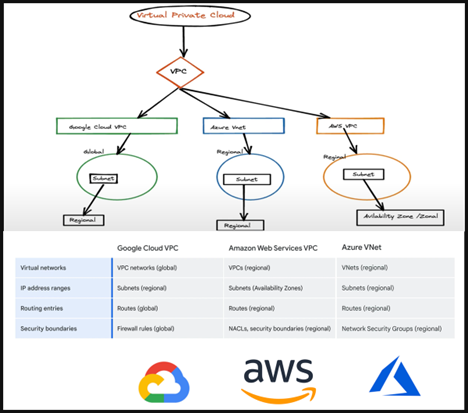
Multi-cloud networking: AWS VPC, Azure VNet and Google Cloud VPC compared for seamless integration.
DevOps & Automation
Proficiency with Terraform, Ansible and Kubernetes to manage multi-cloud infrastructure as code.
Certification spotlight: Certified Kubernetes Administrator (CKA) – a top credential for multi-cloud container management.
FinOps (Cloud Financial Management)
Managing and optimizing costs across different cloud billing systems and dashboards.
Security & Governance
Implementing unified policies for IAM, encryption and compliance across clouds is vital for enterprise-grade multi-cloud operations.
The Best Cloud Computing Courses for Multi-Cloud Mastery
The hiring landscape now favours multi-skilled cloud engineers – professionals who are fluent across AWS, Azure and GCP. Certifications still matter, but the ability to integrate and automate across clouds defines top-tier expertise.
Certifications to Pursue
- Foundational Vendor Certifications
Gain a base understanding of each hyperscaler’s ecosystem:
- AWS: Cloud Practitioner / Solutions Architect – Associate
- Azure: AZ-900 (Fundamentals), AZ-104 (Administrator)
- GCP: Cloud Digital Leader
- Vendor-Neutral Certifications
To ensure your expertise is portable:
- CloudThat: Foundational multi-cloud knowledge, infrastructure and security
- Certified Cloud Security Professional (CCSP): the gold standard for securing multi-cloud environments
Integrated Learning Paths for Multi-Cloud Mastery
As multi-cloud environments become increasingly complex, learners often find that taking isolated, vendor-specific courses creates knowledge gaps rather than genuine expertise. To address this, modern cloud computing courses increasingly follow an integrated learning path approach that teaches AWS, Azure and GCP together through common architectural, operational and automation patterns.
These programs emphasize:
- Unified hands-on labs that span multiple cloud platforms
- Real-world workload migration, hybrid integration and failover scenarios
- Practical exposure to DevOps practices such as CI/CD pipelines, Infrastructure as Code (IaC) and policy-driven governance
- Cross-cloud cost management, security and observability use cases
Outcome: Learners move beyond siloed certifications to develop true multi-cloud fluency, gaining the ability to design, automate and operate resilient cloud systems in real enterprise environments.
From Certified to Versatile
Multi-cloud is no longer optional; it has become the core operating model of digital enterprises.
Over 97% of IT professionals plan to expand their multi-cloud engagement, and organizations are actively seeking versatile engineers who can handle integration, security and performance across diverse platforms.
Upskill Your Teams with Enterprise-Ready Tech Training Programs
- Team-wide Customizable Programs
- Measurable Business Outcomes
About CloudThat


WRITTEN BY Madhuri Abhijeet Joshi
Dr. Madhuri Joshi is a Microsoft Certified Trainer (MCT) and a renowned Subject Matter Expert with a Doctorate in Computer Science and Engineering. With over 23 years of experience in training and consulting, she has established herself as a trusted expert in DevOps and Cloud Computing technologies. She has worked extensively on a wide range of industry projects and has played a key role in designing custom training programs and project-based course outlines for enterprise technologies such as SAP and Red Hat OpenShift. As a technical coach for the Government of Maharashtra's Women Empowerment Program, Dr. Joshi has contributed significantly to upskilling and mentoring women in technology. Having trained over 7,000 professionals across the globe, she is highly respected for her clear, simple, and example-driven teaching style, especially when explaining complex technical concepts.


 PREV
PREV











Comments