

 Login
Login

 March 23, 2026
|
Voiced by Amazon Polly |
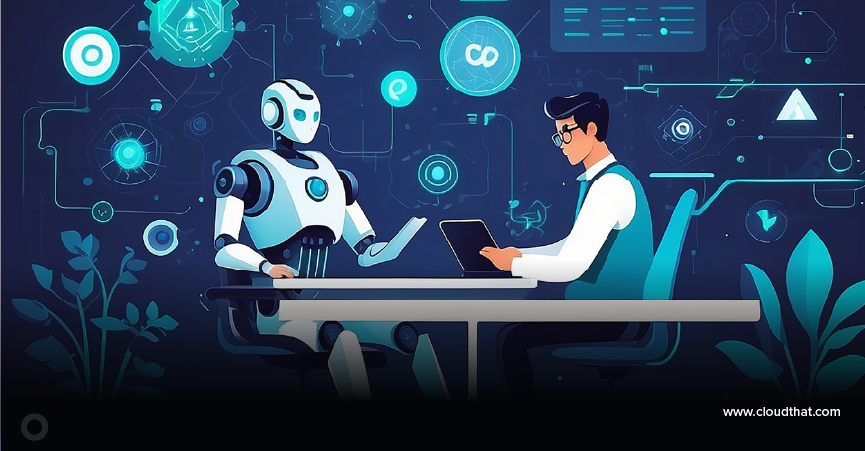
An increasing number of executives now characterize the future workforce as a “nation of digital workers”. AI agents can interpret signals, assess contextual information, and execute tasks across platforms under human supervision. This analogy is becoming widespread as agentic systems advance from simple chat-based support to comprehensive workflow management.
Start Learning In-Demand Tech Skills with Expert-Led Training
- Industry-Authorized Curriculum
- Expert-led Training
What are digital workers?
Digital Workers are computer programs that understand language and can use different tools. They can read and write information, start tasks, and organize steps across business software. They are not just for making content quickly, but also for helping people make decisions and carry out important tasks. That’s why experts say AI is most valuable when it helps people use good judgment and make better choices.
Hotel & Tourism Industry
Imagine a 350-room business hotel in Mumbai in a week with an unexpected surge: a major conference, two flight disruptions, and a wedding block arriving early. A digital concierge agent monitors arrivals, airline alerts, and housekeeping status, then proactively messages guests with multilingual options for early check-in, baggage storage, and lounge access; simultaneously, an operations agent reallocates housekeeping priorities to “rooms needed first”, and a revenue agent recommends rate and inventory adjustments based on pickup and competitor signals.
Hospitality AI adoption is already centered on conversational interfaces for guest queries, operational streamlining, and revenue-management insights, with industry coverage highlighting how AI supports understaffed shifts by handling guest calls and routine requests while staff focus on higher-touch service.
Government using AI for Citizen Services that Don't Close at 5 PM.
Consider a state transport department during the deadline week for permits and renewals. A citizen-facing agent answers eligibility questions in plain language, pulls the correct forms, and checks application completeness before submission, reducing rework. In parallel, an internal agent helps officers summarize case files, draft responses, and update records, precisely the kind of daily-work augmentation governments are testing at scale. For instance, the UK government reported results from a large trial in which civil servants used generative AI for drafting, summarizing, and administrative tasks, with measured daily time savings that could translate into substantial annual capacity gains.
Another government scenario is guidance discovery, where citizens often struggle to find answers across hundreds of thousands of web pages. The UK Govt has experimented with an AI chatbot designed to provide personalized answers grounded in official guidance, while acknowledging accuracy and hallucination risks and emphasizing guardrails and staged rollout.
Financial Organizations
In banking, the most urgent “digital work” value often appears in Know Your Customers and compliance, where teams face alert overload and heavy documentation requirements. A compliance agent clusters related alerts, drafts a case narrative, links supporting transactions, and prepares a Suspicious Activity Report draft for investigator review, reducing manual copying and accelerating decision cycles without removing accountability. Research and industry analysis argue that agentic AI can automate parts of the client lifecycle in financial crime controls, addressing inefficiencies that consume significant Full Time Equivalent capacity in KYC functions.
Another banking scenario is to have a service agent that can summarize the customer’s history, retrieve policy passages, generate a compliant response, and open/close tickets in CRM, again with permission boundaries and audit logs.
Ongoing Development and Research
Three developments are shaping the next wave. First, enterprise software is rapidly embedding agents. Gartner forecasts a sharp rise in task-specific AI agents inside enterprise applications in the near term, signaling that “agents everywhere” will become a default user experience.
Second, platforms are standardizing autonomy with guardrails. Microsoft’s Copilot Studio guidance explicitly frames autonomous agents as trigger-driven actors operating continuously with scoped permissions, auditable processes, and best practices.
Third, current workforce research increasingly focuses on large-scale augmentation. Collaborative studies addressing job enhancement and productivity highlight that the effectiveness of these initiatives is influenced not only by technology but also by factors such as adoption practices, employee training, and operational frameworks.
Want to Learn more and build your Agent using MS 365 Copilot Studio?
Companies like CloudThat emphasize practical learning through labs and projects simulating real industry scenarios for Agent creation, deployment, administration, and management. Readers are encouraged to go through PL‑7008: Create Custom Agents in Microsoft Copilot Studio Training. This training will help you get started building and deploying custom Copilot agents using Microsoft Copilot Studio, Dataverse, topics, entities, etc.
Future of Digital Work
The “country of digital workers” isn’t a slogan. It’s a leadership lens. Hotels use agents to protect guest experience during chaos and optimize revenue; governments use them to make services accessible and reduce administrative drag; banks use them to improve service and strengthen compliance through faster, more consistent casework.
Upskill Your Teams with Enterprise-Ready Tech Training Programs
- Team-wide Customizable Programs
- Measurable Business Outcomes
About CloudThat
FAQs
1. Are digital workers just chatbots?
ANS: – Not anymore. Modern digital workers can be autonomous agents that react to triggers, run workflows, and take actions.
2. Will digital workers replace people in hotels, the Government, or banks?
ANS: – Not really, Custom Agents can boost productivity and reshape tasks, with outcomes dependent on how organizations redesign work and upskill staff.
3. How do governments prevent wrong answers and hallucinations?
ANS: – By limiting scope, grounding answers in authoritative sources, adding guardrails, and rolling out in stages with measurement and human escalation.
4. Where do financial institutions see the biggest value first?
ANS: – High-volume compliance and investigative workflows, such as KYC, are prime targets because they involve repetitive data gathering and narrative writing, enabling agents to accelerate work while investigators retain accountability.
5. What's the biggest mistake companies make when deploying agents?
ANS: – Attempting to simply add agents to outdated processes without updating operations or governance is ineffective. Enterprise guidelines for agent-based strategies emphasize the need to rethink workflows and develop orchestration, control, and management methods tailored for a digital workforce.


WRITTEN BY Rahul Mehta
Rahul Mehta is a Subject Matter Expert at CloudThat, specializing in Microsoft and VMware technologies, Generative AI, and cloud security. With over 19 years of experience in the IT training domain, he has trained more than 1000 professionals to upskill in areas such as Microsoft 365 Copilot, Microsoft Team Administration, Azure Security and Compliance, VMware Data Centre Virtualization. Known for simplifying complex concepts and delivering hands-on, impactful training, he brings deep technical knowledge and practical application into every learning experience. Rahul's passion for continuous learning and emerging technologies reflects in his unique approach to learning and development


 PREV
PREV











Comments