

 Login
Login

 September 4, 2026
|
Voiced by Amazon Polly |
Overview
The growth of autonomous AI agents, Model Context Protocol (MCP) servers, and multi-agent pipelines has driven an explosion in Non-Human Identities (NHIs). In modern cloud environments, machine-to-human identity ratios routinely exceed 100-to-1. While human access is secured with SSO and MFA, non-human identities often rely on overprivileged, static secrets.
When autonomous subagents execute cloud API mutations, compromised credentials expose enterprises to lateral movement, cryptomining hijacking, and severe SOC 2/FedRAMP violations. This guide details architectures for governing NHIs across AWS and GCP using ephemeral workload identity federation, attribute-based access control (ABAC), MCP isolation, and runtime policy enforcement.
Pioneers in Cloud Consulting & Migration Services
- Reduced infrastructural costs
- Accelerated application deployment
Introduction
Traditional IAM was architected for human workflows. Autonomous agentic systems, however, spawn and dispatch ephemeral subagents that programmatically execute cloud operations at high velocity.
Unsecured machine identities create three severe vulnerabilities:
- Secret Sprawl: Static AWS keys or GCP service account JSON files leak through prompt traces and vector stores.
- Overprivileged Roles: Subagents receive blanket permissions rather than downscoped session policies.
- Injection Privilege Escalation: Untrusted external inputs hijack agent memory to trigger unauthorized cloud mutations.
Securing AI workloads requires moving from persistent secrets to a dynamic, cryptographically verifiable Workload Identity Federation.
Core Architecture: The NHI Threat Surface in Agentic Clouds
In multi-agent systems, machine identities interface with cloud resources across three critical tiers:
- The Orchestration State Layer
Orchestrators store session memory and execution checkpoints. Storing raw tokens in these state stores allows prompt injections or compromised workers to exfiltrate credentials directly.
- The Model Context Protocol (MCP) Tool Bridge
Subagents access tools through MCP servers. If an MCP server connects using ambient cloud IAM roles, every calling agent inherits identical permissions, creating a Confused Deputy vulnerability.
- Cloud Runtime Execution Sandboxes
Containerized execution environments (AWS Lambda, ECS, Cloud Run, GKE) require distinct identity perimeters. Ephemeral token bindings ensure credentials expire when tasks complete.
Core Best Practices for Securing NHIs Across AWS and GCP
- Eliminate Static API Keys in Favor of Ephemeral Tokens & Source Identity
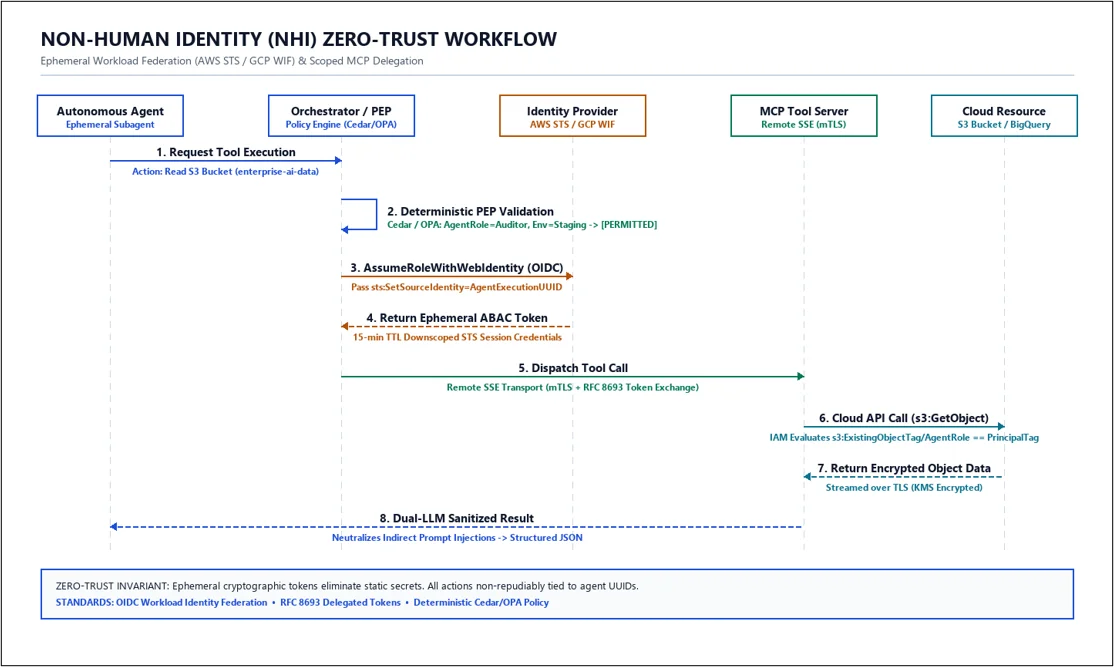
Never issue static IAM access keys or service account JSON files. Configure orchestrators to exchange short-lived OIDC tokens for temporary cloud credentials:
- AWS: Assume IAM execution roles via STS AssumeRoleWithWebIdentity (900s TTL). Crucially, pass sts:SetSourceIdentity with the agent execution UUID to ensure non-repudiable CloudTrail auditing.
- GCP: Use Cloud Run or GKE Workload Identity to fetch OAuth 2.0 access tokens via the metadata server, mapping google.subject and custom attribute.agent_id claims.
- Implement Workload Identity Federation for Cross-Platform Agents
For subagents running outside native cloud boundaries (on-prem, hybrid, or cross-cloud):
- AWS: Deploy AWS IAM Roles Anywhere with X.509 certificates to mint short-lived STS tokens.
- GCP: Configure Workload Identity Pools to map external OIDC tokens directly to Google Service Accounts.
- Enforce Attribute-Based Access Control (ABAC) Policies
Implement ABAC policies that evaluate principal tags against existing resource tags on read, while strictly enforcing request tags on write:
|
1 2 3 4 5 6 7 8 9 10 11 12 13 14 15 16 17 18 19 20 21 22 23 24 25 26 27 28 29 |
{ "Version": "2012-10-17", "Statement": [ { "Sid": "AllowReadMatchingAgentRoleTag", "Effect": "Allow", "Action": ["s3:GetObject", "s3:GetObjectVersion"], "Resource": "arn:aws:s3:::enterprise-ai-data/*", "Condition": { "StringEquals": { "s3:ExistingObjectTag/AgentRole": "${aws:PrincipalTag/AgentRole}", "aws:PrincipalTag/Environment": "Staging" } } }, { "Sid": "AllowWriteEnforcingRequestTagMatchingPrincipal", "Effect": "Allow", "Action": ["s3:PutObject", "s3:PutObjectTagging"], "Resource": "arn:aws:s3:::enterprise-ai-data/*", "Condition": { "StringEquals": { "aws:RequestTag/AgentRole": "${aws:PrincipalTag/AgentRole}", "aws:PrincipalTag/Environment": "Staging" } } } ] } |
- Isolate MCP Tool Access Across stdio and Remote Transport Boundaries
- Local stdio MCP: Isolate tool processes using Linux namespaces, cgroups, seccomp filters, and non-root execution.
- Remote SSE MCP: Enforce mTLS and scoped OAuth tokens. Prevent Confused Deputy risks via RFC 8693 Token Exchange so the server calls cloud APIs under the invoking agent’s identity.
- Contain Indirect Prompt Injection with Dual-Boundary Defense
Implement a Dual-LLM architecture: an unprivileged parser LLM (zero tools) sanitizes external data against strict JSON schemas before passing it to an execution engine governed by a deterministic policy.
Governance Guardrail: Destructive cloud operations (e.g., deleting buckets, altering security groups, mutating IAM policies) must require explicit out-of-band Human-in-the-Loop (HITL) approval.
- Deploy Runtime Policy Enforcement Points (PEPs) with Cedar or OPA
Position deterministic policy engines (Open Policy Agent or Cedar / AWS Verified Permissions) between the AI orchestrator and cloud API dispatchers, validating every tool invocation before execution.
- Continuously Audit Agent Permission Drift and Cloud API Spikes
- AWS: Alert on anomalous API spikes from agent roles using EventBridge rules on CloudTrail events.
- GCP: Stream Cloud Audit Logs to BigQuery and monitor protoPayload.authenticationInfo.principalSubject for unauthorized calls.
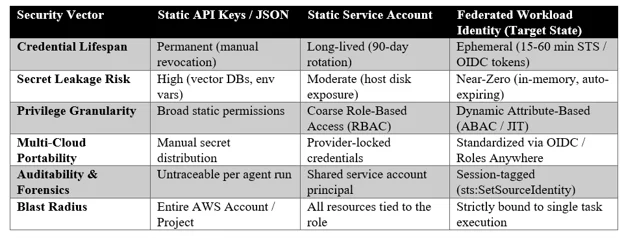
Machine Credential Architectures at a Glance
Trade-Off Analysis: Pros and Cons
Advantages
- Zero Secret Footprint: Eliminates static secrets from prompt logs, memory, and vector stores.
- Blast-Radius Containment: Downscoped session tokens prevent subagents from compromising production workloads.
- Forensic Traceability: sts:SetSourceIdentity ties cloud API mutations directly to specific agent run IDs.
Disadvantages and Challenges
- Token Handshake Latency: Token exchange handshakes add minor latency to initial tool calls.
- Configuration Complexity: Managing identity pools and trust policies requires dedicated IaC automation.
Conclusion
Securing Non-Human Identities (NHIs) is essential as autonomous AI workloads assume operational control over cloud environments. Static keys and blanket permissions create severe vulnerability to automated exploits.
By adopting short-lived Workload Identity Federation on AWS and GCP, enforcing ABAC policies, isolating MCP transport boundaries, and deploying human approval gates, enterprises safely unlock autonomous AI speed.
Drop a query if you have any questions regarding Non-Human Identities (NHIs), and we will get back to you quickly.
Empowering organizations to become ‘data driven’ enterprises with our Cloud experts.
- Reduced infrastructure costs
- Timely data-driven decisions
About CloudThat
FAQs
1. What makes non-human identities vulnerable in AI workflows?
ANS: – Agents operate at machine speed and record verbose reasoning traces. Static credentials stored in agent memory or vector databases easily leak into logs or can be hijacked via prompt injection.
2. How does Workload Identity Federation protect AI subagents?
ANS: – Agents exchange short-lived OIDC or X.509 tokens for temporary cloud credentials, eliminating hardcoded secrets from runtime environments.
3. Why is Attribute-Based Access Control (ABAC) preferred for AI agents?
ANS: – ABAC evaluates request context dynamically (agent role, task ID, environment), ensuring subagents access only resources tagged for their specific, ephemeral task.


WRITTEN BY Musheer Alam
Musheer Alam is a Research Associate at CloudThat with a strong passion for cloud computing, DevOps, and cybersecurity. He holds multiple industry-recognized certifications and has hands-on experience across AWS, containerization, infrastructure automation, and cloud-native security tools. Musheer constantly explores emerging technologies and focuses on building scalable, secure, and efficient solutions. He is committed to continuous learning and enjoys contributing to innovative initiatives that drive real-world impact.


 PREV
PREV











Comments