

 Login
Login


 September 4, 2026
|
Voiced by Amazon Polly |
Overview
Enterprise AI is transitioning from monolithic single-agent systems to modular multi-agent architectures. As autonomous workflows grow in complexity, single-agent models suffer from context window degradation, tool selection entropy, and serial execution bottlenecks.
Hierarchical master-subagent architectures resolve these challenges. A master orchestrator manages state and task routing, while ephemeral subagents execute focused work via scoped Model Context Protocol (MCP) servers. This guide covers core orchestration patterns, tool isolation, AI coding harnesses (Kiro, OpenCode), and model tiering.
Pioneers in Cloud Consulting & Migration Services
- Reduced infrastructural costs
- Accelerated application deployment
Introduction
Monolithic agents combine planning, tool calling, and execution in a single thread. In complex workflows, this introduces three fatal failure modes:
- Context Degradation: Execution logs exhaust token budgets, causing mid-task amnesia and hallucination.
- Tool Selection Entropy: Exposing dozens of tool schemas inflates selection entropy and parameter errors.
- Serial Latency: Independent subtasks run sequentially, multiplying end-to-end task duration.
Multi-agent architectures resolve these limits by decoupling high-level reasoning from discrete tool execution.
Core Architecture: Master Orchestrator and MCP Subagents
Production systems enforce separation of concerns across three distinct planes:
- The Master Orchestrator
The master orchestrator serves as the central control plane, focusing exclusively on task decomposition, delegation, state aggregation, and quality gates:
- Minimal Tooling: Restricted strictly to delegation primitives: spawning subagents, messaging, and polling status.
- System Prompt Registry: Maintains a declarative JSON catalog specifying worker scopes, schemas, and contracts.
- Stateless Delegation: Tracks milestones without absorbing verbose downstream execution logs.
- Specialized Subagents & Lifecycle Isolation
Subagents are ephemeral domain specialists spawned for discrete tasks and terminated upon completion, eliminating token bloat and cross-task state leakage:
- Frontend Agent: Scoped to UI rendering, component synthesis, and browser testing.
- Security Auditor: Scoped to SAST static analysis, CVE lookup, and AST dependency verification.
- Database Engineer: Scoped to schema migrations, connection pooling, and SQL query planning.
- QA Agent: Scoped to test runners, mock harnesses, and regression validation.
- Model Context Protocol (MCP) Integration
Rather than hardcoding integrations, subagents connect via the Model Context Protocol (MCP). MCP standardizes tool exposure, binding dedicated MCP servers to specific subagents for least-privilege access.
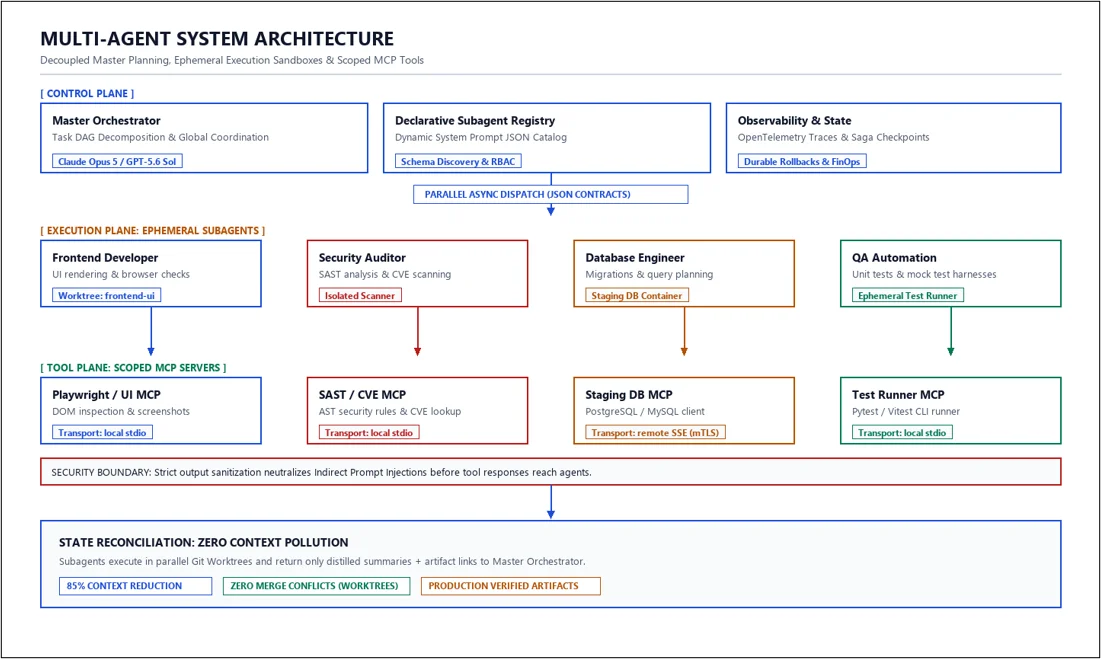
Enterprise Application: AI Coding Harnesses (Kiro, OpenCode, and SDLCs)
The master-subagent pattern forms the foundation of modern AI coding harnesses:
- Kiro: Employs spec-driven development (SDD). A master planner generates formal specs and tasks, delegating execution to specialized subagents via Agent Hooks and MCP servers.
- OpenCode: A modular CLI harness where the root agent tracks state while subagents execute scoped searches, edits, and terminal runs.
- Spec-Driven Harnesses (cc-sdd): Encapsulate verbose compiler outputs and test logs within worker sandboxes, keeping the primary context clean.
Core Best Practices
- Restrict Master Tooling & Enforce Human Approval Gates
The master orchestrator must never hold execution tools, such as shell execution or file editing. Restricting it to coordination primitives prevents tool confusion and focuses reasoning on routing.
Governance Guardrail: For destructive actions (e.g., dropping production tables or mutating IAM policies), the orchestrator must trigger out-of-band Human-in-the-Loop (HITL) approval gates before dispatching tasks.
2. Maintain a Declarative Subagent Registry
The orchestrator system prompt must maintain a structured JSON registry of available subagents:
|
1 2 3 4 5 6 7 8 9 10 11 12 13 14 |
{ "subagents": [ { "id": "security-auditor", "scope": "Static analysis, dependency CVE scanning, and AST security audits", "model_tier": "execution-specialist", "mcp_servers": ["sast-scanner", "cve-database"], "output_contract": { "format": "application/json", "fields": ["vulnerabilities_found", "remediation_diff", "status"] } } ] } |
- Enforce Least-Privilege MCP Isolation & Payload Sanitization
Bind dedicated MCP servers strictly to authorized subagents (e.g., Frontend gets browser MCP; Security gets SAST MCP). Orchestrators must sanitize tool outputs to neutralize indirect prompt injection.
- Preserve Context Through Structured Summarization
Subagents must return compact JSON summaries and artifact references, reducing token consumption by up to 85% compared to sharing raw execution logs.
- Parallel Execution with Workspace Sandboxing
Dispatch independent subtasks in parallel. Pair concurrency with isolated Git Worktrees to prevent filesystem collisions, reconciling parallel branches via an Integration Resolver Subagent.
- Match Model Tiers to Subagent Complexity
- Master Orchestrator: Flagship reasoning models (Claude Opus 5, GPT-5.6 Sol) for strategic planning.
- Domain Specialists: Balanced execution models (Claude Sonnet 5, Gemini 3.7 Flash) for coding and analysis.
- QA & Validation: Fast, cost-efficient models (Gemini 3.5 Flash-Lite, GPT-5.6 Luna) for testing and formatting.
- Deterministic Inter-Agent Contracts
Enforce strict JSON schemas for inter-agent messages. Validate payloads with JSON Schema or Pydantic before state ingestion.
- Durable Checkpointing & Saga Rollbacks
Configure exponential backoff retries. Persist execution DAGs to durable stores (Temporal, PostgreSQL) to enable Saga-pattern compensations if subtasks fail.
- Distributed Tracing & Cost Attribution
Inject OpenTelemetry trace and span IDs across agent hops to monitor execution lineage, token burn, and latency bottlenecks.
Monolithic Agent vs. Master-Subagent Architecture at a Glance
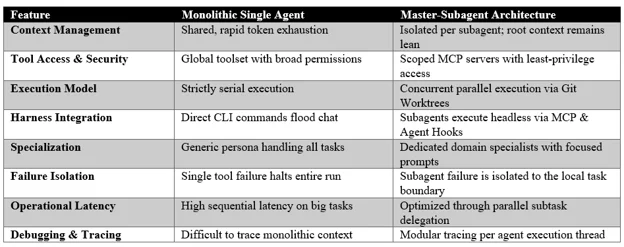
Trade-Off Analysis: Pros and Cons
Advantages
- Context Efficiency: Subagents return distilled insights, eliminating context saturation.
- High Concurrency: Independent tasks execute simultaneously, slashing latency.
- Modular Extensibility: Adding tools requires only registering a new subagent.
- Enhanced Security: Scoped MCP servers enforce least-privilege boundaries.
Disadvantages and Challenges
- Orchestration Overhead: Task decomposition introduces minor upfront latency.
- Coordination Drift: Subagents can drift if schemas are underspecified.
- System Complexity: Requires distributed tracing and state stores.
Conclusion
Hierarchical multi-agent orchestration provides the foundation for scalable, resilient enterprise AI systems. Decoupling planning from tool-isolated execution eliminates context exhaustion, maximizes tool accuracy, and cuts inference costs.
Combined with modern harnesses (Kiro, OpenCode), declarative registries, and Git Worktrees, teams build autonomous systems with deterministic governance and production stability.
Drop a query if you have any questions regarding MCP Subagents, and we will get back to you quickly.
Making IT Networks Enterprise-ready – Cloud Management Services
- Accelerated cloud migration
- End-to-end view of the cloud environment
About CloudThat
FAQs
1. What is the primary role of a master orchestrator agent?
ANS: – A master orchestrator decomposes user goals, delegates tasks to specialized subagents, and synthesizes outputs without directly executing low-level tools.
2. How does Model Context Protocol (MCP) improve multi-agent systems?
ANS: – MCP standardizes tool integration by connecting subagents to dedicated external servers and preventing unauthorized actions across domains.
3. How do AI harnesses like Kiro and OpenCode leverage subagents?
ANS: – Harnesses use master-subagent patterns for spec-driven workflows: root agents coordinate plans while subagents handle file edits, terminal runs, and testing.


WRITTEN BY Musheer Alam
Musheer Alam is a Research Associate at CloudThat with a strong passion for cloud computing, DevOps, and cybersecurity. He holds multiple industry-recognized certifications and has hands-on experience across AWS, containerization, infrastructure automation, and cloud-native security tools. Musheer constantly explores emerging technologies and focuses on building scalable, secure, and efficient solutions. He is committed to continuous learning and enjoys contributing to innovative initiatives that drive real-world impact.


 PREV
PREV





Comments