

 Login
Login


 September 7, 2026
|
Voiced by Amazon Polly |
Introduction
Kubernetes has emerged as the established standard for deploying and managing containerized workloads at scale, offering built-in autoscaling via the Horizontal Pod Autoscaler (HPA), which adjusts the pod count based on metrics such as CPU and memory utilization. However, resource consumption doesn’t always reflect actual application demand, a message-processing service can show minimal CPU usage even as thousands of messages pile up in a queue, appearing healthy at the infrastructure level while quietly falling behind on real work.
This is the gap KEDA (Kubernetes Event-Driven Autoscaling) was built to close. By enabling workloads to scale in response to external events and application-specific signals, such as queue depth or event volume, rather than infrastructure metrics alone, KEDA aligns autoscaling with how cloud-native applications actually behave under real-world load.
Pioneers in Cloud Consulting & Migration Services
- Reduced infrastructural costs
- Accelerated application deployment
Where Traditional Autoscaling Falls Short?
Resource-based autoscaling performs well when CPU or memory usage genuinely reflects system load, but this assumption breaks down for many event-driven applications.
Consider a background worker that consumes messages from a queue. A sudden spike in traffic may barely register on CPU graphs, even as the backlog grows rapidly. If Kubernetes scales purely on CPU thresholds, it may fail to add workers quickly enough, resulting in slower processing and delayed outcomes.
What KEDA Brings to Kubernetes?
KEDA is an open-source project purpose-built for event-driven autoscaling within Kubernetes. It supports a broad ecosystem of external event sources and metrics, letting workloads scale based on signals that are meaningful to the application rather than generic system stats.
For instance, a consumer reading from Amazon SQS can scale directly with queue depth, while a service processing Kafka streams can respond to relevant throughput metrics. Rather than replacing Kubernetes’ native scaling model, KEDA works alongside it, feeding external metrics into the platform’s autoscaling mechanisms and managing activation whenever new events appear. For supported workloads, it can even scale deployments down to zero during idle periods, eliminating unnecessary resource consumption.
This makes KEDA especially valuable for workloads with unpredictable or externally triggered demand patterns.
The mechanics of event-driven scaling
At a conceptual level, KEDA’s scaling flow can be visualized as a straightforward pipeline:
External event source → KEDA → Kubernetes autoscaler → Application pods
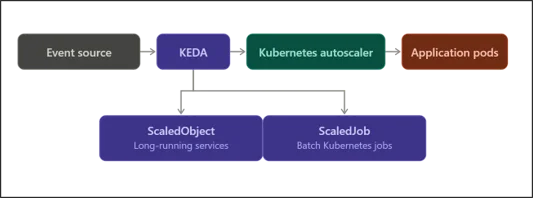
KEDA continuously monitors the configured event source and evaluates the defined scaling trigger. Once demand crosses a specified threshold, pod count increases accordingly; as demand subsides, pods scale back down based on configured cooldown behavior.
For long-running services, KEDA relies on a ScaledObject to define the relationship between a workload and its event-driven triggers. For batch-style processing, a ScaledJob creates Kubernetes Jobs dynamically as work arrives. The key distinction from traditional autoscaling is that decisions are now driven by actual application demand rather than infrastructure usage alone.
KEDA and HPA: A complementary relationship
KEDA and the Kubernetes Horizontal Pod Autoscaler are not competing solutions, they address different scaling problems and often work best together.
HPA remains well-suited for workloads where CPU, memory, or other standard resource metrics accurately reflect demand. KEDA extends this model by introducing event-driven metrics into the same autoscaling framework. In practice, an API-facing service might scale with CPU utilization, while a background worker scales with queue length, letting teams choose the right signal for each workload instead of applying a one-size-fits-all strategy.
Practical use cases
KEDA proves particularly effective where workload intensity fluctuates unpredictably:
- Queue-based processing — workers scale in proportion to pending messages.
- Streaming workloads — applications respond dynamically to throughput metrics from platforms like Kafka.
- Scheduled and batch jobs — event-driven activation supports workloads that don’t need to run continuously, reducing idle resource usage.
With support for numerous scalers and integrations, KEDA lets teams connect Kubernetes workloads to diverse event sources without having to build custom autoscaling logic for each.
Balancing performance and resource efficiency
Autoscaling isn’t just about responsiveness, it’s also a lever for cost efficiency. Running excess worker pods during quiet periods wastes capacity, while under-provisioning during spikes introduces processing delays.
By tying pod capacity to real workload demand, KEDA helps minimize idle resource usage for suitable applications, and its scale-to-zero capability is especially useful for services with intermittent activity. That said, cost optimization depends on the broader architecture, scaling pods down won’t reduce spend if underlying nodes remain underutilized. KEDA should be treated as one piece of a larger resource-optimization strategy, not a complete solution on its own.
Key considerations for production deployments
Implementing event-driven autoscaling requires deliberate configuration. Scaling triggers should reflect genuine workload demand, and thresholds need to account for how quickly the application can realistically process incoming work.
Teams should also evaluate replica limits, polling intervals, cooldown windows, startup latency, and downstream system capacity. Overly aggressive scaling can overwhelm databases or dependent APIs, while overly conservative settings cause processing bottlenecks.
Ongoing monitoring of queue depth, pod count, latency, error rates, and job completion times helps validate whether the strategy is delivering results. Testing configurations against realistic traffic patterns before going live surfaces misconfigured thresholds early.
KEDA is part of a layered scaling strategy
Effective Kubernetes scaling works best as a layered strategy, with KEDA handling one important part of a larger picture. Pod-level scaling, driven by KEDA and HPA together, responds directly to application demand, while node-level cluster autoscaling ensures sufficient compute capacity is available whenever existing nodes can no longer host new pods.
This layered approach allows application-level scaling and infrastructure-level capacity planning to work in tandem, giving teams a more complete and resilient autoscaling strategy across the entire platform.
Conclusion
KEDA represents a meaningful evolution in Kubernetes autoscaling, shifting the underlying focus from infrastructure resource consumption to actual workload demand. Rather than relying solely on CPU and memory utilization, KEDA enables scaling decisions based on the volume of work an application genuinely needs to process. This distinction matters most for event-driven architectures, where traditional resource metrics often fail to capture real demand. Paired with HPA and cluster-level autoscaling, it forms a comprehensive, workload-aware scaling strategy for modern cloud-native applications.
Drop a query if you have any questions regarding KEDA, and we will get back to you quickly.
Empowering organizations to become ‘data driven’ enterprises with our Cloud experts.
- Reduced infrastructure costs
- Timely data-driven decisions
About CloudThat
FAQs
1. What is KEDA in Kubernetes?
ANS: – KEDA (Kubernetes Event-Driven Autoscaling) is an open-source component that scales workloads based on external events and application-specific metrics, such as queue depth, rather than relying solely on CPU and memory.
2. How is KEDA different from the Horizontal Pod Autoscaler (HPA)?
ANS: – KEDA and HPA are complementary. HPA scales based on resource metrics such as CPU and memory, while KEDA extends this with event-driven metrics within the same framework.
3. Does KEDA replace HPA?
ANS: – No. KEDA works alongside HPA to handle activation and event-driven metrics, and delegates scaling above 1 replica to the standard HPA mechanism.


WRITTEN BY Avinash Dodamani
Avinash Dodamani works as a Research Associate at CloudThat, holding a Bachelor of Engineering degree. He is passionate about cloud computing, DevOps, and exploring emerging cloud technologies.


 PREV
PREV





Comments