

 Login
Login

 September 23, 2026
|
Voiced by Amazon Polly |
SAP Joule supply chain manufacturing agents are now executing tasks that once took planners hours to complete, flagging demand exceptions, triggering purchase orders, and resolving production schedule conflicts in real time. This blog explains exactly how SAP Joule integrates with daily manufacturing and supply chain workflows, which tasks it automates today, and the tangible outcomes early adopters like Nestlé have achieved.
Start Learning In-Demand Tech Skills with Expert-Led Training
- Industry-Authorized Curriculum
- Expert-led Training
What Is SAP Joule and How Does It Work in Manufacturing?
SAP Joule is an AI copilot embedded across SAP’s cloud applications, including SAP S/4HANA, SAP IBP, and SAP Ariba. In manufacturing, it operates as a system of Joule Agents, purpose-built AI agents that automate workflows across the supply chain, production, procurement, and quality management without requiring manual intervention.
SAP describes Joule as an AI solution that helps teams act with clarity and collaborate without silos. Joule Agents are AI agents embedded into every business function and accessed with role-based assistants. They use SAP’s process expertise, developed over 50+ years, to automate complex workflows and deliver AI value at scale.
For manufacturing companies managing supply chains, Joule operates across three layers:
- Informational: Answers questions about planning processes, app navigation, and documentation instantly
- Navigational: Routes users to the correct SAP app or workflow without manual searching
- Transactional: Executes actions, runs jobs, shares objects, adjusting plans directly from a natural language prompt
The key architectural shift is from a single AI copilot to a multi-agent system (MAS). The SAP Manufacturing Assistant is built on this architecture, unifying people, operational goals, and processes to orchestrate execution and guide people in real time.
How Does SAP Joule Improve Demand Forecasting in Manufacturing?
SAP Joule, integrated with SAP Integrated Business Planning (IBP), automates demand signal analysis, surfaces anomalies in forecasting data, and provides planners with one-click resolutions for supply-demand mismatches. It reduces planning cycle times by up to 35% by compressing the time between detecting a demand shift and acting on it.
SAP IBP combines supply chain monitoring, sales and operations planning, demand management, inventory planning, and supply planning into one platform. Joule’s integration into IBP means planners no longer have to navigate multiple dashboards manually; they interact with Joule in natural language to access the same outputs.
SAP’s Planning Assistant brings AI-driven agents directly into day-to-day planning workflows. Specific capabilities include:
- Converting supply chain alerts into one-click resolutions, planners no longer triage alert queues manually
- Identifying structural capacity issues and persistent shortages, and creating data-driven scenarios for rapid decision-making
- Evaluating new inventory targets, identifying key drivers, and managing approval workflows automatically
- Resolving unfulfilled demand by pinpointing gating factors and recommending feasible mitigation paths
From a productivity standpoint, SAP Joule reduces time spent on complex multi-step workflows by up to 75%, according to SAP’s published figures. For a demand planner managing 500+ SKUs across 20 plants, this translates to reclaiming hours each week that were previously spent on manual exception reviews.
How Does SAP Joule Automate Procurement and Sourcing Workflows?
SAP Joule’s Sourcing Agent, embedded in SAP Ariba, automates sourcing event creation, supplier selection analysis, and purchase order generation. It helps procurement managers refine sourcing events, navigate geopolitical supply risks, and maintain compliance, all within the SAP environment.
Procurement is one of the highest-value areas for Joule in manufacturing supply chains. Joule’s Sourcing Agent helps managers quickly refine sourcing events, navigate geopolitical risks, and stay ahead in dynamic supply chains.
In a typical manufacturing procurement cycle, a buyer might spend 3-4 hours manually comparing supplier bids, checking compliance status, and building justification documents. With SAP Joule:
- The planner describes the sourcing need in natural language (e.g., “Find alternative suppliers for Component X in Southeast Asia”)
- Joule queries SAP Ariba’s supplier network, which manages over $6.3 trillion in commerce globally
- Joule surfaces qualified supplier options, flags compliance gaps, and drafts the sourcing event
- The buyer reviews and approves, and the entire workflow compresses from hours to minutes
Nestlé’s deployment demonstrates this at enterprise scale. After migrating 50,000 users across 112 countries to SAP S/4HANA Cloud and integrating Joule, Nestlé moved procurement fully to the cloud, gaining global spend visibility and standardized workflows. Joule now automates routine procurement tasks, including journal uploads, service initiations, and trade classifications.
How Does SAP Joule Streamline Production Planning and Scheduling?
SAP Joule’s Manufacturing Assistant acts as an autonomous operations layer for production scheduling. It monitors the shop floor in real time, detects disruptions, equipment failures, material shortages, and workforce gaps, and recommends or executes corrective actions without waiting for a planner to intervene.
The SAP Manufacturing Assistant is a multi-agent system (MAS) designed for autonomous, agile, aligned, and adherent manufacturing. For an IT Manager or Supply Chain Executive, this means the system operates as an always-on layer between the ERP and the shop floor.
Key production planning tasks Joule handles today:
- Real-time disruption monitoring: Joule tracks production KPIs continuously and surfaces deviations before they escalate
- Autonomous corrective execution: With Human-in-the-Loop (HITL) controls enabled, Joule can reschedule production runs, reassign the workforce, and adjust material staging automatically
- Quality and nonconformance management: Joule orchestrates quality workflows, triggers nonconformance reports, and ensures electronic signatures are captured for compliance
- Next-best-action recommendations: When disruptions occur, Joule presents scenario options with pros/cons, so executives approve decisions in seconds rather than convening planning meetings
SAP’s AI-first supply chain strategy, announced at Sapphire 2025, includes three agentic AI systems that enable autonomous operations: maintenance planning, shop floor supervision, and field service dispatch. For a manufacturing plant running SAP Digital Manufacturing, Joule connects service orders directly to the shop floor, synchronizing production changes with execution systems without manual handoffs.
How Are Real Manufacturers Using SAP Joule Today?
Nestlé, the world’s largest food and beverage company, completed the first phase of what it calls the world’s largest SAP S/4HANA Cloud Private Edition upgrade in 2025, deploying Joule across 50,000 users in 112 countries. Joule now automates procurement, supply-demand matching, and finance workflows across its operations in Asia, Oceania, and Africa.
Nestlé’s deployment is the most comprehensive public example of Joule in a global manufacturing supply chain. Key outcomes from the first phase:
- 50,000 employees across 112 countries now have Joule embedded in their SAP workflows
- Retail fulfillment tightened: Joule matches supply and demand in real time for both in-store and e-commerce channels to reduce stock issues
- Procurement standardized globally: Automated workflows replaced fragmented regional procurement processes
- First migration completed in under 20 hours with virtually zero downtime
Beyond Nestlé, Capgemini reported building a fully functional Joule agent-based system in just three weeks using Joule Studio: “It is an intuitive, no-code environment that enables system connectivity across SAP and non-SAP critical environments, for a hybrid landscape where data resides in multiple modules.”
Nestlé, SAP, and IBM also collaborated on a supply chain Agentic AI proof of concept, demonstrating that Joule’s multi-agent architecture can be extended beyond a single vendor’s ecosystem.
What Supply Chain Risks Can SAP Joule Detect and Resolve Autonomously?
SAP Joule detects supply chain risks by continuously monitoring alerts across procurement, inventory, production, and logistics. It identifies structural capacity shortages, persistent inventory deficits, and unfulfilled demand-gating factors, then recommends or executes resolutions, thereby compressing response time from days to minutes.
Manufacturers operating global supply chains face five categories of recurring disruption that Joule directly addresses:
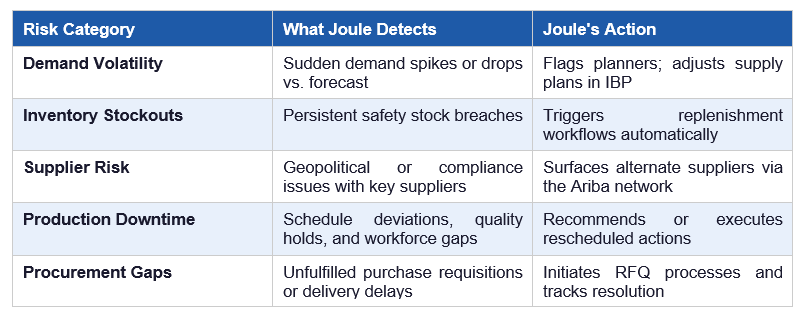
With SAP targeting 400 embedded AI use cases across its cloud portfolio in 2025, the scope of autonomous risk detection is expanding quarter over quarter. For supply chain executives evaluating AI adoption, the question is no longer whether Joule can detect these risks; it already does. The question is how quickly the organization can configure and activate these capabilities.
Key Takeaways
- SAP Joule is a multi-agent AI system embedded in SAP S/4HANA, IBP, and Ariba, not a standalone chatbot
- It reduces complex multi-step supply chain workflows by up to 75% (SAP, 2025)
- The Planning Assistant converts supply chain alerts into one-click resolutions, targeting a 35% reduction in planning cycle times
- Nestlé deployed Joule to 50,000 users in 112 countries in under 20 hours with near-zero downtime
- Joule supports all five major supply chain risk categories: demand, inventory, supplier, production, and procurement
- Joule Studio (announced at Sapphire 2025) allows organizations to build custom Joule agents for SAP and non-SAP environments in weeks
SAP Joule Supply Chain Impact
SAP Joule’s supply chain manufacturing capabilities have moved decisively beyond pilot projects. Nestlé’s global rollout, SAP’s 400-use-case roadmap for embedded AI, and the Joule Studio developer platform are evidence that the technology is production-grade today. For manufacturing organizations managing supply chains on SAP, the practical opportunity is this: Joule does not require a separate AI strategy or a new platform. It operates inside the SAP applications your planners, buyers, and production managers already use every day. The marginal investment is activation and configuration, not replacement.
Upskill Your Teams with Enterprise-Ready Tech Training Programs
- Team-wide Customizable Programs
- Measurable Business Outcomes
About CloudThat
FAQs
1. What is SAP Joule, and how does it work in a manufacturing environment?
ANS: – SAP Joule is an AI copilot embedded across SAP’s cloud applications, including SAP S/4HANA, SAP IBP, and SAP Ariba. In manufacturing, it operates as a system of Joule Agents, purpose-built AI agents that automate workflows in supply chain, procurement, and production scheduling.
2. How does SAP Joule improve demand forecasting in supply chain management?
ANS: – SAP Joule integrates with SAP Integrated Business Planning (IBP) to automate demand signal analysis and exception management. It identifies mismatches between demand forecasts and supply availability, converts alerts into one-click resolutions for planners, and creates data-driven scenarios for structural shortages. SAP’s Planning Assistant targets a 35% reduction in planning cycle times through these capabilities.
3. Can SAP Joule automate purchase orders and procurement tasks?
ANS: – Yes. SAP Joule’s Sourcing Agent, embedded in SAP Ariba, automates sourcing event creation, supplier evaluation, and purchase order workflows. It queries the SAP Business Network, which manages over $6.3 trillion in commerce, to surface qualified supplier alternatives, flag compliance issues, and draft sourcing events. Nestlé has used this to standardize procurement workflows across 112 countries.
4. What SAP modules support SAP Joule integration for the supply chain?
ANS: – SAP Joule is currently available in SAP S/4HANA Cloud, SAP Integrated Business Planning (IBP) for Supply Chain, SAP Ariba (procurement and sourcing), SAP Digital Manufacturing, and SAP SuccessFactors (workforce planning). The SAP Help Portal maintains an up-to-date matrix of Joule capabilities by module and version.
5. How is SAP Joule different from traditional ERP automation tools?
ANS: – Traditional ERP automation tools execute predefined scripts or workflows; they require a human to define every rule in advance. SAP Joule uses large language models and SAP’s 50+ years of business process expertise to understand context, interpret natural language requests, and make recommendations based on live data. Unlike rule-based automation, Joule adapts to exceptions, explains its reasoning, and can operate as part of a multi-agent system that spans procurement, planning, production, and finance simultaneously.


WRITTEN BY Rahul Mehta
Rahul Mehta is a Subject Matter Expert at CloudThat, specializing in Microsoft and VMware technologies, Generative AI, and cloud security. With over 19 years of experience in the IT training domain, he has trained more than 1000 professionals to upskill in areas such as Microsoft 365 Copilot, Microsoft Team Administration, Azure Security and Compliance, VMware Data Centre Virtualization. Known for simplifying complex concepts and delivering hands-on, impactful training, he brings deep technical knowledge and practical application into every learning experience. Rahul's passion for continuous learning and emerging technologies reflects in his unique approach to learning and development


 PREV
PREV











Comments