

 Login
Login

 September 23, 2026
|
Voiced by Amazon Polly |
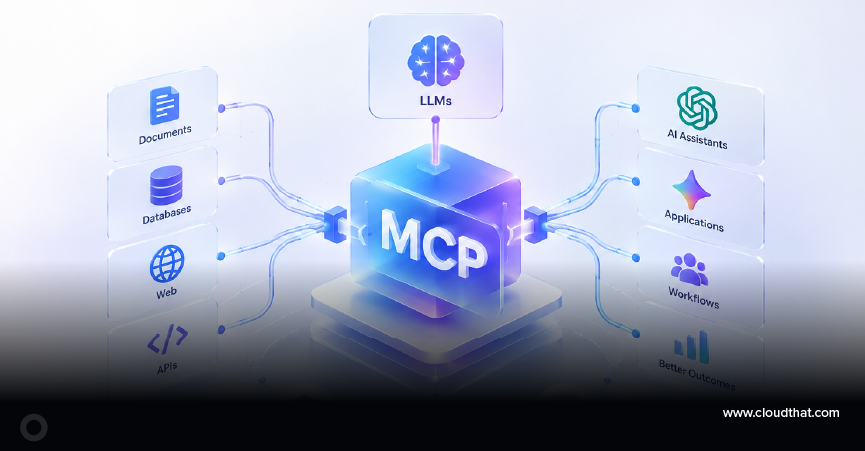
The most powerful AI model is useless if it cannot reach your data. For years, connecting one to your files, database, or apps meant hand-building a custom bridge for every single pairing, fragile work that would break with the next update. The Model Context Protocol fixes exactly that. Open-sourced by Anthropic in November 2024, MCP is a single open standard that lets any AI application communicate with any tool or data source through a single interface. This post explains what MCP is, how it works, who is already using it, and what you can build with it today.
TL;DR: MCP is one open standard that plugs AI models into your tools and data like a USB-C port for AI. Anthropic launched it in late 2024; OpenAI and Google adopted it in 2025. If you build with AI, it is quickly becoming the default way agents reach the real world.
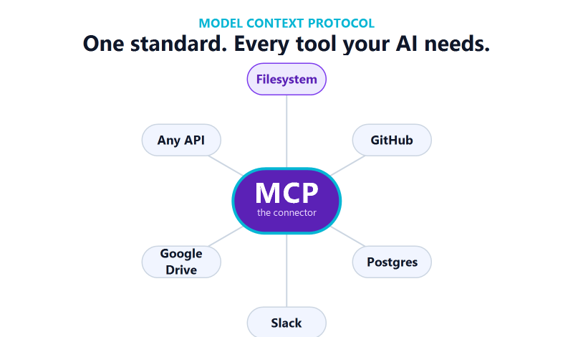
Fig 1: MCP provides every AI application with a single standard way to access the tools and data it needs.
Start Learning In-Demand Tech Skills with Expert-Led Training
- Industry-Authorized Curriculum
- Expert-led Training
What is the Model Context Protocol?
The Model Context Protocol is an open standard that defines one consistent way for AI applications to connect to external tools, files, and data sources. Instead of a separate custom integration for every model-and-tool pairing, developers build to a single specification that both sides understand.
Anthropic’s own framing is the clearest one: MCP is like a USB-C port for AI. Before USB-C, every device needed its own cable. MCP plays that role for models- one connector standard, whatever you plug into it, whether that is a Google Drive folder, a Postgres database, or an internal ticketing system.
Because the specification is open and public, a connector one team builds works with any MCP-compatible application another team builds. That interoperability is the entire point, and it is why the standard spread so quickly.
Why does MCP matter for AI integration?
MCP matters because it turns AI integration from a maintenance problem into a reuse problem. Before it existed, connecting M models to N tools meant building and maintaining M × N separate integrations; five models and ten tools could mean fifty fragile connectors, each breaking on the next update.
A single protocol collapses that math. A server written once serves many AI clients, and a client that speaks the protocol reaches many servers. The wiring stops being rewritten every time either side changes.
There is a second, quieter payoff: answer quality. A model that pulls in live, accurate context provides grounded responses rather than guesses. When an assistant checks the actual record or document, hallucinations drop, and trust rises. For teams building agents that take real actions, that reliability is the line between a demo and a production system.
How does the Model Context Protocol work?
MCP operates through three roles that exchange structured messages with one another: a host, a client, and a server. The host is the AI application the user interacts with; the client manages a single connection within it; and each MCP server exposes a specific capability, such as reading a file system or querying a CRM.
Each server can offer three kinds of building blocks:
- Tools– actions the model can invoke, like running a query or sending a message.
- Resources– data the model can read, such as documents or database rows.
- Prompts– reusable templates that guide the model through a common task.
When you ask a question, the host discovers which servers are available, the client negotiates the connection, and the model decides which tools or resources it needs. The server does the actual work and returns results that the model can reason over. Neither side needs to know how the other was built; the message format handles that contract.
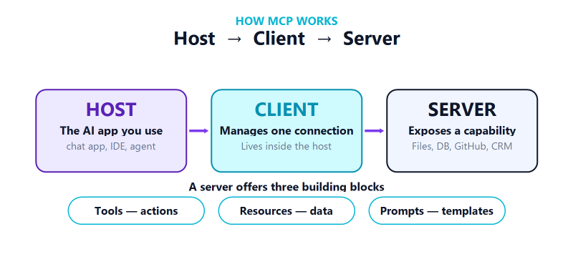
Fig 2: The three MCP roles: the host runs the app, the client manages the connection, and each server exposes tools, resources, and prompts.
What does using MCP look like in practice?
The clearest way to picture MCP is a single, concrete flow. Connect a GitHub MCP server to your AI assistant, then ask it, “Summarise the open pull requests and flag the risky ones.” The assistant calls the server’s tools to list the PRs, read the diffs, and reason over them, no copy-paste and no custom script.
Now swap the GitHub server for a Google Drive or Jira server. The same assistant works against those systems instead, with no change to the model or the prompt. Add a Postgres server, and it can answer questions from your live database in the same conversation.
That is the whole payoff of a standard: the connector changes, but the model and the workflow do not.
Where does MCP fit in your AI stack?
MCP fits between the model and your systems; it is the integration layer, not the model or the application. It standardizes how an assistant reaches tools and data, so it sits underneath your agents and alongside your existing retrieval setup rather than replacing either.
- Below the agent framework – agents use MCP servers as their standard tool interface, instead of hand-coded function calls per tool.
- Alongside RAG – retrieval pulls passages from a vector store for context; MCP calls live tools to fetch current data or take an action. Most real systems use both.
- In front of your systems – one MCP server per system (files, database, CRM, ticketing) exposes a clean, reusable contract to any model that speaks the protocol.
Who is adopting MCP?
Adoption moved from a single vendor to an industry standard in under a year. Anthropic released MCP as open source in November 2024, and by March 2025, OpenAI confirmed it was adopting MCP across its products, including the Agents SDK and desktop app.
Google followed shortly after, confirming MCP support for its Gemini models and SDKs in April 2025. Developer tools moved just as fast: early adopters at launch included Block and Apollo, as well as coding platforms such as Zed, Replit, Sourcegraph, and Codeium, which use MCP to give their AI features live access to code and context. In 2025, Microsoft added MCP support to Copilot Studio and Windows, extending it into enterprise workflows, and a public directory of community-built servers continues to grow.
When the three largest model providers converge on the same protocol within months of each other, that is the strongest signal a standard can send. MCP is no longer an Anthropic feature; it is becoming the default way AI agents reach beyond their training data.
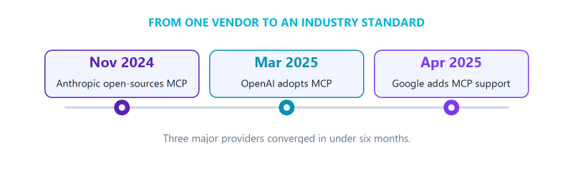
Fig 3: MCP went from one vendor’s release to an industry standard in under six months.
What can you build with an MCP server today?
You can connect an assistant to almost any system you already run, without writing bespoke glue for each one. The value shows up fastest in three patterns.
A developer wires an MCP server to the project repository, so the assistant answers with full knowledge of the codebase rather than a generic guess. A support team connects an agent to its ticketing platform and knowledge base, letting the model surface the right article and draft an accurate reply. A data analyst points an assistant at a warehouse and asks questions in plain language, getting answers pulled from live tables.
What ties these together is reuse. None of them needed a one-off integration; each connector follows the same protocol, so it can be shared, swapped, and reused as needs change. That is what turns scattered AI experiments into a dependable internal capability.
How do you get started with MCP?
Start with one high-value data source, connect it through an existing open-source MCP server, and measure how much the grounded context improves your assistant’s answers. Prove it on one workflow before scaling, not a platform-wide rollout, not a custom build. Expand to more tools once the first connector earns its place, and write custom servers only for the systems unique to your business.
The harder part is usually skills, not software. Teams need people who understand how AI agents reason, how to design safe access to tools, and how to integrate connectors into a broader cloud architecture. Structured training shortens that curve: A hands-on Generative AI training program helps engineers move from theory to working agents, while an AWS Certified AI Practitioner certification grounds them in the architecture and security practices production AI depends on.
Why Does MCP Matter?
The Model Context Protocol matters because it replaces the slow, repetitive work of connecting models to the real world with a single open standard for tools, data, and prompts. With three major providers already behind it, MCP is on track to become the default integration layer for AI agents. The move now is small and concrete: pick one system, connect it through an MCP server, measure the lift, and build the skills to scale from there.
Upskill Your Teams with Enterprise-Ready Tech Training Programs
- Team-wide Customizable Programs
- Measurable Business Outcomes
About CloudThat
FAQs
1. What is the Model Context Protocol in simple terms?
ANS: – The Model Context Protocol is an open standard that lets AI applications connect to external tools and data through one consistent interface. It works like a USB-C port for AI – a single connector standard rather than custom integrations for every model and tool.
2. Who created MCP and when?
ANS: – Anthropic created MCP and released it as an open standard in November 2024. Major providers, including OpenAI and Google, adopted it in 2025, which is how it became an industry-wide standard rather than a single vendor’s feature.
3. What is an MCP server?
ANS: – An MCP server is a lightweight program that exposes a specific capability, such as reading files, querying a database, or calling an API, to any MCP-compatible AI application. Each server offers tools the model can run, resources it can read, and prompts it can reuse.
4. Do I need to build custom MCP servers to start?
ANS: – No. Many open-source MCP servers already exist for common systems, such as file storage, databases, and popular SaaS tools. Most teams start by connecting to an existing server and build custom ones only for systems unique to their business.
5. Can I connect MCP to my own tools?
ANS: – Yes. You add MCP servers as connectors, so your AI assistant can read from and act on systems like GitHub, Google Drive, Slack, and databases. You can connect to an existing open-source server or run your own, and the same setup works with any MCP-compatible application.


WRITTEN BY Sirin Kausar Isak Ali
Sirin Ali is a seasoned corporate trainer and Subject Matter Expert with 11+ years of experience in cloud infrastructure, DevOps automation and Kubernetes. She has extensive real-time project experience in designing enterprise-grade CI/CD pipelines, automating containerized microservices deployments and implementing GitOps practices with advanced observability solutions. Skilled across diverse Kubernetes distributions, she brings hands-on expertise in transforming infrastructure and applications using industry best practices. Sirin has trained over 1500+ professionals worldwide and holds multiple certifications including CKA, Terraform Associate, Azure AI Engineer, GCP ACE, MCP, CCNA and MCT. Her practical, real-world approach simplifies complex DevOps concepts, empowering learners to confidently build production-ready solutions.


 PREV
PREV











Comments