

 Login
Login


 September 7, 2026
|
Voiced by Amazon Polly |
Introduction
Modern Kubernetes environments run on distributed microservices, which introduces new challenges around secure communication, traffic control, and observability between services. Istio addresses this with a dedicated infrastructure layer, traditionally using the sidecar model, an Envoy proxy alongside every pod, which is powerful but adds resource overhead and complexity at scale.
Istio Ambient Mesh takes a different approach. Instead of a proxy per pod, it splits mesh functionality into shared layers: ztunnel for Layer 4 security, and waypoint proxies for Layer 7 features only when needed, shifting from a proxy-per-pod model to a more flexible, shared-infrastructure design.
Pioneers in Cloud Consulting & Migration Services
- Reduced infrastructural costs
- Accelerated application deployment
The Limitations of the Traditional Sidecar Model
In a traditional Istio deployment, every application pod typically receives an Envoy sidecar, through which all traffic is routed to enforce security and networking policies. This model provides strong capabilities, including:
- Mutual TLS (mTLS) encryption
- Authorization and access control
- Traffic routing
- Retries and failure handling
- Observability
However, this approach also introduces real operational challenges. As pod count grows, so does the number of proxies, each consuming CPU and memory and adding infrastructure overhead. The sidecar model also ties application lifecycle management to proxy lifecycle management, since deploying or upgrading a workload often entails managing sidecar configuration alongside the workload.
Not every workload needs advanced Layer 7 functionality, many applications only require secure, authenticated communication. Running a full application-aware proxy beside every pod, regardless of need, introduces unnecessary complexity that ambient mesh is designed to remove.
What Is Istio Ambient Mesh?
Istio Ambient Mesh is a sidecar-less data plane architecture built around shared infrastructure rather than a proxy inside every pod. Its core components include ztunnel for Layer 4 networking and security, waypoint proxies for Layer 7 traffic management, istiod as the control plane, and the Istio CNI for traffic redirection.
Ztunnel, short for Zero Trust tunnel, operates as shared infrastructure at the node level rather than inside individual pods. It handles mutual TLS encryption, workload identity, Layer 4 authorization, and network-level telemetry, giving every workload secure, authenticated communication without a dedicated proxy container.
When an application requires more, HTTP-based routing, request-level authorization, retries, or detailed application-layer observability, a waypoint proxy can be added. Waypoint proxies are Envoy-based and run separately from application pods, scoped to a namespace, service, or workload, so Layer 7 processing applies selectively rather than uniformly across the mesh.
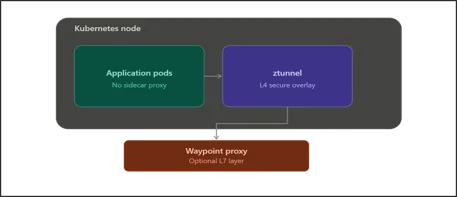
The diagram below shows how these components fit together within a Kubernetes node.
The Mechanics of Ambient Mesh Traffic Flow
Ambient mesh separates Layer 4 and Layer 7 responsibilities in how traffic moves through the mesh. Workloads that require only a secure connectivity route their traffic directly through ztunnel to their destination. When Layer 7 processing is required, traffic is additionally directed through a waypoint proxy before reaching its destination.
This model relies on HBONE (HTTP-Based Overlay Network Environment) to establish secure communication across the mesh, so Layer 7 processing is introduced only where genuinely needed rather than applied to every workload by default. This separation is one of Ambient Mesh’s defining design decisions, since it avoids treating every workload as though it requires the same depth of traffic inspection.
Workflow: Application pod → ztunnel → Waypoint proxy → Destination pod

Ambient Mesh vs. Traditional Sidecar Architecture
The core difference between the two models lies in where mesh functionality runs. In the sidecar model, every pod carries its own proxy; in ambient mesh, Layer 4 capabilities come from shared ztunnel infrastructure, while Layer 7 features are handled by waypoint proxies rather than being deployed automatically with every workload.
This creates several practical advantages:
- Reduced infrastructure duplication — fewer redundant proxies running across large clusters
- Lower operational burden — application teams no longer need to manage a sidecar inside every pod
- Clearer separation of concerns — mesh infrastructure and application workloads are managed independently
Ambient mesh doesn’t render the sidecar model obsolete; Istio supports both, letting organizations choose the right fit for each workload and adopt ambient mode at their own pace.
Why Ambient Mesh Matters for Kubernetes?
The most significant benefit of ambient mesh is flexibility. Organizations can start with secure, baseline connectivity applied broadly across the cluster, then introduce advanced traffic management only where it delivers real value. This supports a more incremental, lower-risk path to service mesh adoption, while also reducing the operational overhead typically associated with rolling out a full mesh at once.
Key Considerations Before Adoption
Teams should evaluate workload requirements before adopting ambient mesh, applications needing only encrypted communication can rely on ztunnel alone, while those requiring HTTP routing or request-level policies will also need waypoint proxies. A phased rollout, starting with non-production workloads and expanding gradually, helps validate behavior and limit operational risk.
Conclusion
Istio Ambient Mesh marks a meaningful shift in how service mesh architecture is designed for Kubernetes, moving away from a proxy-per-pod default toward a shared, layered infrastructure model. This approach gives organizations a practical path to reduce operational overhead while retaining full control over where advanced traffic management is applied.
As Kubernetes environments continue to scale, this kind of flexible, workload-aware architecture is likely to become the standard approach for running service meshes efficiently and securely.
Drop a query if you have any questions regarding Istio Ambient Mesh, and we will get back to you quickly.
Empowering organizations to become ‘data driven’ enterprises with our Cloud experts.
- Reduced infrastructure costs
- Timely data-driven decisions
About CloudThat
FAQs
1. Does ambient mesh eliminate the need for proxies?
ANS: – No. It removes per-pod proxies, but ztunnel and waypoint proxies still run as shared infrastructure.
2. Can ambient mesh and sidecar mode run in the same cluster?
ANS: – Yes. Both modes can coexist, allowing teams to migrate workloads gradually. Mixing them doesn’t reduce security or functionality, since the control plane enforces policies consistently across both models.
3. Is a waypoint proxy required for every service in the ambient mesh?
ANS: – No. It’s only needed for services that require Layer 7 features, such as HTTP routing or policies.


WRITTEN BY Avinash Dodamani
Avinash Dodamani works as a Research Associate at CloudThat, holding a Bachelor of Engineering degree. He is passionate about cloud computing, DevOps, and exploring emerging cloud technologies.


 PREV
PREV












Comments