

 Login
Login


 December 11, 2025
|
Voiced by Amazon Polly |
In today’s digital‑first world, the convergence of cloud computing with Artificial Intelligence (AI) and Machine Learning (ML) has become a foundational pillar of innovation, scalability and business value. Cloud platforms are not just hosting infrastructure anymore; they are increasingly embedding AI/ML capabilities so enterprises can build intelligent applications, automate operations, analyze huge volumes of data and deliver real‑time insights at scale.
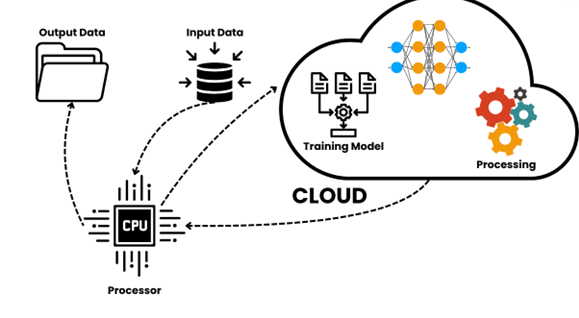
Cloud platforms integrate AI/ML for data processing and intelligent model training at scale.
Start Learning In-Demand Tech Skills with Expert-Led Training
- Industry-Authorized Curriculum
- Expert-led Training
What does “AI/ML integration in the cloud” mean?
AI/ML integration in the cloud refers to embedding machine learning and artificial intelligence workflows into cloud‑native infrastructure and services. It involves leveraging cloud‑scale compute, storage and data services to train, deploy and monitor ML models.
Key Drivers and Benefits
AI/ML integration in the cloud is driven by the need for scalable computing, faster innovation and intelligent automation. Some of the key drivers are shown in the table below:

Architecture & Key Components
Integrating AI/ML in the cloud impacts multiple architectural layers, including data ingestion, feature engineering, training, deployment and monitoring.
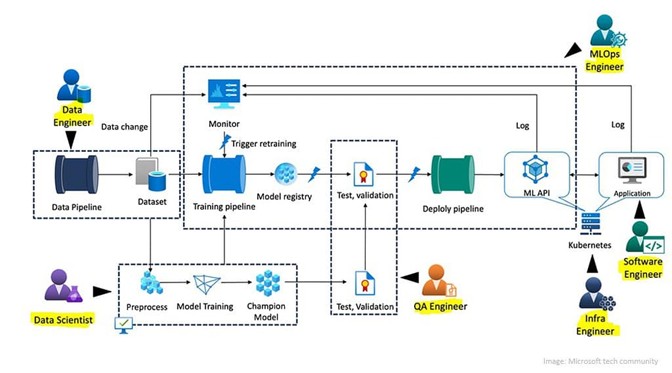
AI/ML integration in cloud spans data ingestion, training, deployment and monitoring layers.
Major Cloud Provider Offerings
The big three, Google Cloud, Microsoft Azure and Amazon Web Services (AWS), are considered the established leaders. However, there are a host of other smaller or niche players that also offer cloud services, including IBM, Alibaba, Oracle, Red Hat, DigitalOcean and Rackspace. The table shows the key offerings and strengths of some major cloud service providers:

Use‑Cases & Examples
Use cases include predictive maintenance in manufacturing, customer experience personalization, security threat detection and edge-cloud synergy.
- Sales & Demand Forecasting: Predict future demand, seasonal trends and supply chain requirements
Example: Amazon uses cloud ML to optimize inventory and logistics.
- Chatbots & Virtual Agents: AI-driven customer service & lead handling.
Example: Google Dialogflow bots in banking & telecom.
- Threat Intelligence: Identify suspicious activities and malware patterns.
Example: Microsoft Defender uses cloud AI analytics.
- AI-powered Marketing: Personalized ads, email automation.
Example: Adobe Experience Cloud AI personalization.
Challenges with Examples
- Data Security & Privacy: Healthcare records must be encrypted and processed in-region.
- High Computational & Storage Costs: Training LLMs on GPUs/TPUs costs thousands per week.
- Data Availability & Quality: IoT & sensor data can be noisy and incomplete.
- Latency & Real-Time Processing: Autonomous vehicles need local inference vs cloud latency.
- Skill Gap & Talent Availability: Companies struggle to hire ML engineers familiar with Kubernetes & GPUs.
- Integration with Legacy Systems: Banks maintaining mainframes + modern AI pipelines.
Roadmap for Implementation
- Define business objectives
Clearly articulate the problem ML should solve and the expected business outcomes. Align goals with measurable KPIs, such as cost reduction, efficiency or customer experience. This ensures that the ML strategy directly supports the overall organizational priorities.
- Evaluate data assets
Assess the quality, volume and accessibility of existing datasets. Identify gaps such as missing labels, inconsistent formats or siloed data. A solid understanding of data readiness determines the feasibility of ML use cases.
- Choose the right cloud platform
Compare cloud providers based on cost, ML services, scalability and compliance. Evaluate managed services like Azure ML, AWS SageMaker or Google Vertex AI. Selecting the right platform optimizes performance and reduces operational complexity.
- Establish architecture & pipelines
Design scalable data ingestion, storage and model training workflows. Implement ETL/ELT pipelines, feature stores and distributed compute as needed. A robust architecture ensures seamless integration of ML models into production systems.
- Pilot a use-case
Start with a high-impact, low-complexity ML use case to validate value. Run proof-of-concept experiments to assess model accuracy and business impact. This helps identify challenges early and refine the ML roadmap.
- Build MLOps frameworks
Automate model training, deployment, monitoring and retraining processes. Implement CI/CD for ML, including version control for data, models and code. MLOps ensures reliability, repeatability and faster iteration cycles.
- Scale & operationalize
Move successful pilots into full production across departments or regions. Leverage autoscaling, distributed processing and resilient cloud infrastructure. Operationalized ML becomes an integral part of day-to-day business workflows.
- Continuous improvement
Monitor model performance for drift, bias and changes in data patterns. Continuously retrain and optimize models using fresh data and feedback loops. This keeps ML solutions accurate, relevant and aligned with business goals.
AI Cloud Recap
AI/ML integration with cloud platforms enables organizations to leverage scalable compute, flexible storage and advanced analytics services. It accelerates model development by providing managed tools, automated pipelines and ready-to-use AI capabilities. Cloud environments support large-scale data processing, making it easier to train, deploy and manage ML models. Businesses can innovate more quickly through continuous delivery, MLOps practices and real-time insights. Overall, cloud-based AI/ML drives efficiency, reduces operational costs and empowers smarter, data-driven decision-making. Practitioners should focus on aligning ML initiatives with cloud governance, cost optimization and continuous retraining.
Upskill Your Teams with Enterprise-Ready Tech Training Programs
- Team-wide Customizable Programs
- Measurable Business Outcomes
About CloudThat


WRITTEN BY Pankaj P Waghralkar
Pankaj Waghralkar is a Subject Matter Expert and Microsoft Certified Trainer at CloudThat. He has total of 15+ years of professional experience in various fields like Cloud Computing, Web Development, Digital Marketing and training experience in IT & Computer Engineering streams. He has trained more than 2500 students, working & corporate professionals. He published two national patents on biometric technologies and also published more than 10+ international research articles on different trends in technologies. His expertise includes designing secure hybrid cloud infrastructures and enhancing online visibility through strategic web development and marketing initiatives. Proficient in leveraging advanced cloud technologies, effective networking solutions and comprehensive software engineering practices to drive business growth, Pankaj has trained professionals across industries, helping them master Azure services such as Virtual Networks, Azure Active Directory, Security, Networking and more. Known for his clear teaching style and deep technical knowledge, Pankaj is dedicated to shaping the next generation of cloud experts.


 PREV
PREV










Comments