

 Login
Login


 December 9, 2025
|
Voiced by Amazon Polly |
Introduction
In the rapidly evolving landscape of artificial intelligence, one of the most significant limitations of traditional AI systems has been their reliance on predefined capabilities. These systems, no matter how sophisticated, could only perform tasks within the boundaries of their pre-programmed tool sets. This constraint meant that developers had to anticipate every possible use case and build tools accordingly, an impossible task in dynamic, real-world environments.
This self-extensibility transforms agents from static executors into adaptive problem-solvers that can evolve their own capabilities on the fly.
The Strands Agents framework has pioneered an elegant approach to meta-tooling, enabling agents to analyze requirements, generate appropriate tools, and seamlessly integrate them into their operational repertoire. This capability bridges the gap between what an AI can do out of the box and what it needs to do to solve novel problems. The implications are profound: agents can now tackle unforeseen challenges without requiring developer intervention, update their capabilities based on user feedback, and continuously expand their utility over time.
Whether you’re building autonomous agents, creating adaptive workflows, or exploring the frontiers of AI capabilities, understanding meta-tooling is essential for unlocking the next generation of intelligent systems.
Pioneers in Cloud Consulting & Migration Services
- Reduced infrastructural costs
- Accelerated application deployment
Features of Meta-Tooling in Strands
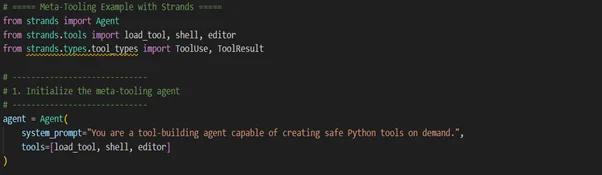
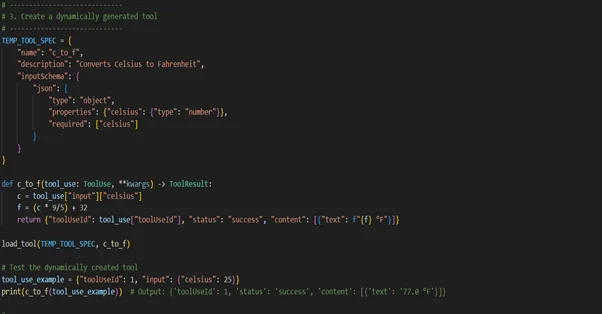
- Dynamic Tool Loading – Strands’ load_tool enables agents to register new tools at runtime, expanding capabilities on the fly. It validates each tool to prevent unsafe or malformed additions, and supports hot reloading so that tools can be updated or replaced without restarting the agent.
- Intelligent Code Generation – Strands utilizes the agent’s natural language understanding to transform user requests into functional Python tools. A standard tool template ensures that all dynamically created tools are consistent, while system prompts guide the agent to interpret both the syntax and the intent, encompassing inputs, processing, and outputs, ensuring that each tool is designed correctly.
- File System Integration – Using the editor tool, agents can directly create and modify tool files with advanced file-system control. Beyond basic writing, it supports syntax-aware edits, targeted string replacements, precise code insertion, and automatic backups. These capabilities ensure that tool updates are accurate, safe, and suitable for production use.
- Execution and Debugging Support – The shell tool closes the loop by letting agents test and debug newly created tools. Agents can run the tool, view the output instantly, and refine the code as needed. It supports both sequential and parallel commands, preserving the working directory to ensure everything runs in the correct environment.
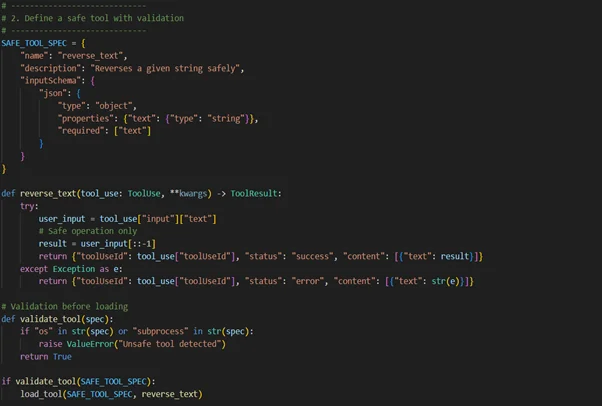
- Standardized Tool Architecture – Strands utilizes a unified TOOL_SPEC format to standardize all tools. This consistency makes tools predictable, easy to combine, automatically validated, and well-documented. Each tool defines a name, description, JSON-Schema-based input structure, and a function that takes a ToolUse object and returns a ToolResult object, ensuring seamless interoperability.
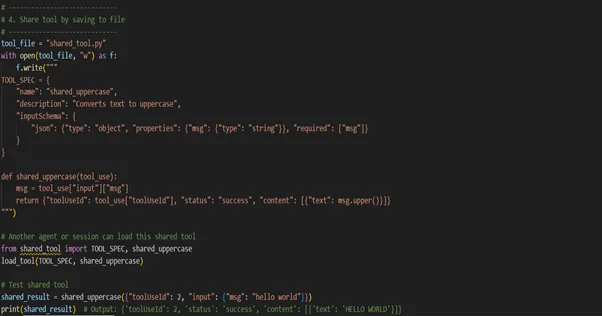
Meta-Tooling Example: Step by Step
Use Cases
- Adaptive Data Processing Pipelines – In data engineering, unexpected needs often emerge during analysis. Meta-tooling enables the agent to instantly create custom utilities, such as data cleaners, converters, or aggregators, to handle them. If a dataset has a uniquely formatted field, the agent can even generate a specialized parser for it, rather than relying on generic string handling.
- Custom Business Logic Implementation – Enterprise systems often have unique rules that standard tools can’t handle. Meta-tooling lets agents generate custom, domain-specific utilities as needed. A finance agent might create tools for custom risk calculations, while a healthcare agent could build HIPAA-compliant validators or data handlers. This ensures the agent can adjust to exact industry requirements.
- API Integration and Wrapper Creation – Meta-tooling enables agents to create custom API wrappers as needed. Instead of relying on pre-built integrations, the agent can generate a service-specific wrapper on the spot, ideal for enterprise environments where internal APIs frequently change.
- Research and Experimentation Environments – In rapidly evolving research environments, meta-tooling enables scientists to quickly prototype new analysis tools. An agent can generate custom statistical tests, visualizations, or data simulators as needed, thereby speeding up the research cycle by eliminating delays between discovering a requirement and having a tool ready for use.
- Personalized User Workflows – Different users work differently, and meta-tooling lets agents create tools tailored to those preferences. If one user prefers bullet-point summaries and another wants narrative summaries, the agent can generate custom formatting tools for each style.
- Educational and Training Applications – In education, meta-tooling allows agents to build custom learning utilities. They can create practice problem generators, grading tools, or explanation aids tailored to a specific curriculum or a student’s learning level.
Conclusion
Meta-tooling transforms AI agents from static executors into adaptive, self-extending systems. Strands demonstrates this with standardized tool specifications, intelligent prompts, and foundational meta-tools, enabling the creation of reliable, maintainable, and interoperable dynamic tools. This empowers agents to handle evolving requirements, reduce development time, and improve autonomy. Safe implementation requires effective governance, thorough validation, and ongoing monitoring. As AI integration grows, meta-tooling is poised to become a standard, enabling agents to solve both known and unforeseen problems, optimize tools, and even collaboratively create new capabilities, making AI not just intelligent but also adaptive.
Drop a query if you have any questions regarding Meta-tooling and we will get back to you quickly.
Empowering organizations to become ‘data driven’ enterprises with our Cloud experts.
- Reduced infrastructure costs
- Timely data-driven decisions
About CloudThat
FAQs
1. Is meta-tooling safe?
ANS: – Yes. Strands enforces structured tool specifications, system prompt restrictions, and validation pipelines to prevent malicious or unsafe tools. For sensitive environments, sandboxing and human review add extra security layers.
2. How does meta-tooling perform compared to pre-built tools?
ANS: – Dynamically created tools run at native Python speed, identical to pre-built tools. Creation adds one-time latency, but persistent storage and caching allow reuse without repeated overhead.
3. Can multiple agents share dynamically created tools?
ANS: – By default, tools are agent-specific, but since they’re standard Python files, they can be shared via a centralized repository with proper versioning and dependency management. Collaborative and marketplace-based sharing is possible with governance mechanisms.


WRITTEN BY Livi Johari
Livi Johari is a Research Associate at CloudThat with a keen interest in Data Science, Artificial Intelligence (AI), and the Internet of Things (IoT). She is passionate about building intelligent, data-driven solutions that integrate AI with connected devices to enable smarter automation and real-time decision-making. In her free time, she enjoys learning new programming languages and exploring emerging technologies to stay current with the latest innovations in AI, data analytics, and AIoT ecosystems.


 PREV
PREV











Comments